Out-of-Hours Liver Transplantation: Identifying High-Risk Timeframes and Implications for Patient Outcomes
Highlight
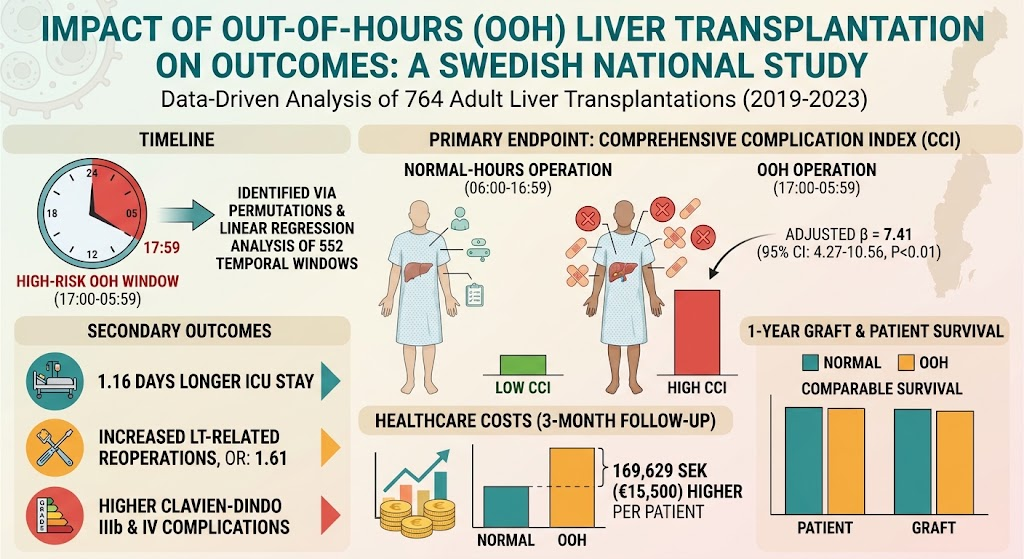
This nationwide Swedish study in 764 liver transplantations identified the 17:00 to 05:59 period as a high-risk out-of-hours (OOH) window associated with increased postoperative complications, prolonged intensive care unit (ICU) stays, higher reoperation rates, and excess healthcare costs. Importantly, no difference was found in one-year graft or patient survival. These findings suggest that liver transplantation timing significantly impacts short-term morbidity and resource utilization.
Study Background
Liver transplantation (LT) is a complex surgical procedure often performed under urgent conditions. The logistics of organ allocation and availability frequently necessitate operations outside of regular daytime hours—traditionally considered nighttime periods starting around 20:00 or later. Prior studies evaluating the impact of OOH surgery on transplant outcomes have shown conflicting results, in part due to inconsistencies in defining OOH time windows. This uncertainty impedes optimal planning and resource allocation in transplant centers and may affect patient morbidity and healthcare costs.
Understanding precisely when during the 24-hour cycle LT carries increased risk is of paramount clinical importance. It offers opportunities to mitigate potential harms by adjusting scheduling, staffing, or perioperative care during high-risk periods.
Study Design
This was a retrospective, multicenter national study conducted in Sweden, examining 764 adult liver transplantation cases performed from 2019 to 2023. The primary endpoint was the 3-month Comprehensive Complication Index (CCI), a validated, continuous measure that captures the overall burden of postoperative complications. Secondary outcomes included Clavien-Dindo complication grades, ICU length of stay, rates of LT-related reoperations, patient and graft survival at one year, and healthcare costs within 3 months post-transplant.
To define the highest risk OOH window empirically rather than arbitrarily, the investigators applied a data-driven approach. Starting times were analyzed in 1-hour intervals across 552 different temporal windows using permutations combined with linear regression analyses to identify the window associated with the greatest negative effect on the CCI score. Covariate adjustments corrected for potential confounders.
Key Findings
The study identified the OOH window spanning from 17:00 to 05:59 as the period with the most significant adverse impact on postoperative complication burden (CCI). Liver transplants initiated during this interval were associated with a mean increase in CCI of 7.41 points, with a 95% confidence interval from 4.27 to 10.56 (p < 0.01), indicating a clinically meaningful rise in symptom burden and complication severity.
Additionally, patients operated in this time window had significantly more major complications categorized as Clavien-Dindo grades IIIb and IV, indicating complications requiring surgical, endoscopic, or radiological intervention, or life-threatening complications requiring intensive care support. ICU stay was on average 1.16 days longer compared to patients operated outside this window.
Reoperation rates linked specifically to LT were also elevated, with an odds ratio of 1.61 (95% CI: 1.11–2.36), suggesting a substantially increased risk of further surgical intervention. Despite these heightened short-term morbidities, one-year patient and graft survival rates did not differ significantly between in-hours and out-of-hours groups, implying that these complications were largely manageable without affecting long-term outcomes.
Importantly, health care costs over the 3-month postoperative period were on average 169,629 SEK (~€15,500) higher per patient who underwent transplantation during the identified OOH period, reflecting the increased resource utilization from complications, longer ICU stays, and reoperations.
Expert Commentary
This study notably challenges traditional definitions of OOH timing by revealing a high-risk window that begins earlier in the day at 17:00 rather than the commonly used nighttime threshold of around 20:00 or later. This nuanced timing has immediate implications for transplant logistics and staff allocation.
The use of a data-driven analytic approach to define risk windows is a methodological strength, removing arbitrary bias and enhancing reproducibility. Moreover, the use of the CCI as a comprehensive complication metric provides a more sensitive assessment of morbidity than traditional binary endpoints.
Several hypotheses may explain the increased morbidity in the early evening to early morning period: decreased staffing levels or experience during these hours, fatigue among surgical and perioperative teams, and systemic circadian influences affecting physiological resilience and perioperative immune response. Yet, the absence of survival differences suggests effective management protocols despite the higher complication burden.
Limitations include the retrospective design and potential unmeasured confounding factors. Generalizability to healthcare systems with differing OOH staffing arrangements or to pediatric populations remains to be evaluated.
Conclusion
This national Swedish study demonstrates that liver transplants initiated between 17:00 and 05:59 carry a significantly increased risk of postoperative complications and higher healthcare costs. These findings advocate for reconsideration of transplant scheduling and resource planning to minimize OOH operations or implement targeted mitigation strategies during the identified high-risk window.
Future prospective research evaluating interventions to reduce the complication burden in OOH transplants will be critical. Such strategies may include enhancing staffing expertise, fatigue management, or preoperative optimization protocols tailored to OOH settings. This study provides a robust foundation to inform clinical practice and health policy for liver transplantation programs worldwide.
Funding and Clinical Trials
The original publication does not specify funding sources or clinical trial registration.
References
Vidgren MVA, Matin R, Lundgren SAE, Romano A, Habermann ALM, Aram ME, Forssten SP, Bennet WFD, Oniscu GC. The Impact of Out-of-Hours Liver Transplantation on Outcomes: A Swedish National Study. Annals of surgery. 2026 Sep 2. PMID: 42681564. https://pubmed.ncbi.nlm.nih.gov/42681564/
Clavien PA, Barkun J, de Oliveira ML, et al. The Comprehensive Complication Index: a novel continuous scale to measure surgical morbidity. Ann Surg. 2013;258(1):1-7.
Kobayashi T, et al. Impact of night-time surgery on post-operative outcomes: a systematic review. J Surg Res. 2019;236:44-50.
This article was created using several editorial tools, including AI, as part of the process. Human editors reviewed this content before publication.