Highlight
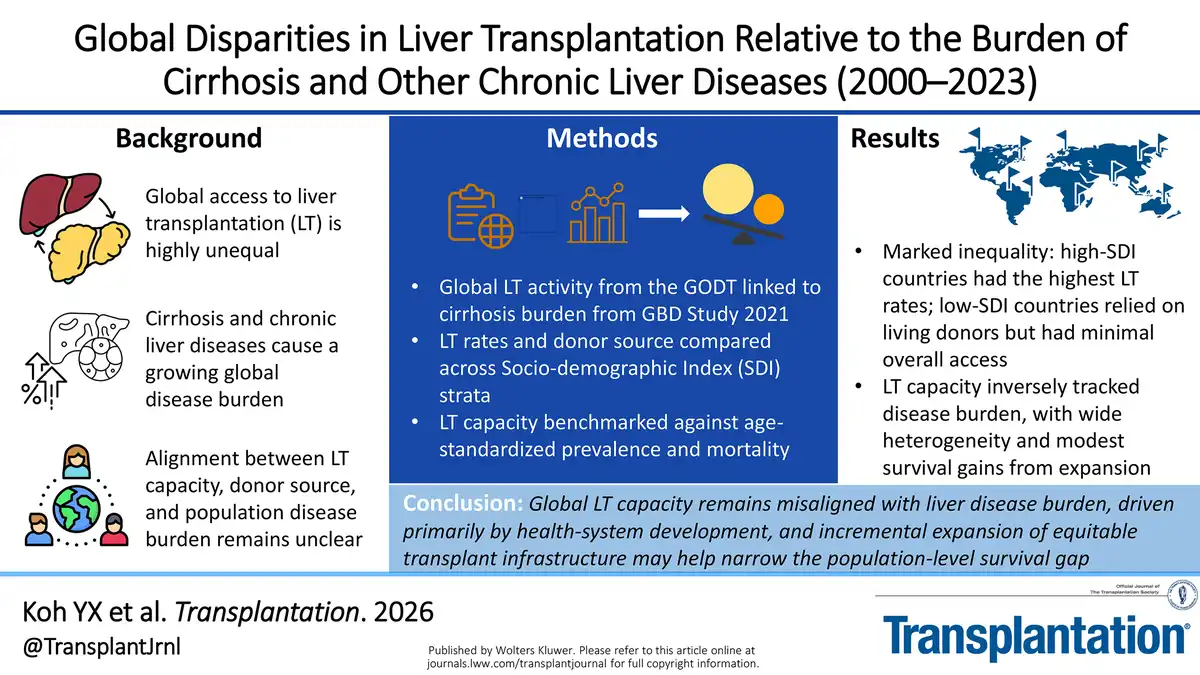
Liver transplantation (LT) activity is predominantly concentrated in high-Sociodemographic Index (SDI) countries, with low-SDI regions exhibiting minimal LT access largely reliant on living donors.
A strong inverse gradient exists between LT capacity and both cirrhosis prevalence and mortality rates across SDI strata, indicating misalignment between transplantation infrastructure and epidemiological need.
Within-country analyses suggest a modest but statistically significant association where increased LT activity correlates with reduced mortality relative to disease prevalence.
Expanding equitable LT infrastructure, alongside ongoing prevention, may improve population-level outcomes in chronic liver disease.
Background
Chronic liver diseases, particularly cirrhosis, represent a growing global health challenge contributing significantly to morbidity and mortality. Liver transplantation remains the definitive treatment for end-stage liver disease and certain acute liver failure cases, demonstrating survival benefits and improved quality of life. However, LT access remains markedly uneven worldwide. Socioeconomic factors, healthcare infrastructure, and donor availability distinctly influence transplantation activity across differing regions. Understanding the global distribution of LT relative to the actual burden of liver disease is essential to inform health policy, resource allocation, and equitable care delivery.
Study Design
This study performed a comprehensive analysis combining country-level liver transplantation data from the Global Observatory on Donation and Transplantation covering 2000 through 2023, with epidemiological data on cirrhosis and other chronic liver diseases from the Global Burden of Disease 2021 Study spanning 2000 to 2021. Countries were stratified by Sociodemographic Index (SDI), a composite measure of income, education, and fertility, categorizing nations into low, middle, and high SDI groups.
Key metrics included liver transplantation rates per population, donor types (deceased versus living donation), and age-standardized prevalence and mortality rates for liver disease. Statistical approaches integrated pooled correlation analyses, within-country temporal evaluations, and two-way fixed-effects regression models accounting for country-year and calendar year to robustly evaluate the alignment between LT capacity and disease burden.
Results
The analysis revealed that from 2000 to 2023, liver transplantation activity was heavily concentrated within high-SDI countries. These nations exhibited higher transplantation rates with a predominant reliance on deceased donors, reflecting advanced organ procurement and allocation systems. Conversely, low-SDI countries depended almost entirely on living donor transplantation but exhibited critically low overall rates of liver transplantation.
When benchmarking LT capacity against age-standardized prevalence and mortality rates of cirrhosis and other chronic liver diseases, a pronounced inverse gradient emerged across SDI strata. High-SDI countries demonstrated relatively abundant LT resources compared with their disease burden, while low-SDI countries displayed a stark mismatch—high disease burden coinciding with negligible transplantation infrastructure. Middle-SDI countries showed substantial heterogeneity, reflecting varying stages of health system development and organ donation frameworks.
Within-country analyses over time and two-way fixed-effects models highlighted a small but statistically significant inverse relationship between LT activity and mortality-to-prevalence ratios. This suggests that incremental increases in transplantation intensity correspond to modest reductions in liver disease mortality relative to disease prevalence at the population level. Nonetheless, the effect size was limited, underscoring that transplantation alone cannot fully address the complex epidemiology of liver disease mortality.
Expert Commentary
This study underscores the pivotal influence of socioeconomic development and health system capacity on access to lifesaving liver transplantation services. While the burden of cirrhosis and chronic liver diseases is substantial and rising globally, particularly in low and middle SDI countries, transplantation capacity is disproportionately skewed toward wealthier nations.
Living donor transplantation represents a critical option in resource-constrained settings but is insufficient in scale to close the gap. Efforts to expand deceased donor programs, optimize organ allocation, and build transplant infrastructure are urgently needed to reduce disparities. Importantly, transplantation should complement robust prevention strategies targeting viral hepatitis, alcohol-related liver disease, and nonalcoholic fatty liver disease to mitigate disease progression and reduce overall demand.
The relatively modest association between LT rates and mortality reductions observed in this study may reflect limitations related to delayed access, waiting list mortality, and underlying competing risks. The findings align with expert guidelines emphasizing integrated care pathways and equitable health system strengthening to ensure effective delivery of transplantation services.
Conclusion
Liver transplantation remains a scarce and inequitably distributed resource globally, misaligned with the epidemiological burden of cirrhosis and chronic liver diseases. High-SDI countries possess the majority of transplantation capacity, whereas low-SDI regions suffer from minimal access despite high disease prevalence and mortality. Incremental expansion of equitable LT infrastructure in conjunction with primary prevention measures offers a pathway to modest improvements in population-level outcomes. Addressing global disparities in liver transplantation demands coordinated international efforts, investment in healthcare systems, and policies ensuring fair access to this critical intervention.
Funding and Clinical Trials
The study was supported by institutional research grants. No specific clinical trial registrations were associated with this analysis.
References
1. Koh YX, Zhao Y, Chua DW, Ooi LLPJ, Cheow PC, Chung AYF, Jeyaraj PR, Goh BKP. Global Disparities in Liver Transplantation Relative to the Burden of Cirrhosis and Other Chronic Liver Diseases (2000-2023). Transplantation. 2026 Oct 1;110(10):e2072-e2081. doi: 10.1097/TP.0000000000005750. Epub 2026 May 18. PMID: 42150104.
2. Global Burden of Disease Collaborative Network. Global Burden of Disease Study 2021 (GBD 2021) Results. Seattle, United States: Institute for Health Metrics and Evaluation (IHME); 2023.
3. Yachimski P, et al. Liver Transplantation for Cirrhosis and Hepatocellular Carcinoma: A Global Perspective. Gastroenterology. 2020;158(7):1913–1929.
4. Gish RG, Zielinski M. The Impact of Liver Transplantation on Mortality in Patients with Chronic Liver Disease. Clin Liver Dis. 2021;25(3):529-540.
5. Angulo P, et al. Epidemiology and Burden of Chronic Liver Disease. Hepatology. 2021;73(S1):4-8.