Highlight
Subtotal colectomy with cecorectal anastomosis (SC-CRA) is noninferior to total colectomy with ileorectal anastomosis (TC-IRA) regarding constipation severity at 1 year in slow-transit constipation (STC) patients.
SC-CRA shows significantly lower rates of early postoperative fecal incontinence compared to TC-IRA at 3 months post-surgery.
No significant difference in perioperative morbidity nor quality of life was observed between the two surgical approaches.
Patient satisfaction slightly favors TC-IRA at one year, underscoring nuanced considerations in surgical decision-making.
Study Background
Slow-transit constipation (STC) is a chronic, often debilitating subtype of functional constipation characterized by prolonged colonic transit time leading to infrequent bowel movements and significant symptom burden. Many patients rely on long-term laxative therapy, but refractory cases warrant surgical intervention. Total colectomy with ileorectal anastomosis (TC-IRA) is traditionally the definitive surgical treatment, effective in relieving colonic transit delay but commonly associated with adverse outcomes such as diarrhea, fecal incontinence, and bowel obstruction, which impair postoperative quality of life. Subtotal colectomy with cecorectal anastomosis (SC-CRA) has been proposed as a less radical alternative that preserves the ileocecal valve and part of the colon, theoretically reducing complications associated with total colectomy. However, concerns persist regarding recurrence of constipation. Prior to this trial, robust comparative evidence between SC-CRA and TC-IRA has been lacking, limiting evidence-based surgical guidance for refractory STC.
Study Design
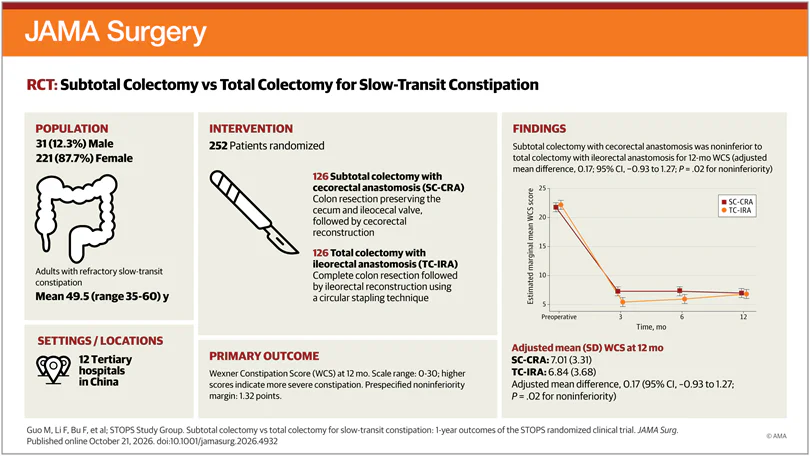
The STOPS trial was a multicenter, open-label, randomized controlled, noninferiority trial conducted in 12 tertiary hospitals across eight provinces in China from April 2022 to April 2025, with planned 12-month follow-up extending to April 2026. Eligibility criteria comprised adults aged 18 years or older diagnosed with functional constipation per Rome IV criteria, exhibiting fewer than one spontaneous bowel movement per week, and dependent on laxatives or prokinetic agents at least thrice weekly for six months or more. Of 272 assessed patients, 252 met inclusion and were randomized 1:1 to receive either SC-CRA or TC-IRA.
The primary endpoint was the Wexner Constipation Score (WCS) at 12 months postoperatively, with a prespecified noninferiority margin of 1.32 points for SC-CRA compared to TC-IRA. Secondary outcomes included incidence of fecal incontinence, perioperative morbidity, health-related quality of life metrics, and patient-reported satisfaction.
Key Findings
The study population (n=252) had a mean age of 49.5 years and was predominantly female (87.7%). The two surgical groups, SC-CRA (n=126) and TC-IRA (n=126), were well balanced in baseline characteristics.
At one year, the adjusted mean WCS was 7.01 (SD 3.31) in the SC-CRA group versus 6.84 (SD 3.68) in the TC-IRA group. The mean difference of 0.17 (95% CI, -0.93 to 1.27) fell well within the prespecified noninferiority margin of 1.32 points (P=0.02 for noninferiority), indicating that SC-CRA is not inferior to TC-IRA in relieving constipation symptoms.
Regarding secondary outcomes, early postoperative fecal incontinence at 3 months was significantly lower in SC-CRA patients (8.7%) compared to TC-IRA patients (21.4%), with a risk difference of -12.7% (95% CI, -21.4% to -4.0%; P=0.01). This suggests better early functional bowel control with subtotal colectomy.
Perioperative morbidity rates were similar (10.3% in SC-CRA vs 12.7% in TC-IRA; P=0.41), with no significant differences in complications such as anastomotic leakage, bowel obstruction, or infections.
Quality of life scores at 12 months, assessed through validated instruments, were comparable between groups, reflecting equivalent overall postoperative recovery and patient well-being.
Patient-reported satisfaction at one year modestly favored TC-IRA (97.5%) over SC-CRA (95.8%), reaching statistical significance (P=0.03). This may reflect patient preferences, expectations, or subtle differences in bowel function outcomes not fully captured by WCS.
Expert Commentary
This meticulously conducted randomized trial provides high-quality evidence supporting the noninferiority of SC-CRA relative to TC-IRA for refractory STC, emphasizing its viability as an alternative surgical option. The lower incidence of early postoperative fecal incontinence with SC-CRA is clinically relevant, as these complications are distressing and impact quality of life.
However, the slightly higher patient satisfaction with TC-IRA raises questions about other dimensions of postoperative outcomes such as stool frequency, urgency, or long-term bowel function stability. The open-label design introduces potential bias in subjective assessments. Additionally, the trial’s 12-month follow-up, while informative, is insufficient to fully capture the durability of functional outcomes or late complications, which necessitates longer observation.
Generalizability is strengthened by the multicentric nature and relatively large sample size, although the predominance of female patients (reflecting disease epidemiology) and the Chinese healthcare context may limit extrapolation to diverse populations.
Future research should explore mechanistic insights into differential functional outcomes, longer-term efficacy and safety, and patient-centered metrics to optimize surgical selection and counseling.
Conclusion
For patients with refractory slow-transit constipation, subtotal colectomy with cecorectal anastomosis offers a noninferior alternative to total colectomy with ileorectal anastomosis in terms of constipation severity at one year. The reduced early postoperative fecal incontinence with SC-CRA is a meaningful advantage. However, the marginally higher patient satisfaction with TC-IRA suggests that individualized surgical decisions should be informed by patient values, expectations, and comprehensive outcome profiles. Extended follow-up data remain essential to ascertain long-term benefits and risks.
Funding and Registration
This trial was conducted under registration ClinicalTrials.gov Identifier: NCT05352074, involving the STOPS Study Group across multiple tertiary centers in China. Funding sources were not specified in the abstract but are documented in the full publication.
References
1. Guo M, Li F, Bu F, et al. Subtotal Colectomy vs Total Colectomy for Slow-Transit Constipation: 1-Year Outcomes of the STOPS Randomized Clinical Trial. JAMA Surg. 2026 Oct 21. PMID: 42905730.
2. Bharucha AE, Pemberton JH, Locke GR. American Gastroenterological Association technical review on constipation. Gastroenterology. 2013;144(1):218-238.
3. Ravelli AM, Kamm MA. Slow-transit constipation. Gastroenterol Clin North Am. 1999;28(3):563-82.
4. Lowry AC, Sachdeva AK. Surgical treatment of constipation. Gastroenterol Clin North Am. 1997;26(3):477-500.