Highlight
The 5-year local recurrence rate after R0 resection in children and young adults with NRSTS was low (4.4%), supporting the effectiveness of risk-adapted multimodality therapy.
Wider negative surgical margins (≥6 mm) were associated with zero local recurrences, while margins of 1 mm carried a slightly higher recurrence risk (4.9%).
Close surgical margins may be adequate particularly when combined with chemoradiotherapy in selected patients, emphasizing a personalized risk-based approach.
Successful salvage therapies led to durable disease control in nearly half of patients experiencing local recurrence.
Study Background
Nonrhabdomyosarcoma soft tissue sarcomas (NRSTS) represent a heterogeneous group of malignancies occurring in children and young adults, distinct from the more common rhabdomyosarcoma subtype. Surgical resection with negative margins remains the cornerstone of localized disease management. However, the optimal extent of pathological negative margins required to minimize local recurrence has been unclear. Excessively wide resections may contribute to functional morbidity, while narrow margins risk tumor persistence. This clinical equipoise underscores the need to define margin parameters that achieve durable local control without unnecessary morbidity, particularly in the pediatric and young adult populations where long-term function is critical. The Children’s Oncology Group (COG) ARST0332 trial investigated this question within a contemporary risk-adapted multimodality treatment framework.
Study Design
This prospective, multicenter, nonrandomized clinical trial enrolled 266 eligible patients younger than 30 years with nonmetastatic NRSTS between 2007 and 2012 at COG member sites, with a median follow-up of 6.2 years. Inclusion criteria mandated R0 resections (microscopically negative margins), excluding those undergoing amputation or non-protocol radiation. Surgical margins were centrally reviewed blinded to outcomes, and measured precisely in a subset (n=132). Patients received risk-adapted multimodality therapy grouped by tumor size, grade, margin extent, and initial resectability, involving upfront or delayed surgery, with or without radiation and/or ifosfamide/doxorubicin chemotherapy. The primary endpoints included cumulative incidence of local recurrence and local control outcomes based on surgical margins and treatment modalities.
Key Findings
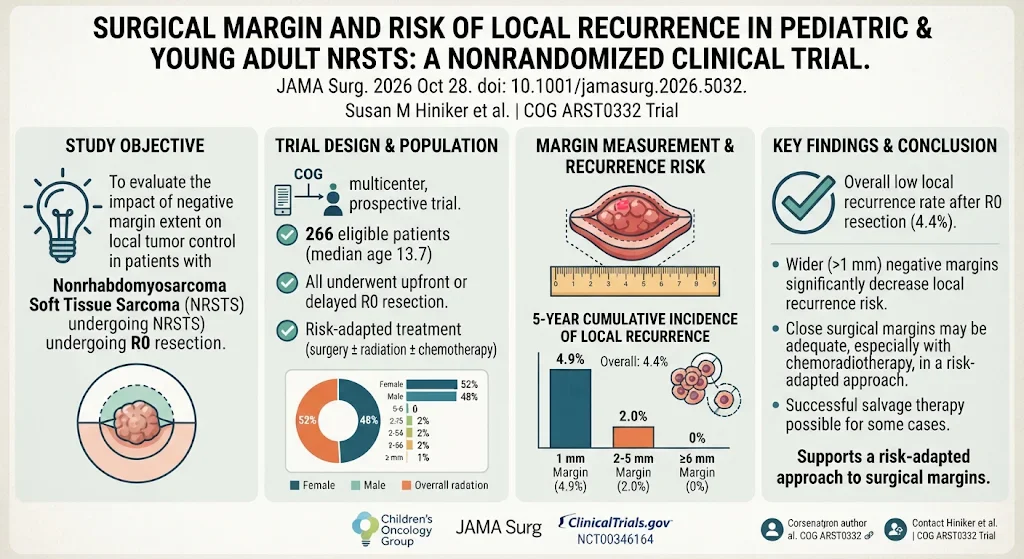
Among 266 patients (median age 13.7 years; 52% female), 207 underwent upfront R0 surgery and 59 had delayed R0 surgery post-induction therapy. Measured surgical margins were categorized as 1 mm (56 patients), 2–5 mm (50 patients), or ≥6 mm (26 patients). Overall, the 5-year cumulative incidence of local recurrence was low at 4.4%.
By treatment modality, local recurrence occurred in 10 of 178 patients (5.6%) treated with surgery alone, versus 2 of 88 patients (2.3%) treated with surgery and chemoradiotherapy. Among patients with quantified margins, recurrence rates inversely correlated with margin width: 4.9% for 1 mm, 2.0% for 2–5 mm, and 0% for those with ≥6 mm clearances.
Tumor size and treatment intensity also influenced outcomes: local recurrence occurred in 5.6% of patients with tumors 5 cm receiving surgery plus chemoradiotherapy; and 1.7% in those with initially unresectable disease managed with neoadjuvant chemoradiotherapy. Notably, salvage treatment after recurrence yielded long-term disease control in 5 of 12 patients, emphasizing that local recurrence did not invariably herald poor prognosis.
Expert Commentary
This trial provides robust prospective evidence that precise pathological measurement of surgical margins can guide risk stratification for local recurrence in pediatric and young adult NRSTS. The data support less radical resections when planned within a risk-adapted protocol incorporating chemotherapy and radiation, thereby balancing oncologic control with preservation of function and quality of life. The finding that wider margins correlate with improved local control is consistent with oncologic principles but nuanced by the relatively low recurrence observed even with close margins, reinforcing the role of adjuvant therapies.
Limitations include the nonrandomized design and exclusion of patients undergoing amputation, which may limit generalizability to all NRSTS populations. Additionally, longer follow-up will further clarify late recurrences. From a biological standpoint, NRSTS comprises diverse histologies with distinct behaviors; thus, margin guidelines may require refinement based on subtype-specific patterns. Further molecular characterization may aid in individualized margin and treatment decisions.
Conclusion
This COG ARST0332 study establishes that in children and young adults with nonmetastatic NRSTS, R0 resection combined with risk-adapted multimodality therapy achieves low local recurrence rates. Wider negative margins greater than 1 mm further reduce recurrence risk, though close margins may be acceptable in the context of chemoradiotherapy. These findings reinforce the importance of personalized surgical planning and integrated oncologic care to optimize long-term outcomes while minimizing treatment-related morbidity. Future research should explore molecular predictors of local recurrence and refine margin recommendations by histologic subtype.
Funding and Trial Registration
This trial was funded and conducted under the auspices of the Children’s Oncology Group. The trial registration identifier is NCT00346164.
References
Hiniker SM, Dixon AH, Xue W, et al. Surgical Margin and Risk of Local Recurrence in Children and Young Adults With Nonrhabdomyosarcoma Soft Tissue Sarcoma: A Nonrandomized Clinical Trial. JAMA Surg. 2026 Oct 28. doi:10.1001/jamasurg.2026.42949735. PMID: 42949735.
Additional foundational references:
1. Ferrari A, Sultan I, Huang TT, et al. Soft tissue sarcoma across the age spectrum: a population-based study from the Surveillance Epidemiology and End Results database. Pediatr Blood Cancer. 2011;57(6):943-949.
2. Stanelle EJ, Volden P, Beck JD, et al. Margin Status and Prognosis in Soft Tissue Sarcomas: A Meta-analysis. J Surg Oncol. 2019;119(2):215-224.
These and other studies contextualize surgical margin implications in NRSTS management.