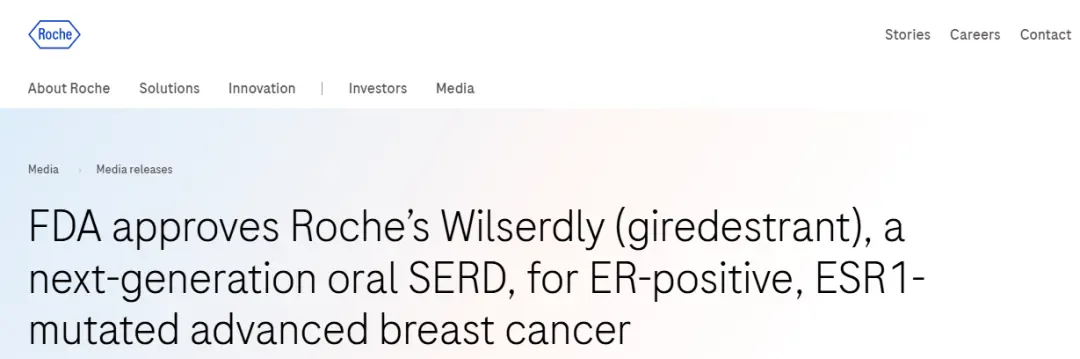
On November 16, 2026, Roche announced that the U.S. Food and Drug Administration (FDA) has approved its oral medication giredestrant (brand name Wilserdly), in combination with everolimus, for the treatment of adult patients with estrogen receptor (ER)-positive, human epidermal growth factor receptor 2 (HER2)-negative, ESR1-mutated locally advanced or metastatic breast cancer.
Giredestrant is a next-generation, potent oral selective estrogen receptor degrader (SERD) and a full estrogen receptor antagonist. It works by blocking estrogen from binding to the estrogen receptor and inducing receptor degradation, thereby inhibiting or slowing tumor cell growth.
The FDA approval is primarily supported by results from the Phase III evERA breast cancer study, an open-label, randomized clinical trial evaluating giredestrant plus everolimus versus standard-of-care endocrine therapy plus everolimus. The study enrolled 373 patients, with an enriched population of individuals harboring ESR1 mutations—which occur in up to 40% of ER-positive breast cancer patients previously treated with CDK inhibitors.
Efficacy in ESR1-Mutated Population (n=207): The giredestrant plus everolimus arm achieved a median progression-free survival (PFS) of 10.0 months, compared to 5.5 months in the control arm (hazard ratio [HR] = 0.38; 95% CI: 0.27–0.54; p < 0.001).
Efficacy in Intention-to-Treat (ITT) Population: Median PFS reached 8.8 months with the giredestrant combination versus 5.5 months in the control group (HR = 0.56; 95% CI: 0.44–0.71; p < 0.001).
Overall Survival (OS) & Safety: While OS data were immature at the time of analysis, clear positive trends were observed in both the ITT (HR = 0.69) and ESR1-mutated (HR = 0.62) populations. The safety profile was manageable and consistent with known single-agent profiles, with stomatitis, diarrhea, and anemia being the most common adverse events.
Beyond this indication, Roche is advancing a comprehensive clinical program for giredestrant across five Phase III trials (lidERA, evERA, persevERA, pionERA, and heredERA) spanning early-stage adjuvant to late-stage metastatic settings. A separate FDA application for giredestrant in Stage I–III ER-positive, HER2-negative breast cancer is currently under review with a decision expected by late November 2026. In China, the drug's marketing application was accepted by the National Medical Products Administration (NMPA) in April 2026.
Commentary & Industry Analysis
Addressing a Major Clinical Bottleneck: ER-positive breast cancer accounts for roughly 70% of all breast cancer cases, and acquired ESR1 mutations following CDK4/6 inhibitor therapy represent one of the primary drivers of endocrine resistance. Nearly doubling median PFS (10.0 vs. 5.5 months) with a 62% reduction in the risk of progression or death establishes giredestrant plus everolimus as a compelling post-CDK4/6 standard of care.
The Convenience Advantage of an All-Oral Regimen: Traditional SERDs like fulvestrant require painful intramuscular injections, which can burden patients undergoing long-term maintenance therapy. By pairing oral giredestrant with oral everolimus to simultaneously block two distinct signaling pathways (ER and mTOR), Roche offers a needle-free regimen that improves patient quality of life and treatment adherence.
Aggressive Lifecycle Management: Roche’s five-trial Phase III strategy demonstrates a clear ambition to move giredestrant into earlier lines of therapy. With an FDA decision for Stage I–III early breast cancer imminent later this month and regulatory review underway in China, giredestrant is positioned to become a foundational endocrine backbone across the entire ER-positive breast cancer continuum.