Highlight
• Pembrolizumab monotherapy significantly extends progression-free survival compared to carboplatin plus paclitaxel in dMMR advanced or recurrent endometrial cancer.
• Pembrolizumab shows a superior safety profile with fewer grade 3 or higher treatment-related adverse events.
• Overall survival benefit did not reach statistical significance at interim analysis.
• The trial establishes immunotherapy as a promising chemotherapy-free first-line option for this patient subset.
Study Background
Endometrial cancer ranks as one of the most common gynecologic malignancies worldwide, with a significant proportion diagnosed at advanced or recurrent stages. Standard first-line treatment traditionally involves chemotherapy, notably carboplatin combined with paclitaxel. However, chemotherapy is associated with considerable toxicity and limited long-term efficacy in these settings. Notably, mismatch repair-deficient (dMMR) tumors, a subset characterized by impaired DNA repair mechanisms and microsatellite instability, represent a biologically distinct group within endometrial cancer. Given their increased neoantigen burden and immunogenicity, dMMR tumors are promising candidates for immune checkpoint blockade therapies. There remains a critical unmet need to develop effective, well-tolerated, chemotherapy-free first-line regimens for patients with advanced or recurrent dMMR endometrial cancer.
Study Design
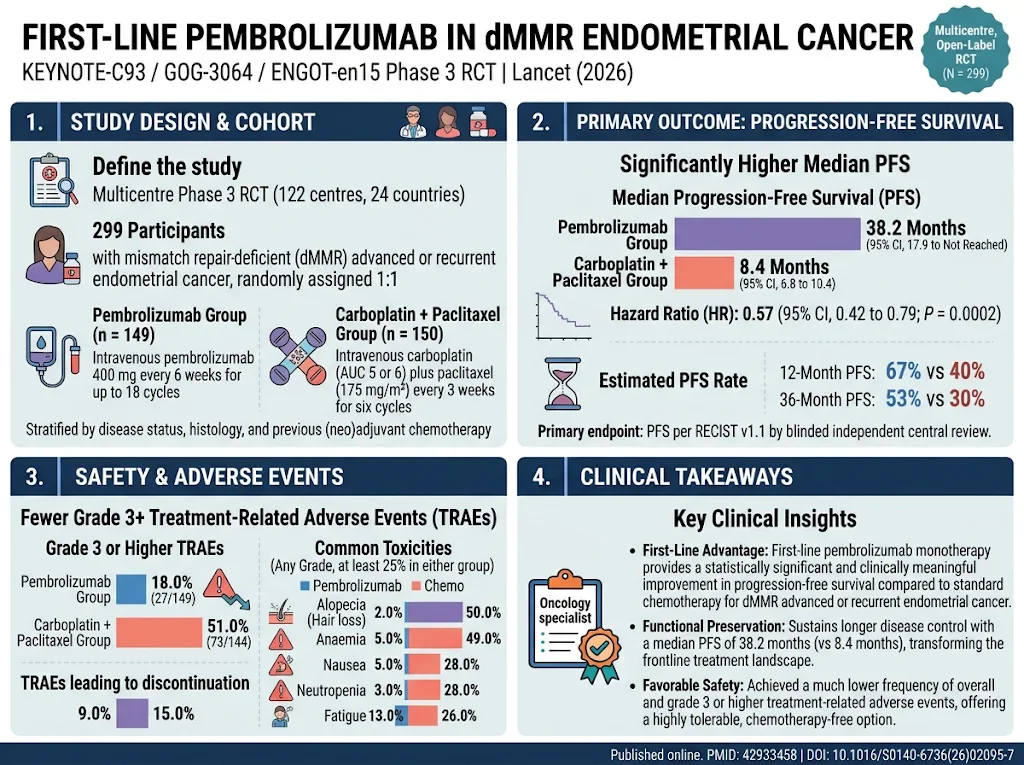
The KEYNOTE-C93/GOG-3064/ENGOT-en15 is an open-label, randomized, active-comparator-controlled phase 3 trial conducted across 122 centers in 24 countries spanning the Americas, Asia, Europe, and Oceania. Eligible adult participants (≥18 years) had inoperable, stage III or IV, persistent, advanced, or recurrent mismatch repair-deficient endometrial cancer. Participants were randomized 1:1 to receive either pembrolizumab 400 mg intravenously every 6 weeks for up to 18 cycles or standard chemotherapy with carboplatin (AUC 5–6 mg/mL/min) and paclitaxel 175 mg/m² intravenously every 3 weeks for six cycles. Randomization was stratified by disease status (persisting, advanced, or recurrent), histological subtype, and prior (neo)adjuvant chemotherapy exposure. The primary endpoints were progression-free survival (PFS), assessed per RECIST version 1.1 by blinded independent central review, and overall survival (OS). This interim analysis evaluated data collected up to April 24, 2026.
Key Findings
Between February 2022 and December 2023, a total of 299 participants were randomly assigned to pembrolizumab (n=149) or carboplatin plus paclitaxel (n=150). The median follow-up duration at the interim cutoff was not explicitly stated, but PFS data were available for key timepoints.
Progression-Free Survival: The median PFS was markedly prolonged in the pembrolizumab group at 38.2 months (95% CI: 17.9 months to not reached) compared with 8.4 months (95% CI 6.8–10.4) in the chemotherapy group. The hazard ratio (HR) was 0.57 (95% CI 0.42–0.79), with a p-value of 0.0002, indicating a highly statistically significant 43% reduction in risk of progression or death. Estimated PFS rates favored pembrolizumab at 12 months (67% vs 40%) and 36 months (53% vs 30%), underscoring durable benefit.
Overall Survival: Median OS was not reached in either group at interim analysis, and while the HR was 0.77 (95% CI 0.52–1.15), the p-value of 0.10 suggested no statistically significant survival advantage at this stage. Longer follow-up is needed for definitive OS interpretation.
Safety Profile: Pembrolizumab exhibited a substantially improved safety profile relative to chemotherapy. Grade 3 or higher treatment-related adverse events (TRAEs) occurred in 18% of pembrolizumab-treated participants versus 51% in the carboplatin-paclitaxel group. Frequent grade ≥3 TRAEs with chemotherapy included anemia, neutropenia, and peripheral neuropathy. Pembrolizumab-related serious adverse events were infrequent. Common any-grade TRAEs differed markedly: alopecia (2% vs 50%), anemia (5% vs 49%), nausea (5% vs 28%), neutrophil decrease (3% vs 28%), peripheral neuropathy (0% vs 26%), and fatigue (13% vs 26%). Treatment discontinuation due to adverse events occurred less often with pembrolizumab (9% vs 15%). There were two treatment-related deaths in the pembrolizumab arm (hepatic failure, bacterial meningitis) and one in the chemotherapy group (pulmonary embolism).
Expert Commentary
This interim analysis of KEYNOTE-C93 represents a paradigm-shifting advancement for patients with dMMR advanced or recurrent endometrial cancer. The robust and durable PFS improvement achieved with pembrolizumab monotherapy, coupled with a more favorable safety profile, highlights the therapeutic potential of immune checkpoint blockade in this molecularly selected population. Importantly, this chemotherapy-free first-line treatment option addresses unmet needs for better-tolerated regimens without sacrificing efficacy.
However, the lack of a statistically significant OS benefit at this early timepoint warrants cautious interpretation. OS data will mature over time, and additional follow-up is necessary to validate long-term survival gains. Furthermore, the trial design compared pembrolizumab monotherapy directly with chemotherapy rather than against emerging standards that combine immunotherapy and chemotherapy, which some current guidelines endorse. Thus, while pembrolizumab monotherapy shows promise, questions about optimal first-line combination strategies remain open.
Biologically, the high mutational burden and resultant neoantigens in dMMR tumors provide a strong rationale for immune checkpoint inhibition. The clinical data here support this molecular targeting approach, reinforcing the importance of routine dMMR testing to guide therapeutic decisions.
Conclusion
KEYNOTE-C93 interim analysis establishes pembrolizumab monotherapy as an effective and safer first-line treatment alternative to carboplatin plus paclitaxel in mismatch repair-deficient advanced or recurrent endometrial cancer. The significantly prolonged progression-free survival and reduced treatment toxicity herald a shift toward chemotherapy-free regimens tailored by tumor molecular profiling. Continued follow-up will clarify overall survival impact and help refine patient selection. Future research should investigate integration with combination immunotherapy and evaluate broader applicability.
Funding and Clinical Trial Registration
This study was funded by Merck Sharp & Dohme, a subsidiary of Merck & Co. The trial is registered at ClinicalTrials.gov with identifier NCT05173987.
References
Slomovitz BM, Zhu J, Yin R, et al. First-line pembrolizumab versus carboplatin plus paclitaxel in participants with mismatch repair-deficient advanced or recurrent endometrial cancer (KEYNOTE-C93/GOG-3064/ENGOT-en15): interim analysis of a multicentre, open-label, randomised, active-comparator controlled, phase 3 trial. Lancet. 2026 Oct 26. PMID: 42933458.