We use cookies

Our website uses essential cookies and, with your consent, additional cookies to measure performance and improve our services. Cookie Policy.

You can change your choice at any time.

MMedXYNews
HomeVideos
MedXY AI/MedXY News/Section: Gastroenterology

Neurotensin Receptor 1: A Key Driver of Immune Exclusion and Poor Prognosis in Colorectal Cancer
MedXY Editorial Team•Sep 23, 2026•Gastroenterology
Tumor MicroenvironmentNeurotensin Receptor 1Immune Exclusioncolorectal cancer

Highlight

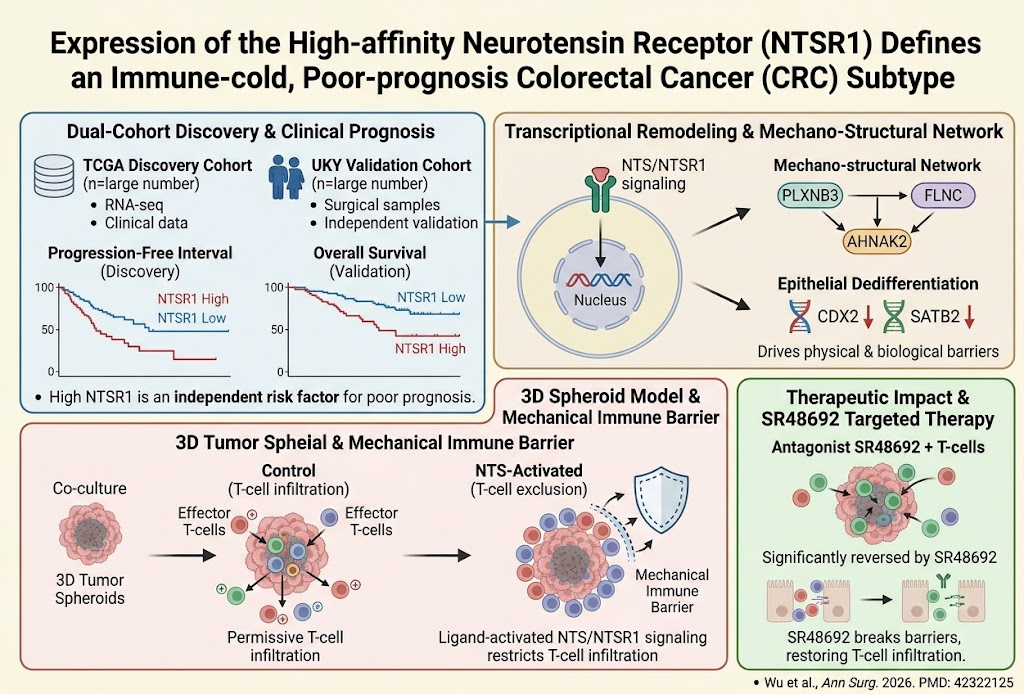
– High-affinity neurotensin receptor 1 (NTSR1) expression identifies a colorectal cancer (CRC) subtype characterized by immune exclusion and poor prognosis.
– NTS/NTSR1 signaling upregulates mechanostructural proteins (PLXNB3, FLNC, AHNAK2) and represses epithelial differentiation transcription factors (CDX2, SATB2), remodeling the tumor microenvironment.
– NTSR1 activation physically restricts T-cell infiltration in 3D tumor models, a phenomenon reversed by NTSR1 antagonist SR48692.
– Targeting the NTS/NTSR1 axis offers a promising strategy to overcome immune exclusion and enhance immunotherapy efficacy in CRC.

Study Background

MedXY registered readers

Sign in free to continue reading

Create or use your MedXY account to unlock the complete article.

This article was created using several editorial tools, including AI, as part of the process. Human editors reviewed this content before publication.

Related articles

Open language-specific specialty feeds and department pages.

Targeting IGF2BP2: A Novel Therapeutic Avenue in Peripheral T-cell Lymphoma Through RNA Modification and Immune ModulationThis article explores the pivotal role of IGF2BP2, an N6-methyladenosine reader, in driving tumor growth and immune evasion in peripheral T-cell lymphoma, highlighting its potential as a dual-action therapeutic target.Sep 24, 2026New International Consensus: Colorectal Cancer Risk in MASLD — What Clinicians Need to KnowAn international Delphi panel concludes metabolic dysfunction‑associated steatotic liver disease (MASLD) raises colorectal cancer (CRC) risk. Experts call for earlier, risk‑adapted CRC screening and integrated metabolic care to reduce CRC bSep 15, 2026Germline MSH3 and MLH3 Mutations as Tumor Suppressors Elevating Colorectal Cancer Risk via Hypermutation Signature ID4Heterozygous germline mutations in MSH3 and likely MLH3 confer an increased colorectal cancer risk through somatic second hits, inducing hypermutant, microsatellite-stable tumors characterized by signature ID4 and excess somatic deletions.Sep 15, 2026
Loading comments...
MedXY briefing

Get the free newsletter

Evidence-led clinical news, trends, and analysis—delivered to your inbox.

Ask MedXY AI

Most popular

Intimate Health
Five Benefits for Women Continuing Sexual Activity After Menopause
Intimate Health
Why Some Women Have a Strong Sex Drive—And Why Men Shouldn't Worry About It
Nursing & care
How often should a couple have sex?
General Surgery
Optimizing Postoperative Opioid Prescriptions After Intra-Abdominal Cancer Surgery: Comparing the 5x-Multiplier and 3-Tier Models
Intimate Health
Classic Intimacy Recommendations: How to Help Women Reach Orgasm and Enjoy Mutual Pleasure
© 2026 MedXY
Contact usAbout usPrivacy PolicyMedXY story
Reevaluating Colorectal Cancer Surveillance in Inflammatory Bowel Disease: The Role of Family History Beyond Early-Onset Cases
A nationwide cohort study reveals that in IBD patients, colorectal cancer risk increases notably with multiple affected relatives, challenging current guidelines prioritizing early-onset family history for surveillance.
Sep 6, 2026
Unveiling the Molecular Evolution from Primary Gastric Cancer to Peritoneal Metastases: Implications for Targeted Surgical OncologyThis study elucidates transcriptomic differences between primary gastric cancers and peritoneal metastases, revealing distinct tumor microenvironments and molecular pathways, highlighting potential targets for improved diagnosis and therapySep 5, 2026
Distinct Myeloid Landscapes Define Prognostic Niches in Extranodal NK/T-Cell LymphomaSpatial multimodal profiling reveals two macrophage-defined ENKTL subgroups with distinct tumor-myeloid interactions influencing prognosis and potential immunotherapy targets.Aug 30, 2026