Highlight
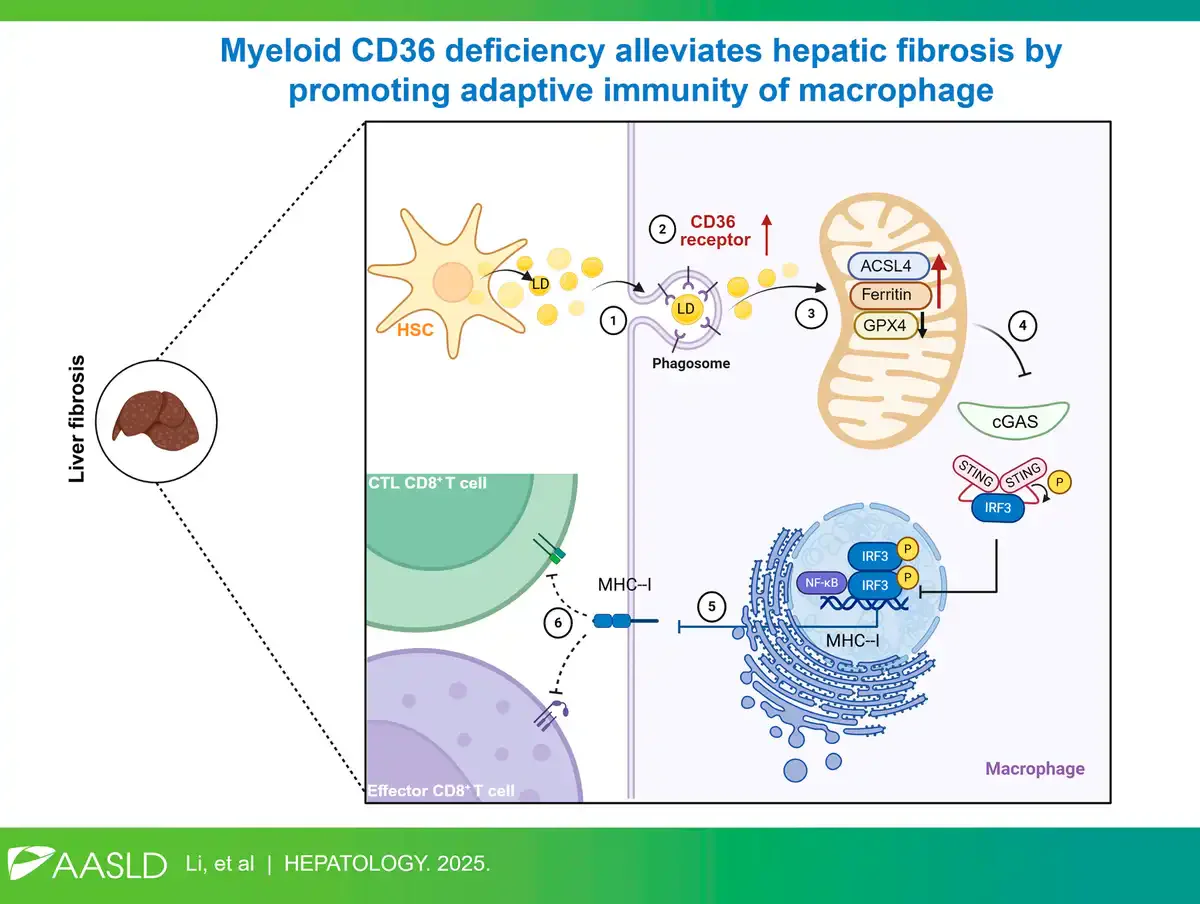
Macrophage CD36 mediates uptake of hepatic stellate cell-derived lipids, triggering lipid peroxidation and ferroptosis, impairing adaptive immunity.
Myeloid-specific CD36 deficiency enhances macrophage antigen presentation via cGAS-STING pathway activation and promotes CD8+ T cell activation in liver fibrosis.
Single-cell RNA sequencing reveals upregulation of MHC-I genes in CD36-deficient macrophages within fibrotic liver microenvironment.
Clinical correlations demonstrate elevated CD36 expression in cirrhotic patients, supporting translational relevance of targeting CD36 in hepatic fibrosis.
Study Background and Disease Burden
Hepatic fibrosis, characterized by excessive accumulation of extracellular matrix components leading to scarring and impaired liver function, represents a critical global health issue. It is often a precursor to cirrhosis and hepatocellular carcinoma, contributing substantially to morbidity and mortality worldwide. Current therapeutic options for halting or reversing fibrosis are limited, primarily because of incomplete understanding of the cellular and molecular drivers of fibrogenesis. Macrophages, versatile immune cells in the liver, have a dualistic role in fibrosis progression and resolution. Their functional heterogeneity and metabolic regulation significantly influence disease outcome. CD36, a class B scavenger receptor expressed on macrophages, facilitates lipid uptake and trafficking, linking metabolic and immune functions. This study investigates the mechanistic pathway by which CD36 modulates macrophage lipid metabolism, adaptive immune function, and subsequent progression of hepatic fibrosis, addressing a critical unmet need in liver disease therapeutics.
Study Design
This preclinical investigation employed a multi-level approach including in vivo murine models, ex vivo cellular assays, and patient sample analyses. A conditional knockout mouse model with myeloid-specific CD36 deletion was utilized to decipher the functional consequences on hepatic fibrosis progression. Lipid uptake and ferroptosis assays, antigen presentation measures, and downstream signaling pathway analyses (notably cGAS-STING) were performed on macrophages isolated from fibrotic livers. Single-cell RNA sequencing provided transcriptomic insights into immune cell crosstalk and gene expression changes. Complementing animal work, histological and serological assessments of CD36 expression were conducted in liver biopsy specimens and blood samples from patients with cirrhosis. The study included standard fibrosis scoring and immunophenotyping endpoints.
Key Findings
The study revealed that hepatic stellate cells secrete lipids taken up by macrophages through CD36, leading to heightened lipid peroxidation and ferroptosis within these immune cells. This ferroptotic death impairs macrophage antigen-presenting capacity, weakening CD8+ T cell activation, a critical component of adaptive immunity in fibrosis control.
Conversely, CD36-deficient macrophages demonstrated a robust restoration of antigen presentation, mediated by activation of the cytosolic DNA sensing cGAS-STING pathway. Single-cell RNA sequencing identified an upregulation of MHC class I genes and enhanced interaction with CD8+ T cells in the fibrotic microenvironment, suggesting an immune reprogramming effect driven by CD36 deficiency.
Functionally, mice with myeloid-specific deletion of CD36 exhibited marked resistance to fibrosis progression, as evidenced by reduced collagen deposition and fibrotic markers. These beneficial effects correlated with improved T cell-mediated immunity, highlighting a critical immunometabolic axis.
In clinical samples from patients with liver cirrhosis, increased CD36 expression was confirmed both histologically in liver macrophages and serologically. This underscores the translational relevance of targeting CD36 for therapeutic intervention.
Expert Commentary
This study presents compelling evidence that CD36-mediated lipid metabolism critically governs macrophage fate and function in hepatic fibrosis. The identification of macrophage ferroptosis as a key detrimental event disrupting adaptive immunity advances our understanding of fibrogenesis. Engagement of the cGAS-STING pathway upon CD36 loss aligns with emerging paradigms linking metabolism and innate immune sensing.
However, translation to clinical therapy will require further validation, particularly in human trials assessing CD36 inhibition safety and efficacy. The heterogeneity of macrophage populations and fibrotic stages necessitates precise targeting strategies. Moreover, balancing lipid metabolism without compromising host defense remains a challenge.
These findings also prompt exploration of combinatorial therapies that synergize macrophage reprogramming with antifibrotic agents or immune checkpoint modulators, potentially revolutionizing treatment paradigms.
Conclusion
Targeting myeloid CD36 represents a promising strategy to alleviate hepatic fibrosis by preventing macrophage ferroptosis and restoring their antigen-presenting function, thereby enhancing adaptive immunity through CD8+ T cell activation. This immunometabolic axis opens new avenues for therapeutic interventions addressing a significant unmet clinical need in liver fibrosis management. Future clinical trials should evaluate the efficacy and safety of CD36 inhibition to translate these findings into clinical practice.
Funding and Clinical Trial Registration
The clinical study referenced was registered in the Research Registry under number researchregistry10830. Further details on funding support are not explicitly provided but are typically outlined in the published original article.
References
Li L, Fang Y, Zhang J, Song M, Sun S, Chen X, Zhu S, Diao S, Zhao Y, Li H, Chen Z, Li X, Liu Z, Meng X, Xu T, He Y, Wang H, Huang C, Li J. Myeloid CD36 deficiency alleviates hepatic fibrosis by promoting adaptive immunity of macrophages. Hepatology (Baltimore, Md.). 2025 Dec 16;84(5):1396-1414. PMID: 41400628.
Additional supporting literature:
1. Wynn TA. Cellular and molecular mechanisms of fibrosis. J Pathol. 2008 Jan;214(2):199-210.
2. Dixon SJ et al. Ferroptosis: an iron-dependent form of nonapoptotic cell death. Cell. 2012 May 25;149(5):1060-72.
3. Mehal WZ, Iredale J, Friedman SL. Scraping fibrosis: expressway to the core. Nat Med. 2011 Jul 6;17(7):726-7.
4. Sun L et al. Cyclic GMP-AMP synthase is a cytosolic DNA sensor that activates the type I interferon pathway. Science. 2013 Feb 15;339(6121):786-91.
These references provide essential context on fibrosis, ferroptosis, immunometabolism, and innate immune sensing relevant to the study’s findings.