Study Background
Lung cancer remains a leading cause of cancer mortality worldwide. Early detection through lung cancer screening (LCS) with low-dose computed tomography (LDCT) significantly reduces mortality, but this benefit is contingent on rigorous adherence to follow-up care after initial screening. Despite evidence supporting LCS programs, real-world adherence to follow-up recommendations is often below 50%, especially in community healthcare settings where resources and systemic supports may be limited. Understanding the multifaceted barriers and facilitators to LCS follow-up in these settings is critical to enhancing screening effectiveness and reducing lung cancer mortality at a population level.
Study Design and Methods
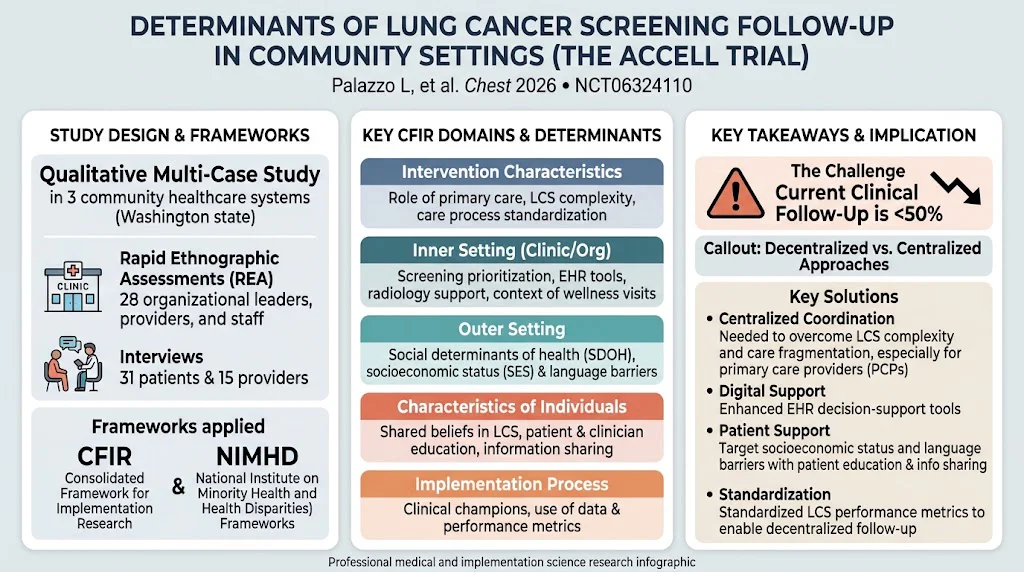
This qualitative multi-case study was conducted as part of the ACCELL trial (NCT06324110) to explore determinants of LCS follow-up within three community-based healthcare systems in Washington State. Employing rapid ethnographic assessments (REA), the investigators performed virtual and in-person visits to examine LCS delivery processes and organizational contexts. Additionally, semi-structured interviews were conducted with patients and providers at two sites slated for intervention implementation.
Interview transcripts and observational data were analyzed using the Rapid Group Analysis Process and triangulated through theoretical frameworks—the Consolidated Framework for Implementation Research (CFIR) and the National Institute on Minority Health and Health Disparities (NIMHD) Research Framework. This dual-framework approach permitted comprehensive examination across intervention characteristics, inner and outer setting domains, individual characteristics, and implementation processes, capturing both systemic and patient-level factors influencing follow-up adherence.
Key Findings
The study included 28 organizational leaders, providers, and staff in REA and interviews with 31 patients along with 15 providers at future intervention sites. Several critical determinants of LCS follow-up care were identified across multiple domains:
Intervention Domain
Role of Primary Care Providers (PCPs): PCP involvement was essential yet limited by competing demands and complexity of LCS protocols.
LCS Complexity and Process Standardization: Variation and complexity in screening pathways contributed to fragmented care and follow-up gaps; standardization efforts were valued but inconsistently applied.
Inner Setting (Organizational and Clinic Context)
Screening Prioritization: LCS was often deprioritized amidst competing clinical priorities, reducing follow-up adherence.
Electronic Health Record (EHR) Utilization: Effective use of EHR tools to track patients and automate reminders was associated with improved follow-up.
Radiology Support: Availability and coordination with radiology services influenced timely communication of results.
Context of Wellness Visits: Opportunities during routine care visits for reinforcing follow-up recommendations were underutilized.
Outer Setting (Socioeconomic and External Factors)
Social Determinants of Health: Socioeconomic barriers, language differences, and transportation issues significantly hindered follow-up adherence.
Individual Domain
Shared Beliefs and Education: Patients’ and providers’ shared understanding of LCS importance and education improved motivation for follow-up.
Implementation Process Domain
Clinical Champions: Presence of engaged champions was critical in facilitating LCS process improvements.
Use of Data and Metrics: Tracking and feedback mechanisms helped sustain follow-up efforts and accountability within care teams.
Expert Commentary
The ACCELL trial’s qualitative findings elucidate the intricacies impacting LCS follow-up in decentralized community healthcare settings. The complexity of lung cancer screening processes and fragmentation of care among multiple providers emerge as notable impediments. Socioeconomic factors and language barriers further compound follow-up challenges, echoing broader disparities in oncologic care.
While centralized approaches to streamline LCS coordination may enhance follow-up rates, the study suggests that pragmatic improvements in decentralized settings are feasible. Integration of EHR-based tracking tools, provider and patient education, and standardizing performance metrics offer actionable pathways. These findings align with current guideline recommendations emphasizing system support and multi-disciplinary coordination for effective lung cancer screening programs.
However, limitations include the qualitative design and regional focus within Washington State, which may affect generalizability. The study does not quantify the relative impact of individual determinants nor directly evaluate intervention outcomes, which is reserved for subsequent phases of the ACCELL trial.
Conclusion
Adherence to lung cancer screening follow-up care in community settings is influenced by a constellation of factors spanning organizational processes, social determinants, and individual beliefs. Addressing LCS complexity and care fragmentation through centralized coordination may offer optimal improvements but enhancing EHR utilization, provider/patient education, and standardized monitoring in decentralized settings can substantially support follow-up. These insights are instrumental in designing pragmatic interventions to increase LCS adherence and ultimately reduce lung cancer mortality in diverse populations.
Funding and Clinical Trial Registration
The ACCELL study was registered under ClinicalTrials.gov identifier NCT06324110. Details regarding funding sources were not specified in the primary publication.
References
Palazzo L, Hansell L, Wernli KJ, Brown M, Snidarich M, Louie T, Long S, Walsh C, Coronado GD, DeCell Arnp K, Lodhi S, Leone RJ, Wysham N, Triplette M. Determinants of lung cancer screening follow-up care in community care settings: A qualitative multi-case study in the ACCELL trial. Chest. 2026 Oct 22:S0012-3692(26)06929-1. doi: 10.1016/j.chest.2026.10.019. Epub ahead of print. PMID: 42913880.