Macrotroponin Complexes and Risk of Cardiovascular Events: Implications for Cardiac Troponin Testing in Population Risk Stratification
Highlights
Macrotroponin complexes frequently interfere with cardiac troponin assays, especially troponin I, leading to discordant elevated measures in community populations.
Individuals with biochemical evidence of myocardial injury (non-discordant troponin elevations) are at significantly higher risk of cardiovascular events compared to those with macrotroponin-associated elevations.
Macrotroponin presence does not correlate with increased future risk of myocardial infarction, ischemic stroke, or cardiovascular mortality, highlighting the importance of distinguishing true injury from assay artifact.
Recognition and biochemical verification of macrotroponin complex formation are crucial for refining cardiovascular risk assessment in general population screening and clinical practice.
Background
Cardiac troponins, specifically troponin I and troponin T, are the cornerstone biomarkers for detecting myocardial injury and have seen expanding roles in cardiovascular risk stratification beyond acute settings. Elevated troponin levels often signal subclinical or overt cardiovascular disease and predict adverse outcomes such as myocardial infarction, stroke, and cardiovascular death. However, elevations may also arise from assay interference mechanisms, including the formation of macrotroponin complexes—immune complexes between troponin proteins and immunoglobulins—that alter assay detection or clearance from circulation.
The clinical implications of macrotroponin complexes remain incompletely understood, particularly their prevalence in the general population and their relationship with long-term cardiovascular risk. As troponin assays become increasingly used for population-level risk assessment, accurately discerning true myocardial injury from assay artifacts is imperative.
Key Content
Prevalence and Biochemical Characterization of Macrotroponin Complexes
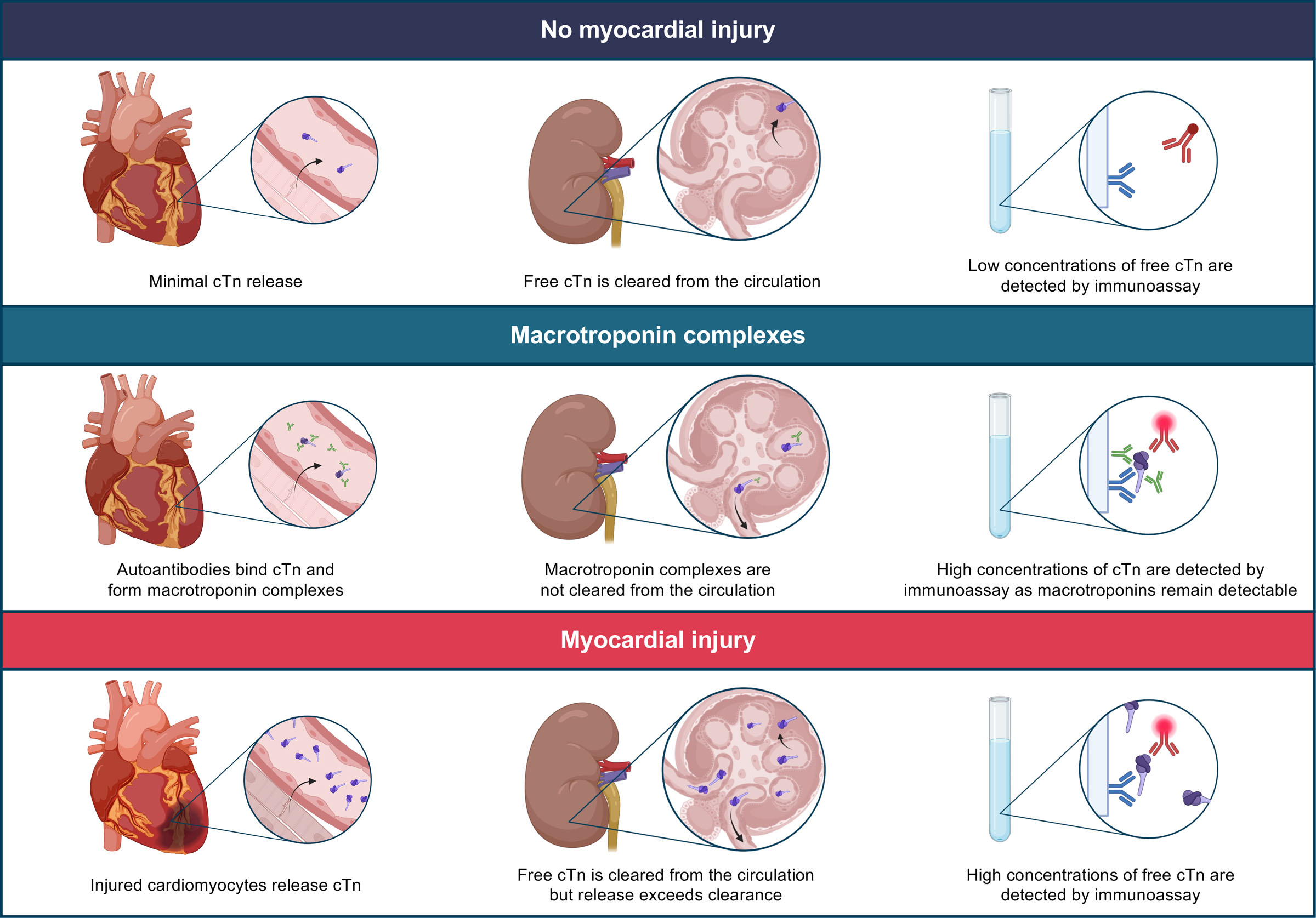
Using a large general population cohort (n=19,499; median age 49 years; 58.3% female), de Bakker et al. demonstrated elevated cardiac troponin I in 1% and troponin T in 6% of participants. Among these, nearly half exhibited discordant elevations, defined by a >3-fold difference between troponin I and T values. Advanced biochemical analyses—including immunoglobulin depletion and ultracentrifugation performed on a subset (n=203)—confirmed macrotroponin complexes in 92.5% of discordant troponin I cases and 15.4% of discordant troponin T cases. This indicates macrotroponin complexes are common assay interferences, far more so for troponin I assays.
Risk Association of Macrotroponin Versus Myocardial Injury
Participants were stratified into groups: no myocardial injury (both troponins normal), suspected macrotroponin elevation (discordant elevated troponin), and myocardial injury (non-discordant elevated troponins). Cox proportional hazards models adjusted for established cardiovascular risk factors revealed that myocardial injury conferred a significantly elevated risk for future myocardial infarction, ischemic stroke, or cardiovascular death (troponin I: adjusted HR 2.90; troponin T: adjusted HR 1.99). Conversely, individuals with suspected macrotroponin elevations exhibited risk profiles similar to those without troponin elevation (troponin I: adjusted HR 1.59, non-significant; troponin T: adjusted HR 1.27).
These findings were robustly replicated in an independent general population cohort, reinforcing their generalizability.
Mechanistic Insights
Macrotroponins represent high molecular weight complexes formed when cardiac troponin molecules bind circulating immunoglobulins. This complexation can alter assay antibody binding and prevent normal clearance of troponin, leading to persistent elevated assay signals unrelated to ongoing myocardial injury. Such immune-complexed troponins lack corresponding pathophysiological release from damaged cardiomyocytes, explaining the absence of elevated risk in affected individuals.
Implications for Clinical Practice and Risk Assessment
These findings underscore the necessity for clinicians and laboratories to be alert to the phenomenon of macrotroponin interference, particularly when discordant troponin elevations (I vs T) are observed. Without recognition, misclassification of patients as having subclinical myocardial injury may lead to unnecessary investigations, anxiety, or inappropriate therapies.
Incorporation of confirmatory biochemical testing for macrotroponins—such as immunoglobulin removal or alternative assay platforms—can improve specificity. Guidelines and diagnostic algorithms for cardiovascular risk assessment may need to incorporate considerations for macrotroponin interference to optimize risk prediction accuracy.
Expert Commentary
The study by de Bakker and colleagues is a landmark in defining the epidemiology and risk significance of macrotroponin complexes in community populations. It clarifies a key diagnostic pitfall in troponin assay interpretation, advancing the understanding that not all troponin elevations signify adverse cardiovascular prognosis.
Current clinical guidelines primarily focus on troponin elevations indicative of myocardial injury but rarely address macrotroponin-related assay interference. Given the common occurrence of macrotroponin complexes in troponin I assays and their potential to confound risk stratification, integrating biochemical verification steps or using multimarker approaches may enhance diagnostic precision.
Limitations include the observational design and reliance on statistical adjustment—unknown confounders may modestly influence risk associations but are unlikely to negate the core observations. The study’s replication cohort and comprehensive biochemical validations strengthen confidence.
Future research should explore optimized assay designs less susceptible to macrotroponin interference, development of clinical protocols for identification and management of suspected cases, and cost-effectiveness analyses for routine macrotroponin screening in primary prevention.
Conclusion
Macrotroponin complexes constitute a common source of assay interference in cardiac troponin measurement, particularly for troponin I, leading to false-positive elevations in the general population. Critically, these elevations do not associate with increased risk of myocardial infarction, stroke, or cardiovascular death. Discerning true myocardial injury from macrotroponin-related assay artifacts is essential to improve cardiovascular risk assessment accuracy, avoid unnecessary interventions, and guide optimal patient management. Future integration of biochemical confirmation and algorithmic interpretation will enhance the clinical utility of cardiac troponin assays in population health.
References
de Bakker M, Thurston AJF, Hammarsten O, Khachatryan M, Fujisawa T, Li Z, McEvoy JW, Lindahl B, Omland T, Sattar N, Sudlow CLM, Eggers KM, Welsh P, Mills NL. Macrotroponin Complexes and Risk of Cardiovascular Events. Circulation. 2026 Sep 8; PMID: 42708217. https://pubmed.ncbi.nlm.nih.gov/42708217/
Collinson PO, Gaze DC, Goodacre S, et al. Guidelines for the use of cardiac troponin in acute cardiac care – a joint consensus document. Heart. 2016;102(18):1440-1445. doi:10.1136/heartjnl-2015-308508
Dunn A, Noor-Ul-Hoda R, Anwar H, et al. Macrotroponin: An underrecognized cause of persistently elevated cardiac troponin levels. Clin Chem Lab Med. 2020;58(5):685-692. doi:10.1515/cclm-2019-0910
This article was created using several editorial tools, including AI, as part of the process. Human editors reviewed this content before publication.