We use cookies

Our website uses essential cookies and, with your consent, additional cookies to measure performance and improve our services. Cookie Policy.

You can change your choice at any time.

MMedXYNews
HomeVideos
MedXY AI/MedXY News/Section: Cardiology

Long-Term Quality of Life Outcomes in Older Patients Undergoing Heart Transplantation or Mechanical Circulatory Support: Insights from the SUSTAIN-IT Study
MedXY Editorial Team•Sep 23, 2026•Cardiology
Heart Transplantationheart failuremechanical circulatory supportquality of life

Highlight

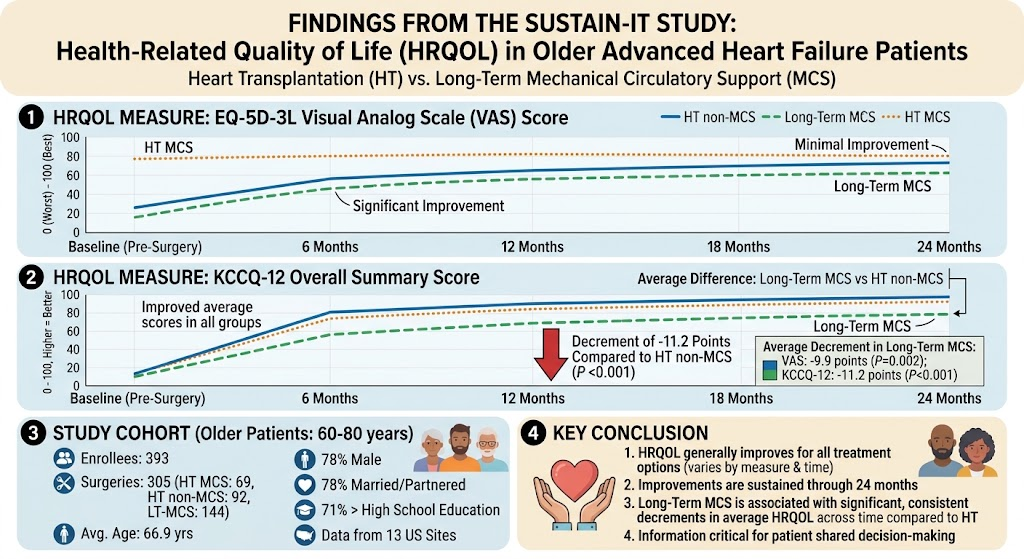
The SUSTAIN-IT study evaluated changes in health-related quality of life (HRQOL) over two years in older adults (60-80 years) with advanced heart failure undergoing heart transplantation (HT) or long-term mechanical circulatory support (MCS). Patients who underwent HT without pretransplant MCS and those with long-term MCS experienced significant and sustained improvements in HRQOL, whereas those with HT and pretransplant MCS showed limited HRQOL gains. Long-term MCS was associated with lower overall HRQOL scores compared to HT without MCS.

Study Background

MedXY registered readers

Sign in free to continue reading

Create or use your MedXY account to unlock the complete article.

This article was created using several editorial tools, including AI, as part of the process. Human editors reviewed this content before publication.

Related articles

Open language-specific specialty feeds and department pages.

Unraveling the Clinical Complexity of Extremely High NT-proBNP in Hospitalized Adults: Beyond Heart FailureExtremely high NT-proBNP levels in hospitalized patients often indicate infection rather than heart failure, with a high mortality risk; interpretation requires comprehensive clinical context.Sep 27, 2026Laparoscopic Radiofrequency Ablation versus Myomectomy: Comparative Effects on Uterine Leiomyoma Symptoms and Quality of LifeA multicenter prospective study comparing laparoscopic radiofrequency ablation and myomectomy in symptomatic uterine leiomyomas reveals both improve symptoms and quality of life, with myomectomy showing modest but clinically non-significantSep 25, 2026Cardiac Resynchronization Therapy With or Without Atrioventricular Node Ablation in Atrial Fibrillation: The CAAN-AF TrialThis trial evaluated whether atrioventricular node ablation improves outcomes of cardiac resynchronization therapy in heart failure patients with permanent atrial fibrillation, finding no significant benefit over medical rate control.Sep 25, 2026
Loading comments...
MedXY briefing

Get the free newsletter

Evidence-led clinical news, trends, and analysis—delivered to your inbox.

Ask MedXY AI

Most popular

Intimate Health
Five Benefits for Women Continuing Sexual Activity After Menopause
Intimate Health
Why Some Women Have a Strong Sex Drive—And Why Men Shouldn't Worry About It
Nursing & care
How often should a couple have sex?
General Surgery
Optimizing Postoperative Opioid Prescriptions After Intra-Abdominal Cancer Surgery: Comparing the 5x-Multiplier and 3-Tier Models
Intimate Health
Classic Intimacy Recommendations: How to Help Women Reach Orgasm and Enjoy Mutual Pleasure
© 2026 MedXY
Contact usAbout usPrivacy PolicyMedXY story
Bridging Evidence-Based and Personalized Medicine in Heart Failure and Cardiomyopathies: Balancing Standardization with Individualization
This article explores the integration of evidence-based medicine and personalized approaches in managing heart failure and inherited cardiomyopathies, proposing a framework to optimize patient care by harmonizing standardized guidelines wit
Sep 17, 2026
Cardiac Resynchronization Therapy: Metabolomic Insights into Heart Failure ImprovementThis study reveals how cardiac resynchronization therapy (CRT) improves left ventricular function in heart failure patients and modulates systemic metabolomic profiles, highlighting differences between ischemic and nonischemic cardiomyopathSep 15, 2026
Heart Failure in Portuguese Adults Aged 50 and Above: Insights from the PORTHOS Study on Prevalence and Predominant PhenotypesThe PORTHOS study reveals a 16.5% prevalence of heart failure among Portuguese adults aged 50+, with HFpEF constituting over 90% of cases, mostly undiagnosed, highlighting the need for enhanced screening strategies in aging populations.Sep 15, 2026