Long-term Outcomes of Neoadjuvant Nivolumab and Ipilimumab in MSI-High Gastric and GEJ Adenocarcinoma: Insights from the Phase 2 NEONIPIGA Trial
Highlight
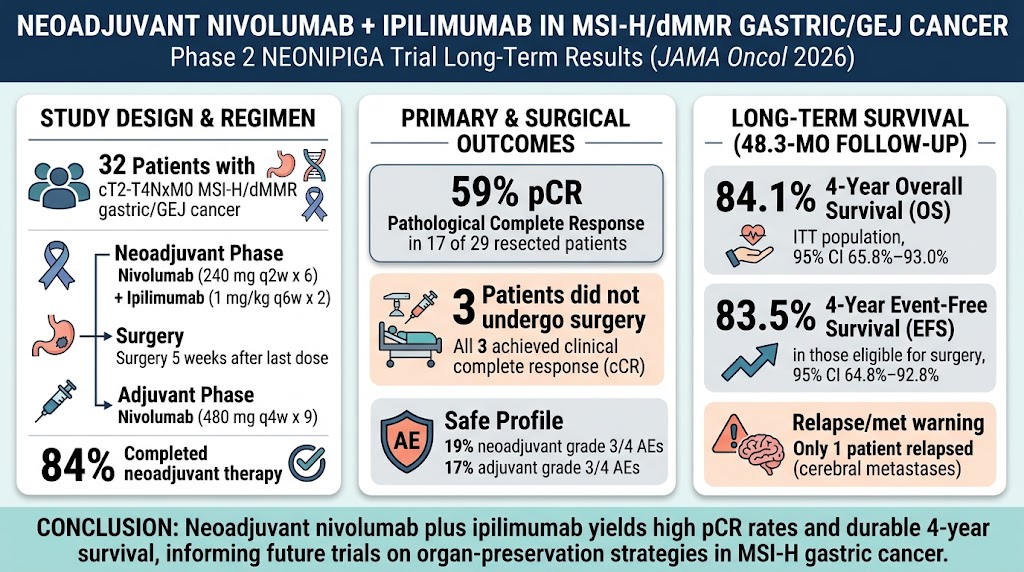
Neoadjuvant combination of nivolumab plus ipilimumab achieved 59% pathological complete response (pCR) in MSI-high localized gastric and gastroesophageal junction (GEJ) adenocarcinoma.
Long-term follow-up (median 48.3 months) showed encouraging 4-year overall survival (OS) of 84.1% and event-free survival (EFS) of 83.5% in patients undergoing surgery.
The therapy was generally well tolerated with manageable grade 3/4 adverse events occurring in under 20% of patients during neoadjuvant and adjuvant phases.
These findings support exploration of organ-preserving strategies and randomized trials incorporating immunotherapy in this molecularly defined subgroup.
Study Background
Gastric and gastroesophageal junction (GEJ) adenocarcinomas with deficient mismatch repair (dMMR) or microsatellite instability-high (MSI-high) status represent a distinct subset characterized by high tumor mutational burden and responsiveness to immune checkpoint inhibitors (ICIs). Standard treatment often involves surgery with or without chemotherapy, but the role of immunotherapy in localized MSI-high disease remains investigational. The NEONIPIGA trial addresses a significant clinical gap by evaluating neoadjuvant nivolumab (anti–PD-1) and ipilimumab (anti–CTLA-4) combination, hypothesizing this strategy may improve pathological response and long-term outcomes in MSI-high localized gastric and GEJ adenocarcinoma.
Study Design
The NEONIPIGA study was a multicenter, single-arm, phase 2 nonrandomized clinical trial conducted in France. Eligible patients had histologically confirmed localized dMMR/MSI-high gastric or GEJ adenocarcinoma staged cT2-T4NXM0, and were candidates for curative surgery. Enrollment occurred between October 23, 2019, and June 4, 2021.
Patients received neoadjuvant nivolumab 240 mg every two weeks for 6 cycles combined with ipilimumab 1 mg/kg every 6 weeks for 2 cycles. Surgery was performed approximately 5 weeks after the last nivolumab dose. Postoperatively, adjuvant nivolumab 480 mg was administered every 4 weeks for 9 cycles. Primary endpoint was pathological complete response (pCR), previously reported. Secondary endpoints included event-free survival (EFS), overall survival (OS), and safety.
Key Findings
Thirty-two patients with median age 65 years (range 40-80) were enrolled; half had gastric and half GEJ tumors. Among these, 31 underwent surgery, while one developed metastasis precluding surgery and two refused surgery. Completion rates were 84% for neoadjuvant therapy and 44% for all planned therapy including adjuvant nivolumab.
The pathological complete response was observed in 17 of 29 (59%) surgical specimens, underscoring strong tumor eradication potential. Median follow-up of 48.3 months revealed 4-year OS of 84.1% (95% CI, 65.8%-93.0%) in the intent-to-treat group and 4-year EFS of 83.5% (95% CI, 64.8%-92.8%) among those undergoing surgery.
Adverse events grade 3/4 related to neoadjuvant treatment occurred in 6 patients (19%), and during adjuvant therapy in 4 patients (17%). No unexpected late toxicities emerged during long-term follow-up. Notably, all patients not undergoing surgery achieved clinical complete responses with immune checkpoint inhibitors, though one died from unrelated causes.
In terms of relapse, only one patient developed cerebral metastases. Deaths related to cancer or treatment totaled two, while four were unrelated.
Expert Commentary
The NEONIPIGA study’s results are promising for integrating immunotherapy upfront in MSI-high gastric and GEJ adenocarcinoma, a subgroup typically resistant to conventional chemotherapy but responsive to immune checkpoint blockade due to high neoantigen load. The relatively high pCR rate contrasts favorably with historical data from surgery or chemotherapy alone, suggesting that neoadjuvant immunotherapy can profoundly modify the tumor biology preoperatively.
However, the trial’s single-arm design and a relatively small cohort limit definitive conclusions regarding superiority over standard treatment. The absence of a control arm means survival benefits cannot be conclusively attributed to the intervention. Multicenter randomized studies are needed to confirm these findings and to explore whether a nonoperative approach may be feasible in complete responders, given the substantial clinical complete responses observed in patients foregoing surgery.
The manageable safety profile aligns with known toxicities of dual checkpoint inhibition in other cancer types. Importantly, the study emphasizes biomarker-driven precision immunotherapy that aligns molecular subtype with tailored treatment.
Conclusion
The NEONIPIGA phase 2 trial establishes that neoadjuvant nivolumab and ipilimumab produce durable long-term survival and high pathological complete response rates in localized MSI-high gastric and GEJ adenocarcinoma. While survival outcomes are encouraging, comparative trials are warranted to define the precise role of immunotherapy relative to surgery and chemotherapy.
The findings pave the way for prospective investigation of organ preservation and treatment de-escalation strategies in select patients, potentially sparing morbidity without compromising oncologic outcomes. This study underscores the evolving paradigm of immunotherapy in early-stage gastrointestinal malignancies driven by molecular profiling.
Funding and Clinical Trial Registration
The NEONIPIGA trial was conducted in France with funding sources and support details available in the original publication. The clinical trial is registered under ClinicalTrials.gov identifier NCT04006262.
References
1. Samaille T, Henriques J, Tougeron D, et al. Nivolumab-Ipilimumab for Localized Microsatellite Instability-High Gastric/Gastroesophageal Junction Adenocarcinoma: The Phase 2 NEONIPIGA Nonrandomized Clinical Trial. JAMA Oncol. 2026 Oct 15;PMID: 42879140.
2. Le DT, Durham JN, Smith KN, et al. Mismatch repair deficiency predicts response of solid tumors to PD-1 blockade. Science. 2017 Jul 28;357(6349):409-413.
3. Cristescu R, Mogg R, Ayers M, et al. Pan-tumor genomic biomarkers for PD-1 checkpoint blockade-based immunotherapy. Science. 2018 Nov 2;362(6411):eaar3593.
4. NCCN Clinical Practice Guidelines in Oncology: Gastric Cancer. Version 2.2024.
5. Janjigian YY, Shitara K, Moehler M, et al. First-line nivolumab plus chemotherapy versus chemotherapy alone for advanced gastric or gastro-oesophageal junction cancer (CheckMate 649): a randomized, open-label, phase 3 trial. Lancet. 2021 Oct 9;398(10294):27-40.
This article was created using several editorial tools, including AI, as part of the process. Human editors reviewed this content before publication.