We use cookies

Our website uses essential cookies and, with your consent, additional cookies to measure performance and improve our services. Cookie Policy.

You can change your choice at any time.

MMedXYNews
HomeVideos
MedXY AI/MedXY News/Section: Gastroenterology

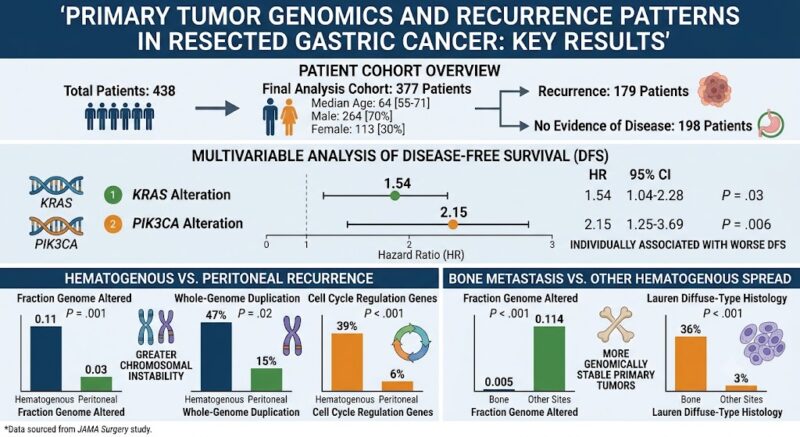
Genomic Profiling of Primary Gastric Tumors Predicts Recurrence Patterns and Survival Outcomes
MedXY Editorial Team•Aug 9, 2026•Gastroenterology
tumor genomicsrecurrencepersonalized medicinemetastasisGastric Cancer

Highlight

  • Alterations in KRAS and PIK3CA genes independently associate with worse disease-free survival in resected gastric cancer.
  • Distinct genomic characteristics differentiate patterns of recurrence: hematogenous, peritoneal, and lymphatic metastases.
  • Hematogenous recurrence correlates with increased chromosomal instability and cell cycle regulatory gene alterations.
  • Bony metastases arise predominantly from genomically stable, diffuse-type tumors, highlighting histologic-genomic interplay.

Study Background

MedXY registered readers

Sign in free to continue reading

Create or use your MedXY account to unlock the complete article.

This article was created using several editorial tools, including AI, as part of the process. Human editors reviewed this content before publication.

Related articles

Open language-specific specialty feeds and department pages.

Recurrent Dupuytren Contracture: Comparing Surgical Fasciectomy and Collagenase Injection for Optimal ManagementThis randomized controlled trial compares surgical fasciectomy and collagenase injection for recurrent Dupuytren contracture, revealing similar functional outcomes at 2 years but higher adverse events with surgery.Sep 27, 2026Personalizing Allogeneic Hematopoietic Cell Transplantation in Adult AML Using Measurable Residual Disease TestingMeasurable residual disease (MRD) testing offers critical insights to tailor allogeneic hematopoietic cell transplantation in adults with acute myeloid leukemia, optimizing patient selection, conditioning intensity, and relapse surveillanceSep 27, 2026Advancing Surgical Quality Assessment in Distal Gastrectomy: Automated Evaluation of the Critical View of Quality Using Computer VisionThis study validates the Critical View of Quality (CVQ) as an intraoperative metric of lymphadenectomy quality in distal gastrectomy and presents a novel computer vision model for its automated video-based assessment, enhancing objective suSep 23, 2026
Loading comments...
MedXY briefing

Get the free newsletter

Evidence-led clinical news, trends, and analysis—delivered to your inbox.

Ask MedXY AI

Most popular

Intimate Health
Five Benefits for Women Continuing Sexual Activity After Menopause
Intimate Health
Why Some Women Have a Strong Sex Drive—And Why Men Shouldn't Worry About It
Nursing & care
How often should a couple have sex?
General Surgery
Optimizing Postoperative Opioid Prescriptions After Intra-Abdominal Cancer Surgery: Comparing the 5x-Multiplier and 3-Tier Models
Intimate Health
Classic Intimacy Recommendations: How to Help Women Reach Orgasm and Enjoy Mutual Pleasure
© 2026 MedXY
Contact usAbout usPrivacy PolicyMedXY story
Long-Term Recurrence of Hypertropia After Surgery in Sagging Eye Syndrome: Insights and Implications
Strabismus surgery effectively corrects hypertropia in sagging eye syndrome (SES), yet about 25% of patients experience delayed recurrent hypertropia over two years, reflecting SES’s progressive nature. Overcorrections are rare and ma
Sep 22, 2026
Bridging Evidence-Based and Personalized Medicine in Heart Failure and Cardiomyopathies: Balancing Standardization with IndividualizationThis article explores the integration of evidence-based medicine and personalized approaches in managing heart failure and inherited cardiomyopathies, proposing a framework to optimize patient care by harmonizing standardized guidelines witSep 17, 2026
Real-World Five-Year Survival After Neoadjuvant Therapy and Surgery in Localized Pancreatic Ductal AdenocarcinomaThis study reveals that over one-third of patients with localized PDAC receiving neoadjuvant therapy and surgery achieve actual five-year survival, highlighting the impact of early systemic failure and identifying factors predicting long-teSep 15, 2026