Clinical Outcomes and Prognostic Factors in Lung Metastases Following Gastrectomy for Gastric Cancer
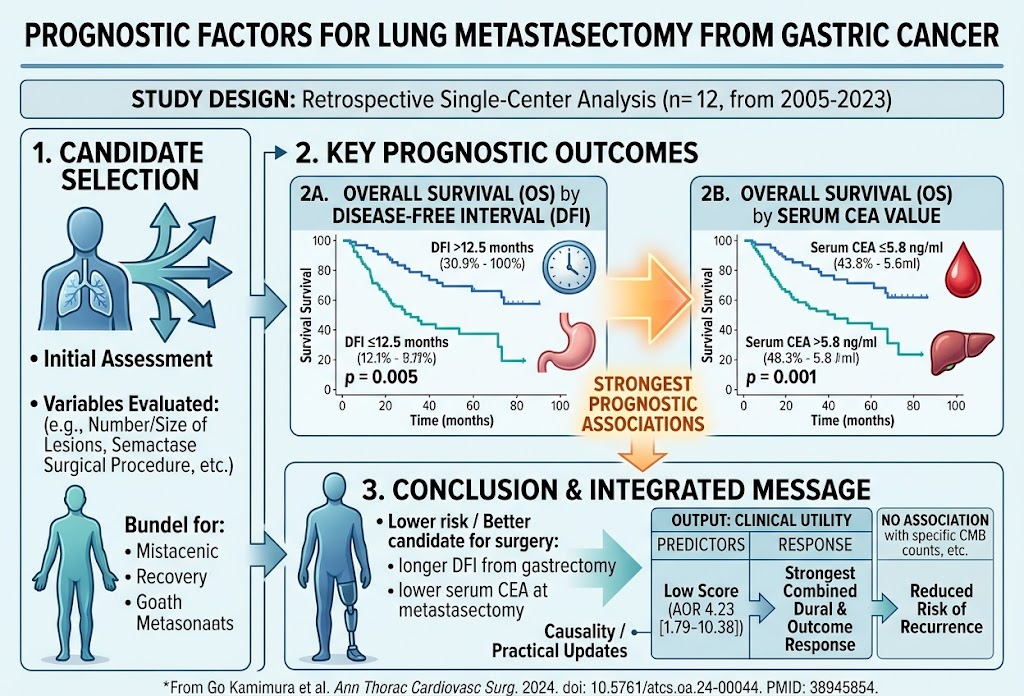
Highlight
Lung metastases after gastrectomy for gastric cancer are rare but carry a poor prognosis, with a 5-year survival of 14.5%. Key prognostic factors for improved survival include unilateral lung involvement, fewer metastatic lesions (three or fewer), hematogenous spread pattern, and isolated lung metastases. Surgical resection (pulmonary metastasectomy) correlates with better overall survival in selected patients.
Study Background
Gastric cancer remains a significant global health burden with a high propensity for metastasis and recurrence after gastrectomy. While the liver and peritoneum are common metastatic sites, lung metastases are uncommon, reported in less than 1% of cases. Due to their rarity, the clinical behavior, natural history, and optimal management of lung metastases following gastrectomy remain poorly characterized. Understanding the prognostic factors and treatment outcomes in this subset could aid in individualized therapeutic strategies and improve survival.
Study Design
This retrospective cohort study analyzed data collected between January 2000 and December 2023, encompassing patients who underwent gastrectomy for gastric cancer and later developed lung metastases. The study included 22,927 gastrectomy patients from which 110 cases with confirmed lung metastases were identified (0.5%). Clinical records and radiologic imaging were reviewed for metastatic patterns, disease burden, recurrence intervals, concomitant metastatic sites, and overall survival following lung metastasis diagnosis.
Key Findings
The median interval from gastrectomy to lung metastasis diagnosis was 18 months (IQR: 10-38 months), signaling a relatively early metastatic event. Radiographically, most patients (64.5%) had bilateral pulmonary involvement, and 74.5% presented with multiple lung lesions (≥4 nodules). The predominant metastatic spread pattern was hematogenous (68.2%), consistent with systemic dissemination. Importantly, isolated lung metastases as the initial site of recurrence were identified in 28.2% of patients, suggesting a potential window for local treatment intervention.
Distant lymph nodes were the most frequent concomitant metastatic site (48.2%), highlighting frequent systemic spread beyond the lungs. Median overall survival (OS) after lung metastasis diagnosis was 10 months (IQR: 5-32 months), underscoring the dismal outcomes typical of metastatic gastric cancer. Nevertheless, 5-year OS was 14.5%, indicating a subset of patients achieve long-term survival.
Univariate analysis demonstrated significantly longer survival for patients with unilateral lung involvement (P = .007), having three or fewer lung lesions (P = .001), hematogenous metastatic spread (P < .001), and isolated lung metastases (P = .039). Multivariable Cox regression identified metastatic spread pattern (P < .001), diagnosis era (P = .001), and undergoing pulmonary metastasectomy (P = .008) as independent predictors of overall survival.
The role of pulmonary metastasectomy emerged as a potentially beneficial treatment strategy in carefully selected patients with limited metastatic burden. This surgical intervention was associated with improved survival, suggesting that a subset of gastric cancer patients with lung-only or oligometastatic disease might benefit from aggressive local therapy.
Expert Commentary
Lung metastases from gastric cancer represent a distinct clinical entity seldom addressed in large-scale studies due to their rarity. The observed median survival of 10 months post-diagnosis is consistent with previous smaller cohorts but emphasizes the limited efficacy of conventional systemic therapies alone. The identification of prognostic factors such as metastatic burden and laterality aligns with oncologic principles observed in other solid tumors with pulmonary metastasis, where limited disease correlates with better outcomes.
The significant survival benefit associated with pulmonary metastasectomy underscores the value of a multidisciplinary approach. Surgical resection should be considered for patients with controlled primary disease, good performance status, and limited lung lesions. However, given the retrospective design and single-center data, selection bias cannot be excluded. Prospective trials are challenging due to low incidence but warranted to delineate optimal treatment paradigms.
Conclusion
Lung metastases after gastrectomy for gastric cancer are rare and portend poor prognosis overall. Yet, selected patients exhibiting unilateral involvement, limited number of lung lesions, and isolated pulmonary recurrence may achieve meaningful long-term survival, particularly when pulmonary metastasectomy is feasible. Careful characterization of metastatic burden at recurrence is crucial to identify candidates for aggressive local treatment, emphasizing a tailored therapeutic strategy to extend survival in this challenging clinical scenario.
Reference
Kamimura G, Aoki M, Umehara T, Harada-Takeda A, Nagata T, Koriyama C, Ueda K. Prognostic Outcome of Pulmonary Resection for Pulmonary Metastases from Gastric Cancer. Ann Thorac Cardiovasc Surg. 2024;30(1):24-00044. doi: 10.5761/atcs.oa.24-00044. PMID: 38945854; PMCID: PMC11219219.
This article was created using several editorial tools, including AI, as part of the process. Human editors reviewed this content before publication.