Highlight
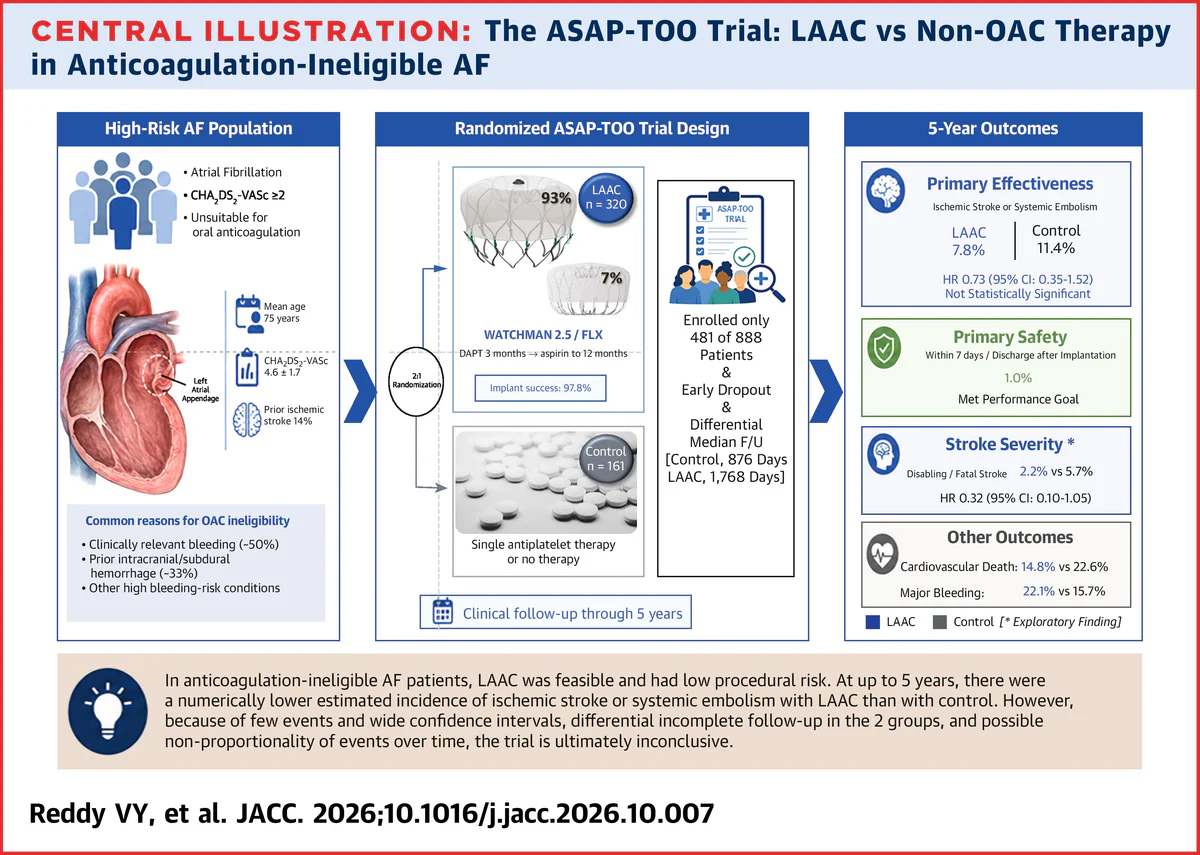
ASAP-TOO evaluated left atrial appendage closure (LAAC) for patients with atrial fibrillation (AF) unsuitable for oral anticoagulation (OAC).
LAAC implantation success was high (97.8%) with low periprocedural complications.
Over 5 years, ischemic stroke or systemic embolism rates trended lower with LAAC but were not statistically significant due to early trial termination and underpowering.
Major bleeding was numerically higher in the LAAC group, primarily during the first 3 months due to mandated antiplatelet therapy.
Study Background
Atrial fibrillation (AF) significantly elevates risk of thromboembolic stroke. Oral anticoagulation (OAC) with agents such as warfarin or direct oral anticoagulants (DOACs) effectively reduces this risk. However, many patients are either contraindicated or at high bleeding risk, limiting OAC use. The left atrial appendage (LAA) is a predominant site of thrombus formation in AF. Percutaneous left atrial appendage closure (LAAC) using devices like the Watchman implant offers an alternative stroke prevention strategy without the need for long-term OAC.
Previous large trials comparing LAAC against OAC demonstrated stroke risk reduction and safety, establishing LAAC as an option for patients eligible for OAC. Nevertheless, data on LAAC in patients contraindicated or unsuitable for OAC remain limited. The ASAP-TOO trial was designed to address this unmet clinical need by evaluating LAAC’s long-term safety and effectiveness in this high-risk population.
Study Design
The ASAP-TOO trial was an international, randomized, controlled study enrolling patients with non-valvular atrial fibrillation, elevated stroke risk (CHA2DS2-VASc score ≥2), and absolute or relative contraindications to OAC. Target enrollment was 888 patients, randomized in a 2:1 ratio to LAAC with the Watchman device or to control treatment, which consisted of either single antiplatelet therapy or no antithrombotic therapy.
Patients assigned to the LAAC group received dual antiplatelet therapy (DAPT) for three months post-implant followed by aspirin alone through 12 months. The primary effectiveness endpoint was ischemic stroke or systemic embolism. The primary safety endpoint combined death, ischemic stroke, systemic embolism, and device or procedure-related adverse events within 7 days needing major intervention.
Key Findings
Enrollment was halted prematurely at 481 patients due to slow accrual exacerbated by the COVID-19 pandemic, resulting in a statistically underpowered analysis. Among randomized subjects, mean age was 75 years, mean CHA2DS2-VASc score was 4.6, and 34% had prior intracranial or subdural hemorrhage. Implant success was high at 97.8%, with three pericardial effusions requiring intervention, reflecting acceptable procedural safety.
During up to 5 years of follow-up (median 1768 days in LAAC group versus 876 days in controls), ischemic stroke or systemic embolism occurred in 7.8% of LAAC patients and 11.4% of control patients (hazard ratio [HR] 0.73; 95% confidence interval [CI], 0.35–1.52; P=0.39). The numerical trend favored LAAC but did not reach statistical significance. Only 31 of the originally planned 101 events occurred, reducing power to detect differences.
Major bleeding events were numerically higher with LAAC (22.1% vs. 15.7%; HR 1.64; 95% CI 0.96–2.81; P=0.067), largely during the initial 3 months when DAPT was mandatory. Notably, disabling or fatal strokes occurred less frequently in the LAAC group (2.2% vs. 5.7%; HR 0.32; 95% CI 0.10–1.05), an exploratory finding suggestive of potential clinical benefit.
Expert Commentary
The ASAP-TOO trial contributes important insights into stroke prevention for AF patients unsuitable for OAC, a population with limited therapeutic options and high bleeding risk. Despite early termination and underpowering limiting definitive conclusions, implantation success, safety outcomes, and exploratory efficacy data align with prior evidence supporting LAAC as a reasonable alternative.
Early bleeding associated with mandated antiplatelet therapy highlights the challenge of balancing thrombosis and bleeding risks in this cohort. Future protocols could explore individualized antithrombotic regimens to optimize safety.
Generalizability is affected by trial limitations including imbalance in follow-up duration and withdrawal rates (higher in control group), which may bias results. The relatively low ischemic event rate and the trial’s premature halt curtail robust statistical comparisons.
Current clinical guidelines consider LAAC a viable option for patients with AF and contraindications to long-term OAC, endorsed by consensus documents and supported by a growing body of real-world and randomized evidence. ASAP-TOO adds further data specifically from a randomized trial setting, reinforcing shared decision-making that incorporates patient values, bleeding risk, and stroke prevention priorities.
Conclusion
The ASAP-TOO trial demonstrates that left atrial appendage closure with the Watchman device is feasible and safe in patients with atrial fibrillation who are not candidates for oral anticoagulation. Although underpowered due to early termination, efficacy signals for thromboembolic event reduction were numerically favorable but non-significant.
There was an apparent increased risk of early bleeding linked to antiplatelet therapy following implantation, emphasizing caution and need for individualized antithrombotic management. These findings should be integrated with existing evidence and clinical judgement when considering LAAC in high-risk AF patients unsuitable for anticoagulation. Further larger studies are warranted to definitively establish long-term outcomes and optimize peri-procedural management.
Funding and ClinicalTrials.gov
The ASAP-TOO trial was registered under NCT02928497. Funding details were not specified in the abstract but are typically disclosed in full publications.
References
1. Reddy VY, Buchbinder M, Nair DG, et al. Left Atrial Appendage Closure in Patients Considered Unsuitable for Oral Anticoagulation: Randomized Outcomes Through 5 Years in ASAP-TOO. J Am Coll Cardiol. 2026; PMID: 43018511.
2. January CT, Wann LS, Alpert JS, et al. 2019 AHA/ACC/HRS Guidelines for the Management of Patients With Atrial Fibrillation. Circulation. 2019;140:e125-e151.
3. Holmes DR Jr, Reddy VY, Turi ZG, et al. Percutaneous closure of the left atrial appendage versus warfarin therapy for prevention of stroke in patients with atrial fibrillation: a randomized non-inferiority trial. Lancet. 2009;374(9689):534-42.
4. Reddy VY, Doshi SK, Kar S, et al. 5-Year Outcomes After Left Atrial Appendage Closure: From the PREVAIL and PROTECT AF Trials. J Am Coll Cardiol. 2017;70(24):2964-2975.