Long-Term Benefits of Surgical Unroofing in Angina Patients with Myocardial Bridge and Non-Obstructive Coronary Arteries
Highlight
– Myocardial bridge (MB) can cause angina in patients without obstructive coronary artery disease.
– Surgical unroofing of functionally significant MB provides substantial long-term symptom relief and improved quality of life (QoL).
– Propensity-matched analysis demonstrates superior benefits of surgery over medical management for refractory angina due to MB.
– Surgical intervention should be considered for patients with severe angina and functionally significant MB unresponsive to maximal medical therapy.
Study Background
Myocardial bridge (MB) represents a congenital coronary anomaly characterized by the tunneling of an epicardial coronary artery segment beneath a band of myocardial muscle. This anomaly commonly involves the left anterior descending artery (LAD). While often considered benign, MB may produce ischemic symptoms including angina, particularly when coronary arteries are angiographically non-obstructive.
Patients with angina and non-obstructive coronary arteries (ANOCA) present a clinical challenge due to limited treatment options. The presence of a functionally significant MB can lead to dynamic compression and abnormal coronary hemodynamics causing ischemia and refractory angina. Despite maximal medical therapy, which may include beta-blockers, calcium channel blockers, and nitrates, some patients continue to experience debilitating symptoms.
Surgical unroofing, a procedure that involves removing the overlying myocardial fibers to relieve the arterial compression, has been reported to improve short-term symptoms and quality of life. However, long-term clinical outcomes and symptomatic benefits have been less well characterized, prompting this prospective investigation.
Study Design
In this prospective observational study, 218 adult patients with symptomatic MB who underwent surgical unroofing were followed over a median duration of 5 years (range: 3–9 years). Inclusion criteria required a functionally significant MB, defined as a dobutamine-stress diastolic fractional flow reserve (dFFR) and/or resting full-cycle ratio (RFR) ≤ 0.76. Comprehensive preoperative assessments included stress echocardiography, coronary computed tomography angiography (CCTA), invasive coronary angiography, and intravascular ultrasound to confirm MB presence and functional significance.
The Seattle Angina Questionnaire (SAQ) was used to evaluate patient-reported angina symptoms and quality of life at baseline and during follow-up. Furthermore, to assess comparative effectiveness, a propensity score-matched subset analysis was conducted comparing 65 surgically treated patients to 65 matched non-surgical controls with similar baseline characteristics and functionally significant MB who continued on medical management.
Key Findings
The longitudinal follow-up revealed significant and clinically meaningful improvements across all measured SAQ domains post-surgical unroofing. These domains included physical limitation, anginal stability, anginal frequency, treatment satisfaction, and quality of life. The SAQ summary scores also improved markedly.
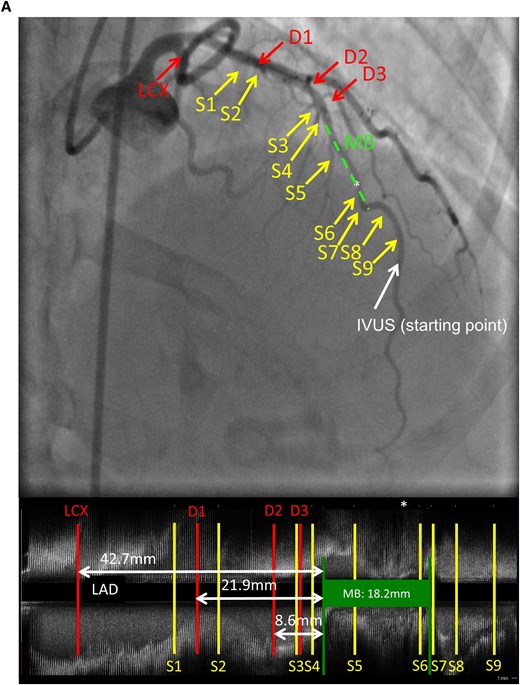
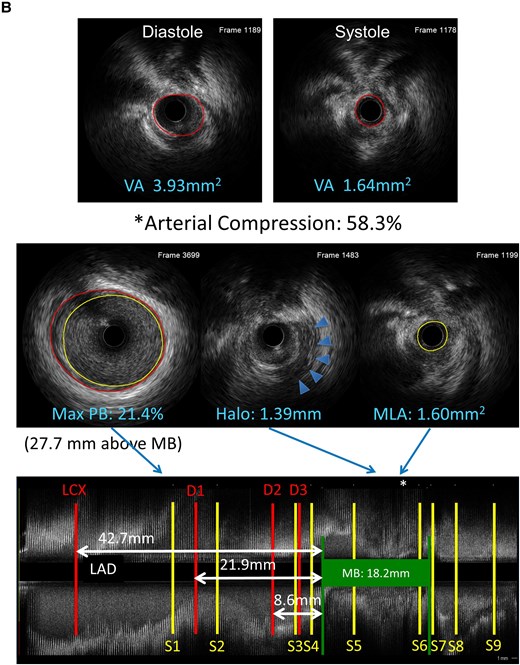
(A) Left anterior descending artery with an MB on coronary angiography and corresponding longitudinal IVUS. IVUS map showing the left anterior descending artery with an MB on coronary angiography with longitudinal IVUS. The green dotted line represents the MB. S1–S9 are septal perforators. D1–D3 are diagonal branches. (B) Arterial compression, MPB, and halo thickness on IVUS. (i) End-diastolic and end-systolic IVUS with 58.3% arterial compression. (ii) MPB of 21.4% and maximal MB halo thickness of 1.39 mm, MLA of 1.60 mm2 located within the MB (asterisk). The blue arrows point to the location of the MPB, maximum halo thickness, and MLA on longitudinal IVUS (iii). LCX, left circumflex artery; MB, myocardial bridge; IVUS, intravascular ultrasound; Max PB, maximum plaque burden; MLA, minimal lumen area; VA, vessel area
When compared to the matched non-surgical group, surgically unroofed patients demonstrated greater improvements in physical limitation (+27.8 vs +11.4, P = .004) and angina frequency (+30 vs +20, P = .01). These improvements translated into enhanced functional capacity and reduced symptom burden over the long term.
No major safety concerns were reported related to the surgical procedure during follow-up. The sustained symptomatic relief supports surgical unroofing as a durable intervention for patients with refractory angina attributable to MB.
Expert Commentary
These findings underscore the clinical relevance of identifying functionally significant MB in patients presenting with angina and non-obstructive coronary arteries. The careful use of advanced hemodynamic measurements such as dFFR and RFR aids in selecting candidates who may benefit from surgical intervention.
While medical therapy remains first-line, the persistence of symptoms despite maximal medical management should prompt consideration of surgical unroofing. Importantly, the long-term symptomatic benefits observed align with prior smaller studies demonstrating short-term improvements, thus expanding confidence in the procedure’s enduring value.
Limitations include potential selection bias inherent in the non-randomized design and the relatively small matched cohort for comparative analysis. Larger randomized controlled trials would further validate these findings. Additionally, longer follow-up will be necessary to assess the impact on major adverse cardiovascular events and survival.
Conclusion
Surgical unroofing of functionally significant myocardial bridges in patients with refractory angina and non-obstructive coronary arteries is associated with significant and sustained improvement in symptoms and quality of life over a median 5-year follow-up. For patients with persistent angina despite optimal medical therapy, surgical correction represents a valuable therapeutic option.
Identification of functionally significant MB by comprehensive imaging and invasive physiology assessment is critical to guide management. This study provides robust evidence supporting surgical unroofing as an effective long-term treatment strategy, filling an important clinical gap in the care of angina patients without obstructive coronary disease.
Funding and Clinical Trial Registration
The article did not specify funding sources or clinical trial registration. Readers are encouraged to consult the original publication for detailed disclosures.
References
- Pargaonkar VS et al. Angina with non-obstructive coronary arteries and myocardial bridge: long-term outcomes of surgical unroofing. Eur Heart J. 2026;47(31):4290–4303.
- Corban MT, et al. Myocardial bridging: contemporary understanding of pathophysiology with implications for diagnostic and therapeutic strategies. J Am Coll Cardiol. 2014;63(22):2346–55.
- Escaned J, et al. Functional assessment of myocardial bridging: The role of invasive physiology and imaging. EuroIntervention. 2017;13(17):e2057–64.
- Shirani J, et al. Surgical treatment of symptomatic myocardial bridging: long-term follow-up. J Cardiovasc Surg (Torino). 2019;60(1):24-31.
This article was created using several editorial tools, including AI, as part of the process. Human editors reviewed this content before publication.