Highlight
Both dental caries and periodontitis are independently associated with an increased risk of primary liver cancer (PLC).
A dose-response relationship exists between the number of remaining teeth and PLC risk; fewer teeth confer higher risk.
Distinct associations were observed where caries related more to non-HCC PLC, while periodontitis was specifically linked to hepatocellular carcinoma (HCC).
The findings remained consistent after controlling for genetic and early-life environmental factors in sibling analyses.
Study Background
Primary liver cancer (PLC), predominantly hepatocellular carcinoma (HCC), constitutes a major global cancer burden with high morbidity and mortality. Established risk factors include chronic hepatitis infections, alcohol-related liver disease, nonalcoholic fatty liver disease, and cirrhosis. Emerging evidence suggests that systemic inflammation and microbiome dysbiosis may contribute to hepatocarcinogenesis. Poor oral health—characterized by dental caries (tooth decay), periodontitis (chronic gum infection), and tooth loss—has been implicated in systemic inflammatory and metabolic disorders and linked to increased risk of several cancers. However, the association between oral health and PLC risk remains poorly understood. This study addresses an important clinical gap by evaluating the relationship between diagnosed dental diseases, tooth loss, and incidence of PLC in a large, nationwide cohort.
Study Design
The researchers conducted a retrospective cohort study using the Swedish Dental Health Register, encompassing 5,893,325 adults registered between 2009 and 2016. Participants’ dental diagnoses (caries, periodontitis) and counts of remaining teeth were recorded. This dental data was linked with national health registers to ascertain incident cases of primary liver cancer, including subtypes HCC and non-HCC PLC. The mean follow-up duration was 6.36 years. Cox proportional hazards regression models were employed to assess the associations, using attained age as the timescale and adjusting for confounders such as sex, socioeconomic status, and comorbidities. Notably, sibling comparison analyses controlled for shared genetic and early-life environmental influences, strengthening causal inference.
Key Findings
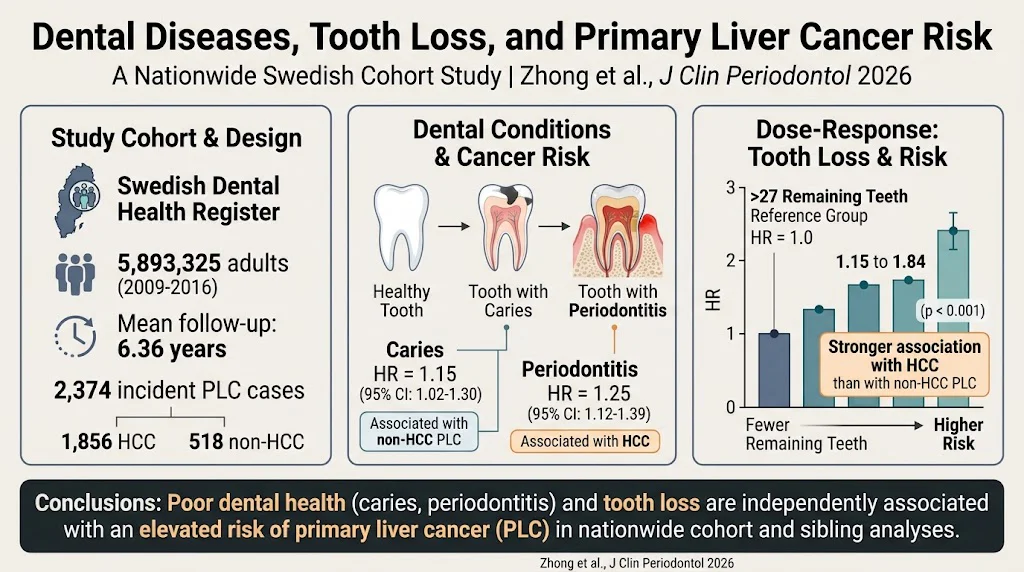
During follow-up, 2,374 PLC cases were identified, including 1,856 HCC and 518 non-HCC PLC cases. Key findings are summarized as follows:
Dental Caries: Participants diagnosed with caries had a 15% higher risk of PLC (HR 1.15, 95% CI 1.02–1.30). Subtype analyses indicated this association was primarily driven by non-HCC PLC.
Periodontitis: Periodontitis was associated with a 25% increased risk of PLC (HR 1.25, 95% CI 1.12–1.39). This effect was stronger for HCC, underscoring a potential role of chronic gum inflammation in hepatocarcinogenesis.
Tooth Loss: A clear dose-response pattern was observed: fewer remaining teeth correlated with progressively elevated PLC risk (HRs ranging 1.15–1.84 compared with those having >27 teeth). Tooth loss showed a stronger association with HCC compared to non-HCC PLC, suggesting tooth loss as a surrogate marker for chronic oral inflammatory burden may be implicated in HCC etiology.
Sibling Analyses: Associations between dental diseases, tooth loss, and PLC risk persisted after adjusting for shared familial factors, supporting the robustness and independence of these findings.
Sensitivity and subgroup analyses confirmed the consistency of the results across demographic strata.
Expert Commentary
This study robustly supports an epidemiological link between poor oral health and increased liver cancer risk, extending the scope of oral-systemic health connections. Potential biological mechanisms include chronic oral infection-driven systemic inflammation, bacterial translocation facilitating endotoxemia, immune modulation, and altered liver microenvironment promoting carcinogenesis. Periodontitis-associated pathogens such as Porphyromonas gingivalis may contribute to hepatic injury and oncogenesis. The distinct associations for caries and periodontitis with PLC subtypes provide novel insights, suggesting differing pathophysiological pathways.
Limitations include observational design precluding definitive causality, potential residual confounding despite sibling adjustments, and lack of detailed data on established liver cancer risk factors such as viral hepatitis status or alcohol use. Nevertheless, the large population size, comprehensive national registers, and sibling design enhance validity and generalizability, particularly to populations with similar healthcare systems.
Future research should explore molecular and microbiome mechanisms underlying these associations and assess whether improved dental care can reduce liver cancer incidence.
Conclusion
This nationwide Swedish cohort study highlights that diagnosed dental diseases, especially caries and periodontitis, alongside tooth loss, are associated with an elevated risk of primary liver cancer. The associations differ by PLC subtype, reflecting unique etiological pathways. These findings underscore the importance of maintaining good oral health as a potentially modifiable risk factor in liver cancer prevention strategies. Clinicians should be aware of the systemic implications of oral diseases and encourage multidisciplinary approaches integrating dental and general healthcare for holistic patient management.
Funding and Trial Registration
The original study was conducted using Swedish national registers; specific funding sources were not detailed in the abstract. No clinical trial registration was reported.
References
Zhong Q, Ruan Z, Yin L, Adami HO, Ye W. Diagnosed Dental Diseases, Tooth Loss and the Risk of Primary Liver Cancer in a Nationwide Swedish Cohort. J Clin Periodontol. 2026 Oct 25. PMID: 42927980.
Michaud DS. Periodontal disease, tooth loss, and cancer risk. Epidemiol Rev. 2008;30:125-132.
Abnet CC, Qiao YL, Mark SD, et al. Tooth loss is associated with increased risk of stomach cancer and esophageal squamous cell carcinoma in a rural Chinese population. Cancer Epidemiol Biomarkers Prev. 2001;10(12):1126-1130.
Scannapieco FA, Cantos A. Oral inflammation and infection, and chronic medical diseases: implications for the elderly. Periodontol 2000. 2016;72(1):153-175.
Yoneda M, Naka S, Fujii H. Oral bacteria and cancer: From carcinogenesis to prevention. Cancers (Basel). 2021;13(10):2435.