Highlight
Alginate dietary fiber promotes recovery from colitis by enhancing mucosal healing via a microbiota-dependent taurine pathway.
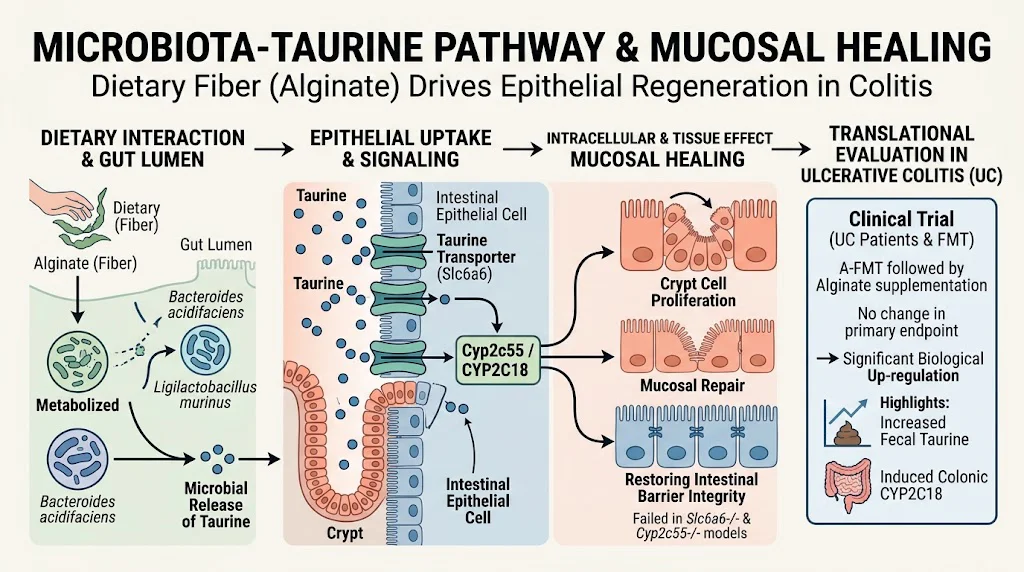
Alginate enriches taurine-releasing bacteria, increasing intestinal taurine and stimulating epithelial regeneration mediated by CYP enzymes.
Gene knockout murine models (Slc6a6-/-, Cyp2c55-/-) confirm taurine uptake and CYP2C enzyme involvement in therapeutic effects.
A randomized clinical trial in ulcerative colitis showed biological markers consistent with mechanistic pathways, although the primary endpoint was not met.
Study Background
Ulcerative colitis (UC) is a chronic inflammatory bowel disease characterized by epithelial barrier disruption and impaired mucosal healing, precipitating symptomatic flares and long-term complications. The gut microbiota and dietary factors, including fibers, play critical roles in modulating intestinal homeostasis and inflammation. While dietary fibers are known to alter host-microbiota interactions, the mechanistic pathways by which specific fibers enhance epithelial repair remain incompletely understood. Alginate, a polysaccharide derived from brown algae, is of interest for its potential to influence gut microbial composition and metabolites conducive to mucosal recovery. This study investigates how alginate affects colitis resolution, focusing on microbiota-dependent mechanisms involving taurine and epithelial cytochrome P450 enzymes, with translational evaluation in UC patients.
Study Design
In this comprehensive investigation, the primary preclinical model employed dextran sodium sulfate (DSS)-induced colitis in mice to simulate ulcerative inflammation. Multiple dietary fibers were screened to determine impact on colitis outcomes, focusing particularly on alginate. Key endpoints included survival, inflammatory markers, barrier integrity assessed via histology and epithelial cell proliferation, and transcriptomic analyses.
Microbiota dependence was interrogated by administering broad-spectrum antibiotics to disrupt gut flora and by supplementation with specific taurine-producing bacterial strains such as Bacteroides acidifaciens and Ligilactobacillus murinus. Metabolomic profiling utilized capillary electrophoresis–time-of-flight mass spectrometry (CE-TOFMS) to quantify luminal metabolites. Intestinal epithelial programs were evaluated through RNA sequencing and injury assays in colonic organoids.
Further mechanistic validation involved genetically engineered mice lacking Slc6a6, the taurine transporter, and Cyp2c55, a cytochrome P450 enzyme, to assess the necessity of taurine uptake and CYP enzymatic activity for the therapeutic effect of alginate. Finally, translational relevance was assessed in a randomized, placebo-controlled clinical trial in UC patients. Participants underwent antibiotic-primed fecal microbiota transplantation (A-FMT) followed by oral alginate supplementation or placebo. Outcomes measured included clinical remission, histological scores, fecal taurine, and colonic expression of CYP2C18, the human homolog relevant to the pathway.
Key Findings
Preclinically, alginate supplementation significantly enhanced recovery from DSS-induced colitis. Mice fed alginate demonstrated reduced inflammatory infiltrates, restoration of tight junction integrity, and increased crypt epithelial cell proliferation compared to controls. Alginate altered the gut microbial community by enriching taurine-releasing species, specifically Bacteroides acidifaciens and Ligilactobacillus murinus. This concomitantly elevated intestinal taurine concentrations, a metabolite implicated in epithelial restitution and anti-inflammatory signaling.
Disruption of gut microbiota with antibiotics abolished alginate’s beneficial effects, indicating a clear microbiota-dependent mechanism. Moreover, in Slc6a6-/- mice unable to transport taurine effectively, alginate failed to confer protection, directly implicating taurine as indispensable. Alginate and taurine administration induced expression of a cytochrome P450 enzyme, Cyp2c55, within intestinal epithelial cells. Loss of Cyp2c55 in knockout mice or organoid models negated alginate’s protective effects, underscoring the critical role of this enzyme in mediating epithelial repair signaling in response to taurine.
Translationally, the clinical trial did not reach its primary endpoint of clinical remission improvement following alginate supplementation. However, secondary biological analyses revealed increased fecal taurine levels and upregulated colonic CYP2C18 expression in treated patients, paralleling preclinical findings. These biomarker shifts suggest engagement of the microbiota-taurine-CYP axis in human UC, despite the absence of overt clinical benefit in this trial context.
Safety data indicated alginate was well tolerated with no significant adverse events, supporting feasibility for further clinical exploration.
Expert Commentary
The study elegantly delineates a novel pathway linking a specific dietary fiber—alginate—to mucosal healing in colitis via modulation of gut microbiota that augment taurine production. Taurine uptake and its downstream metabolism by cytochrome P450 enzymes in epithelial cells appear critical for re-epithelialization and barrier restoration. This mechanistic insight advances understanding of how diet-microbiome interactions can be leveraged therapeutically in inflammatory bowel disease.
Although the clinical trial did not achieve its primary efficacy endpoint, biologic evidence of pathway activation establishes proof-of-concept. Potential reasons for the clinical trial’s limitations include the complexity of human disease heterogeneity, trial design, and the preparative use of antibiotics that might impact microbial dynamics variably in patients. Larger, longer-duration studies or combination therapies targeting this pathway may be necessary to translate these promising mechanistic findings into improved clinical outcomes.
This work complements emerging research emphasizing metabolite-mediated crosstalk between microbiota and host epithelium, highlighting taurine as a metabolite of interest. Future studies might explore patient stratification based on microbiota composition or metabolic profiles to identify responders. Additionally, defining the full spectrum of CYP enzymes involved and their metabolic products could reveal novel therapeutic targets.
Conclusion
Alginate dietary fiber exerts beneficial effects on mucosal healing in preclinical colitis through a microbiota-dependent taurine pathway that activates epithelial cytochrome P450 enzymes critical for barrier repair. Translational investigation in UC patients indicates biological engagement of this pathway, though clinical efficacy remains to be conclusively demonstrated. These findings open avenues to develop microbiota-targeted nutritional or pharmacological interventions aimed at enhancing mucosal regeneration in inflammatory bowel disease.
Continued exploration of the microbiota-taurine-epithelial signaling axis holds promise for novel, mechanism-guided treatments to address unmet needs in UC management, emphasizing integration of diet, microbiome, and host metabolism.
Funding and Clinical Trial Registry
This research was supported by institutional and national funding sources as detailed in the original publication. The clinical trial was registered with identifiers jRCTs031200103 (https://jrct.mhlw.go.jp/) registered September 1, 2020, and UMIN000041968 (https://www.umin.ac.jp/ctr/index.htm) registered October 1, 2020.
References
Odakura R, Seki N, Nomura K, et al. Microbiota-Taurine Pathway Links Dietary Fiber to Mucosal Healing. Gastroenterology. 2026 Oct 21; PMID: 42906827.
Gkouskou KK, Alexandraki V, Dimitriadi D, et al. The gut microbiota and inflammatory bowel disease: clinical observations and therapeutic implications. Gut Microbes. 2020;11(2):1–15.
Parada Venegas D, De la Fuente MK, Landskron G, et al. Short Chain Fatty Acids (SCFAs)–Mediated Gut Epithelial and Immune Regulation and Its Relevance for Inflammatory Bowel Diseases. Front Immunol. 2019;10:277.
Kim YS, Milner JA. Dietary modulation of human colonic metabolism: the influence of fiber type on formation of short-chain fatty acids. Asia Pac J Clin Nutr. 2007;16 Suppl 1:365–370.