Levothyroxine Treatment and Cardiometabolic Biomarkers in Older Adults with Subclinical Hypothyroidism: A Comprehensive Review
Highlights
- Levothyroxine therapy shows minimal overall effect on lipid and cardiometabolic biomarkers in older adults with subclinical hypothyroidism (SCH).
- Potential beneficial lipid and lipoprotein profile changes were observed in individuals with baseline TSH ≥10 mIU/L, warranting further investigation.
- Evidence from randomized controlled trials and meta-analyses indicates levothyroxine’s lipid-lowering effects are more pronounced in younger or milder SCH populations.
- Adjunctive lifestyle interventions like Baduanjin exercise may complement pharmacotherapy by improving lipids and reducing TSH in elderly SCH patients.
Background
Subclinical hypothyroidism (SCH), defined by elevated thyroid-stimulating hormone (TSH) with normal circulating thyroid hormones, is prevalent in older adults, affecting up to 10-15% of this population. It is frequently associated with dyslipidemia and increased cardiovascular risk, partly due to altered lipid metabolism mediated by thyroid hormone effects on hepatic LDL receptor expression and lipoprotein turnover. Because overt hypothyroidism unequivocally increases cardiovascular risk and responds to levothyroxine therapy, the role of levothyroxine in SCH remains an active area of investigation, especially in older adults where the benefit-risk ratio is not well-established.
Cardiometabolic biomarkers, including detailed lipid panels and metabolomic signatures, are sensitive indicators of cardiovascular risk and may help detect subtle treatment responses beyond traditional clinical endpoints like cardiovascular events.
Key Content
Levothyroxine Effects on Cardiometabolic Biomarkers in Older Adults with SCH
The landmark 2026 post-hoc analysis by Ao et al. evaluated cardiometabolic biomarker responses to levothyroxine in 286 adults aged ≥65 years with SCH, using data from two double-blind randomized controlled trials (RCTs). The study assessed seven core lipid measures (ApoB, total cholesterol, non-HDL cholesterol, remnant cholesterol, LDL cholesterol, HDL cholesterol, triglycerides) alongside 167 metabolomic markers by nuclear magnetic resonance spectroscopy.
Overall, levothyroxine produced no statistically significant improvement in ApoB (-0.03 g/L), total cholesterol (-0.17 mmol/L), non-HDL-C (-0.15 mmol/L), remnant cholesterol (-0.09 mmol/L), LDL-C (-0.07 mmol/L), or triglycerides (-0.07 mmol/L) at 12 months. Notably, subgroup analysis of participants with baseline TSH levels ≥10 mIU/L (n=27) revealed nominally significant favorable changes in almost all lipid parameters except HDL-C, and improvements in Apolipoprotein B-containing lipoproteins, very-low-density lipoprotein (VLDL) size, and fatty acid profiles, although these did not survive correction for multiple testing. This suggests a possible threshold effect of TSH elevation whereby levothyroxine is more effective in correcting dyslipidemia in more pronounced SCH.
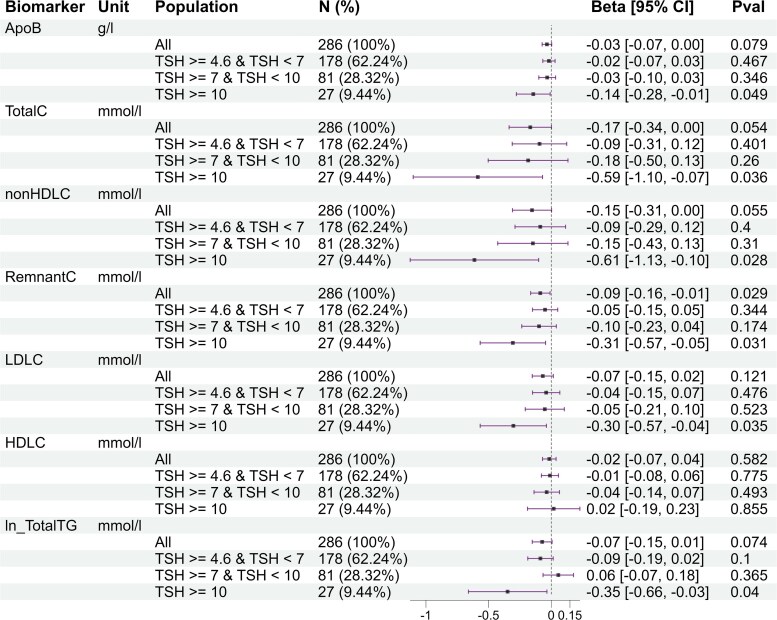
The effects of levothyroxine treatment on lipid-related biomarkers for all included participants and TSH-stratified groups. This figure shows the estimated effects (β and 95% confidence interval) based on the primary ANCOVA models for the corresponding metabolic biomarker in different population groups. The “Pval” column indicates the P-values of tests for the estimated associations in the corresponding population group.
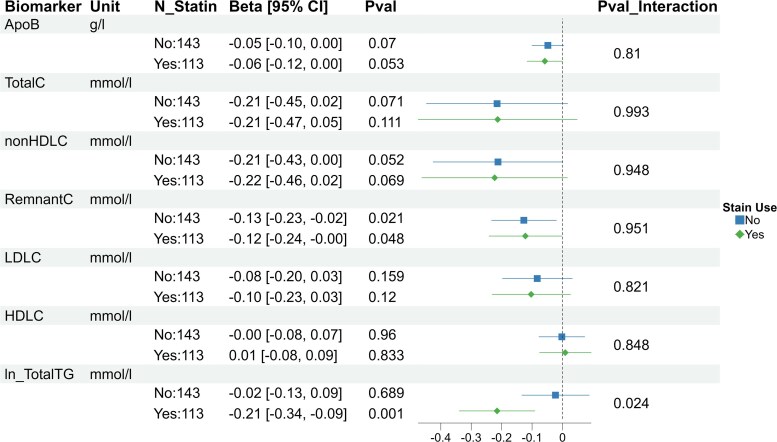
The effects of levothyroxine therapy on metabolic biomarkers in a subgroup stratified by baseline statin use. The “N_Statin” column shows the number of participants without (No) and with (Yes) taking statins at baseline. The “Beta [95% CI]” column indicates the estimated β and 95% confidence interval in subgroups not taking statins and those taking statins at baseline, respectively. The “Pval” column indicates the P-values of tests for the estimated associations in subgroups not taking statins and those taking statins at baseline, respectively. The “Pval_Interaction” column shows the results of the interaction tests between levothyroxine treatment and baseline statin use.
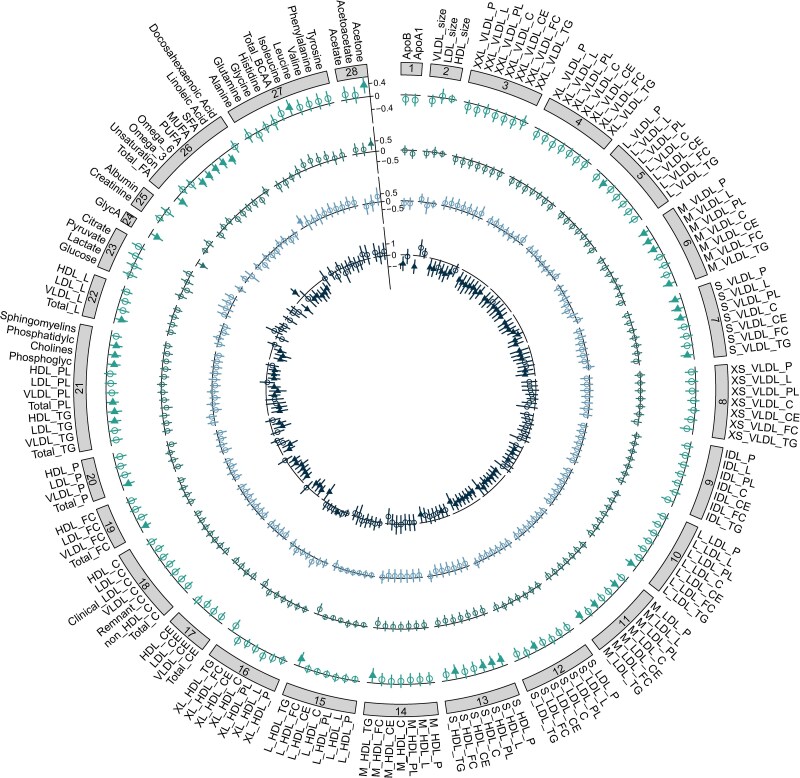
The effects of levothyroxine therapy on standardized metabolomic measurements for all included participants and TSH-stratified groups. From outer to inner circles, each circle represents the estimated β and 95% confidence interval based on the ANCOVA models for all participants (n = 228), participants with baseline TSH ≥ 4.6 and TSH < 7 mIU/L (n = 143), participants with baseline TSH ≥ 7 and TSH < 10 mIU/L (n = 62), participants with baseline TSH ≥ 10 mIU/L (n = 23), respectively. Hollow dots, solid triangles, and solid diamonds indicate estimates with P > .05, estimates with P < .05, and estimates with P < 1.79e-3, respectively. Numbers indicate groups: (1) Apolipoproteins; (2) Lipoprotein particle sizes; (3) Extremely large VLDL; (4) Very large VLDL; (5) Large VLDL; (6) Medium VLDL; (7) Small VLDL; (8) Very small VLDL; (9) IDL; (10) Large LDL; (11) Medium LDL; (12) Small LDL; (13) Small HDL; (14) Medium HDL; (15) Large HDL; (16) Very large HDL; (17) Cholesteryl esters; (18) Cholesterol; (19) Free cholesterol; (20) Lipoprotein particle concentrations; (21) Glycerides and phospholipids. (22) Total lipids; (23) Glycolysis-related metabolites; (24) Inflammation; (25) Fluid balance; (26) Fatty acids; (27) Amino acids; (28) Ketone bodies.
Historical and Comparative Evidence
Earlier RCTs and meta-analyses provide a mixed but informative landscape:
- Meta-analysis by Rodondi et al. (2017) found that levothyroxine treatment in SCH reduced TSH by 66% and total and LDL cholesterol by approximately 9% and 14%, respectively, with other lipids unaffected. This supports modest lipid benefits, particularly LDL-C reduction, in treated SCH patients.
- Randomized trials in younger or middle-aged adults (e.g., the Basel Thyroid Study, 2001; Whickham cohort) observed significant decreases in LDL-C and total cholesterol and improvements in cardiovascular symptoms after levothyroxine replacement, especially notable when TSH levels were >8-10 mIU/L.
- The TRUST trial and related investigations in older adults reported no significant reduction in cardiovascular outcomes or lipid biomarkers with levothyroxine over 12 months, corroborating the findings of limited lipid modification in this age group with mild TSH elevation.
- Studies comparing levothyroxine versus statin therapy suggest that while statins substantially improve lipid profiles and intima-media thickness (IMT) in SCH, levothyroxine’s effects on lipids may be less robust, but levothyroxine can reduce carotid IMT possibly via non-lipid mechanisms.
Lifestyle and Adjunctive Therapies
A 2025 RCT on the incorporation of Baduanjin exercise in elderly women with mild SCH and mild cognitive impairment demonstrated greater improvements in lipid profiles, blood pressure, and TSH levels compared to levothyroxine alone, indicating that physical activity and lifestyle modifications might synergize with thyroid hormone therapy to optimize cardiometabolic health.
Other Endpoints and Organ Systems
Research on levothyroxine’s effects on non-lipid cardiometabolic parameters such as endothelial function, insulin resistance, oxidative stress, and renal function in SCH patients exhibits heterogeneous results. For example, L-thyroxine therapy reduced oxidative stress markers and proteinuria in diabetic nephropathy patients with SCH, implying renoprotective potential.
Expert Commentary
The nuanced findings from Ao et al. and prior studies underscore the complexity of managing SCH in older adults. While levothyroxine effectively normalizes TSH, its ability to improve lipid biomarker profiles diminishes with advancing age and milder TSH elevations. This may relate to age-associated changes in thyroid hormone sensitivity, comorbidities confounding lipid metabolism, or insensitivity of traditional lipid measures in capturing therapy effects.
The subgroup trends indicating lipid improvement in patients with TSH ≥10 mIU/L align with existing guideline recommendations that suggest consideration of treatment above this TSH threshold due to higher risk of progression and complications. However, the small sample size within this subgroup limits definitive conclusions, and multiple-testing correction reduces statistical confidence.
Moreover, levothyroxine’s limited impact on HDL-C and triglycerides is consonant with its primary effect on LDL receptor-mediated LDL clearance rather than comprehensive lipid modulation.
The inconsistency in lipid response in SCH patients might also stem from variable presence of thyroid autoimmunity, adiposity, and genetic predispositions influencing lipoprotein(a) and other atherogenic particles.
Clinicians should weigh the potential modest lipid benefits against risks of overtreatment (e.g., atrial fibrillation, bone loss) particularly in the elderly. Personalized treatment based on TSH levels, symptomatology, and cardiovascular risk profile is prudent.
Lastly, emerging evidence favoring lifestyle interventions advocates integrating non-pharmacologic approaches alongside or in lieu of levothyroxine in select elderly patients.
Conclusion
Levothyroxine treatment in older adults with subclinical hypothyroidism does not significantly alter cardiometabolic biomarkers at a population level, although patients with higher baseline TSH (≥10 mIU/L) may derive modest lipid profile improvements. These findings emphasize a cautious, individualized approach to treatment in older SCH patients, prioritizing symptom relief and cardiovascular risk factors beyond lipid metrics alone. Future large-scale, long-duration RCTs integrating metabolomic biomarkers and stratifying by TSH severity are warranted to refine therapeutic guidelines and elucidate mechanistic pathways of levothyroxine on cardiometabolic health.
References
- Ao L, Noordam R, Trompet S, et al. Levothyroxine treatment response of cardiometabolic biomarkers in older adults with subclinical hypothyroidism. J Clin Endocrinol Metab. 2026;111(9):2445-2455. PMID:41965091
- Rodondi N, den Elzen WP, Bauer DC, et al. Subclinical hypothyroidism and the risk of coronary heart disease and mortality. J Clin Endocrinol Metab. 2010;95(4):1554-1563. PMID:20130033
- Razvi S, Weaver JU, Butler TJ, Pearce SH. Levothyroxine treatment of subclinical hypothyroidism and myocardial function (randomized controlled trial). J Clin Endocrinol Metab. 2012;97(7):2466-2475. PMID:22551843
- Van Vliet NA, Batterham RL, van Heemst D, Mooijaart SP. Cardiovascular risk and treatment of subclinical hypothyroidism in the elderly: reviewing the evidence. Curr Opin Endocrinol Diabetes Obes. 2015;22(5):395-402. PMID:26277555
- Chen YJ, Yu B, Miao Y, et al. Effects of levothyroxine on lipid profiles and carotid artery intima-media thickness in subclinical hypothyroidism: A meta-analysis of randomized controlled trials. Lipids Health Dis. 2019;18(1):131. PMID:31242342
- Zhou XY, Hu JM, Jiang H, et al. Effects of Baduanjin exercise on lipid profile and thyroid function in elderly women with subclinical hypothyroidism: A randomized controlled trial. Geriatr Nurs. 2025;64:103434. PMID:40582060
This article was created using several editorial tools, including AI, as part of the process. Human editors reviewed this content before publication.