Integrative Muscle-Adipose Score (IMAS): Enhancing Sex-Sensitive Prognostication After Liver Transplantation
Highlight
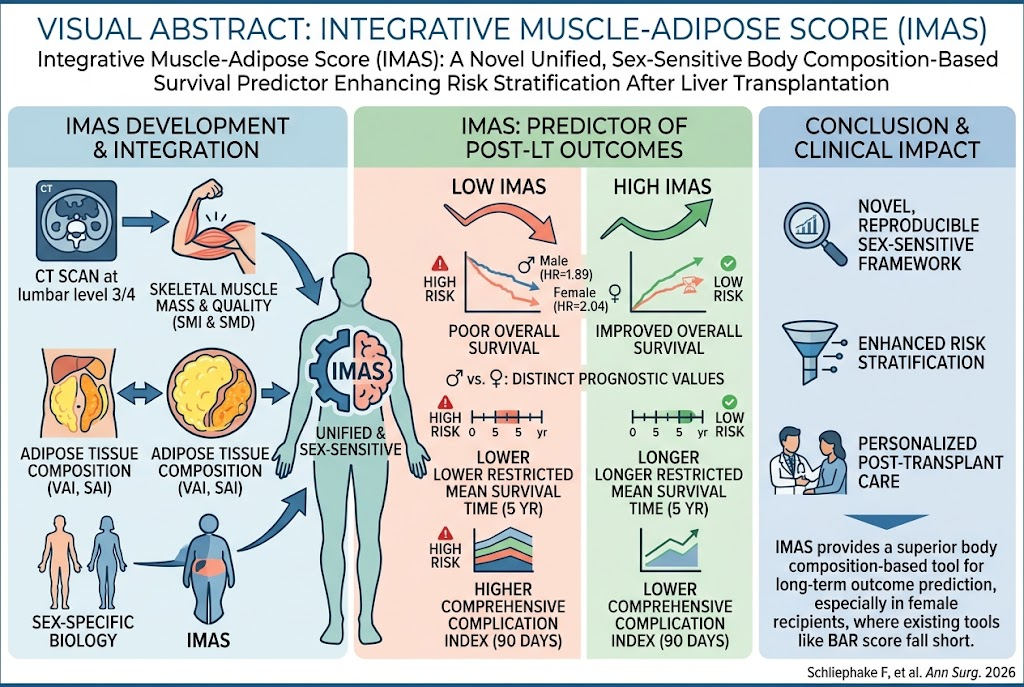
The Integrative Muscle-Adipose Score (IMAS) offers a novel, unified body composition-based metric that integrates muscle mass, muscle quality, and adipose tissue metrics to predict long-term survival after liver transplantation (LT). This sex-sensitive tool significantly stratifies outcomes in both male and female LT recipients across two European centers. IMAS outperforms standard scores, such as the BAR score, particularly in females, highlighting its potential to address sex disparities in post-transplant prognosis.
Study Background
Liver transplantation remains the definitive treatment for end-stage liver disease and selected hepatic malignancies, but postoperative survival varies widely. Nutritional status and metabolic reserves, commonly reflected by body composition (BC), are increasingly recognized as key factors influencing post-transplant outcomes. Traditional prognostic models often neglect the nuanced role of muscle and fat tissue composition and their sex-specific implications, potentially limiting their predictive accuracy.
Despite advances, robust, validated prognostic tools incorporating detailed BC remain scarce. Moreover, growing evidence points to notable sex differences in post-LT outcomes, possibly stemming from physiological variations in muscle and adipose tissue distribution and function. Hence, a unified, sex-sensitive BC-based tool could enhance risk stratification, guiding clinical management and personalized care.
Study Design and Methods
This bicentric European cohort study included 695 adult patients who underwent orthotopic liver transplantation at Charité-Berlin (n=412, 2010-2020; discovery cohort) and University Hospital Aachen (n=283, 2010-2018; validation cohort). Body composition was quantitatively analyzed using computed tomography (CT) scans at the lumbar vertebrae L3/L4 level, a standard anatomical site for BC assessment. Parameters measured included muscle mass, muscle quality (e.g., radiodensity), and adipose tissue compartments.
The investigators developed the Integrative Muscle-Adipose Score (IMAS) by integrating these muscle and fat-related parameters into a unified metric. Statistical analyses evaluated IMAS’s correlation with overall survival and postoperative morbidity, with a specific focus on sex-specific cutoff values. The performance of IMAS was compared to the established BAR (Balance of Risk) score, with survival endpoints censored at up to five years post-transplant.
Key Findings and Results
Median follow-up was 54 months for the discovery cohort and 47 months for the validation cohort. Females comprised 31% of the total study population. IMAS quartiles robustly stratified overall survival in both cohorts (p<0.01), affirming its reproducibility across centers.
Notably, low IMAS was independently prognostic of poorer overall survival in multivariate Cox regression analyses, taking into account established clinical covariates. Sex-specific IMAS cutoffs demonstrated strong independent predictive value for mortality in both males (hazard ratio [HR]=1.89, 95% confidence interval [CI]: 1.37–2.70, p=0.001) and females (HR=2.04, 95% CI: 1.17–3.55, p=0.012). In contrast, the BAR score failed to predict long-term survival accurately in female recipients, underscoring IMAS’s advantage.
Patients with low IMAS exhibited a significantly shorter restricted mean survival time at five years compared to those with high IMAS (males: 43.2 vs. 50.16 months, p<0.001; females: 44.2 vs. 51.71 months, p=0.013). Furthermore, low IMAS was associated with higher Comprehensive Complication Index scores within 90 days post-LT, indicating greater early postoperative morbidity.
Expert Commentary
This study elegantly addresses the clinical need for improved long-term prognostic tools after liver transplantation, integrating muscle and adipose tissue metrics into a single, sex-sensitive score. By leveraging routinely obtained CT scans, IMAS provides a practical and reproducible approach for personalized risk stratification.
Sex differences in BC and metabolism profoundly affect post-transplant recovery and survival. The failure of established models like BAR to predict female outcomes corroborates previous reports and highlights potential bias in generic scores. IMAS’s sex-specific cutoffs enhance its clinical accuracy and may guide tailored prehabilitative interventions, nutritional optimization, and immunosuppressive regimens.
Limitations include retrospective design and potential variability in CT image acquisition or interpretation. Nonetheless, the robust validation in an independent cohort strengthens generalizability. Future prospective studies and mechanistic explorations of how muscle-adipose interplay influences transplant physiology are warranted.
Conclusion
The Integrative Muscle-Adipose Score (IMAS) emerges as a novel, unified, and sex-sensitive prognostic tool that significantly enhances long-term survival prediction and postoperative morbidity assessment after liver transplantation. Its implementation has the potential to refine clinical decision-making and optimize individualized patient management, ultimately improving outcomes across sexes. Integration of IMAS into transplant evaluation protocols merits further prospective investigation.
Funding and Trials
The original study funding sources were not detailed in the abstract. The study did not cite clinical trial registration numbers.
References
1. Schliephake F, Lurje I, Bednarsch J, et al. Integrative Muscle-Adipose Score (IMAS): A Novel Unified, Sex-Sensitive Body Composition-Based Survival Predictor Enhancing Risk Stratification After Liver Transplantation. Ann Surg. 2026 Sep 2. PMID: 42681570.
2. Montano-Loza AJ. Muscle wasting in cirrhosis: impact on outcomes and potential therapies. J Hepatol. 2014;60(6):1327-1339.
3. Sinclair M, Gow PJ, Grossmann M, Angus PW. Review article: sarcopenia in cirrhosis—aetiology, implications and potential therapeutic interventions. Aliment Pharmacol Ther. 2016;43(7):765-777.
4. Nault JC, Villanueva A, Llovet JM. Personalized management of hepatocellular carcinoma: a new era of clinical and translational research. Hepatology. 2020;72(4):1390-1405.
This article was created using several editorial tools, including AI, as part of the process. Human editors reviewed this content before publication.