Highlight
This prospective cohort study developed and validated a straightforward endoscopic classification system to assess the integrity of fundoplication after antireflux surgery. Three critical endoscopic parameters—intrathoracic valve position, valve disruption, and visible hiatal opening—were significantly associated with pathologic gastroesophageal reflux disease (GERD). The classification demonstrated high diagnostic accuracy with an area under the curve (AUC) near 0.87 in both development and validation cohorts, predicting reflux severity and symptoms effectively.
Clinical, manometric, and reflux monitoring metrics worsened stepwise with increasing numbers of impaired mechanisms, emphasizing the classification’s role in stratifying surgical outcomes and guiding postoperative management.
Study Background
Gastroesophageal reflux disease is often treated surgically with fundoplication to restore the function of the gastroesophageal junction. Postoperative assessment of the antireflux barrier integrity is crucial for identifying surgical failures that contribute to recurrent or persistent reflux symptoms. Endoscopy remains the primary diagnostic tool for visualizing the gastroesophageal valve after antireflux surgery; however, existing endoscopic classifications are complex and have not been validated against objective, pathophysiologic reflux parameters.
There is a clinical need for a simple, reproducible, and validated tool that endoscopists can reliably use to evaluate fundoplication integrity and correlate findings with functional reflux outcomes to tailor patient management effectively.
Study Design
This was a single-center, prospective two-phase cohort study conducted between 2018 and 2026. Adult patients who underwent antireflux surgery and subsequently underwent endoscopy, high-resolution manometry (HRM), and reflux monitoring were enrolled. An initial development cohort (2018–2024) was used to identify endoscopic parameters associated with objective pathological reflux defined by the Lyon 2.0 criteria. Endoscopic video clips obtained in retroflexion were reviewed blindly without knowledge of functional test results.
Parameters significantly associated with pathologic reflux were incorporated into a fundoplication integrity classification system based on the number of impaired mechanisms (0 to 3). A second phase prospectively validated this classification in a separate patient cohort (2024–2026).
Key Findings
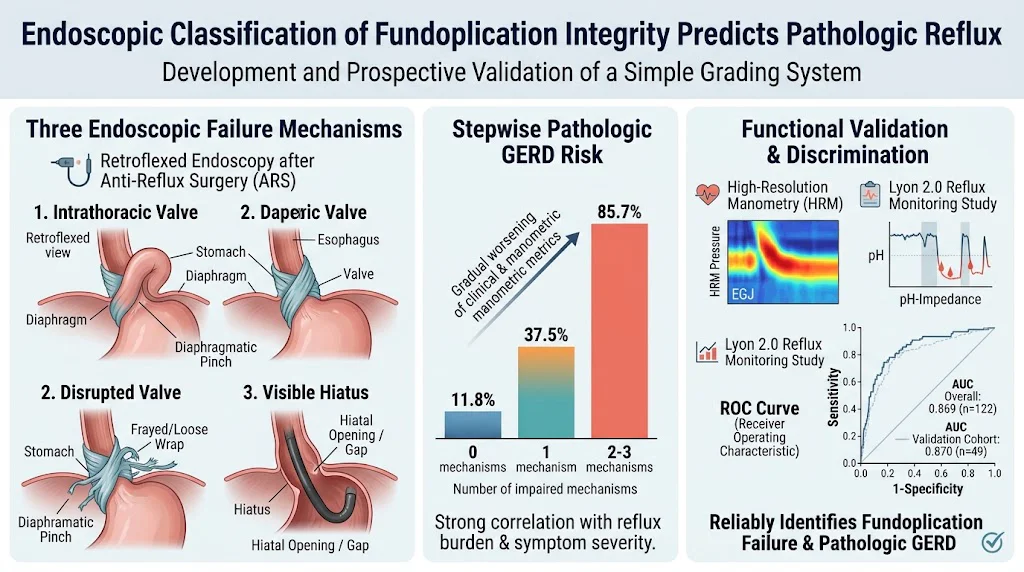
Among 122 total patients (73 development, 49 validation), three endoscopic parameters correlated with pathologic GERD:
Intrathoracic displacement of the gastroesophageal valve, indicating herniation above the diaphragm.
Disruption or discontinuity of the valve structure.
Visualization of a visibly open hiatus, suggesting hiatal defect.
The classification stratified patients into groups based on how many of these mechanisms were impaired (zero to three). Outcome measures, including GERD symptoms, HRM parameters, and reflux burden measured by pH monitoring, showed a graded deterioration aligned with the number of impaired mechanisms.
Pathologic GERD prevalence increased significantly across groups: 11.8% in patients with zero impaired mechanisms, 37.5% with one or two impaired mechanisms, and 85.7% with all three impaired. The classification showed excellent discriminative power with area under the curve values of 0.860 in the development cohort and 0.870 in the validation cohort. Overall diagnostic performance was robust (AUC 0.869).
The proposed classification thus enables a simple and objective determination of fundoplication integrity and predicts reflux pathology reliably in the postoperative setting.
Expert Commentary
This study addresses an important gap in the clinical assessment of antireflux surgery durability — the lack of a validated, practical endoscopic classification that correlates with meaningful reflux outcomes. By simplifying endoscopic evaluation to three easily recognizable parameters, this work enhances reproducibility and clinical utility compared to more complex prior systems.
The strong correlation with objective pathophysiologic data supports the biological plausibility that anatomical disruption and herniation contribute to reflux recurrence post-surgery. Additionally, the validation in an independent cohort reinforces the generalizability of the findings.
Limitations include the single-center design and potential operator dependency inherent to endoscopic assessment; however, blinded video review mitigates bias. Future multicenter studies could extend validation and assess interobserver reliability.
Conclusion
The introduction of a simple, validated endoscopic classification based on valve location, integrity, and hiatal opening provides clinicians with a reliable tool to identify fundoplication failure. This classification correlates well with clinical symptoms, HRM features, and reflux monitoring data, offering an evidence-based approach to guide postoperative evaluation and management of patients with previous antireflux surgery. Widespread adoption could streamline care algorithms and improve long-term outcomes by facilitating timely interventions for fundoplication failure.
Funding and ClinicalTrials.gov
The study details did not specify funding sources or ClinicalTrials.gov registration.
References
Siboni S, De Maron R, Lovece A, et al. Endoscopic Classification of Fundoplication Integrity Predicts Pathologic Reflux: Development and Prospective Validation. Annals of Surgery. 2026 Oct 29. PMID: 42951928.
Katz PO, Gerson LB, Vela MF. Guidelines for the diagnosis and management of gastroesophageal reflux disease. Am J Gastroenterol. 2013 Mar;108(3):308-28; quiz 329. doi: 10.1038/ajg.2013.2.
Lyon DT, et al. The Lyon Consensus on the diagnosis of GERD: clinical implications. Gut. 2018;67:1351-1362.