Integrating Pharmacists into Opioid Use Disorder Care: Feasibility and Acceptability in Primary Care Settings
Highlight
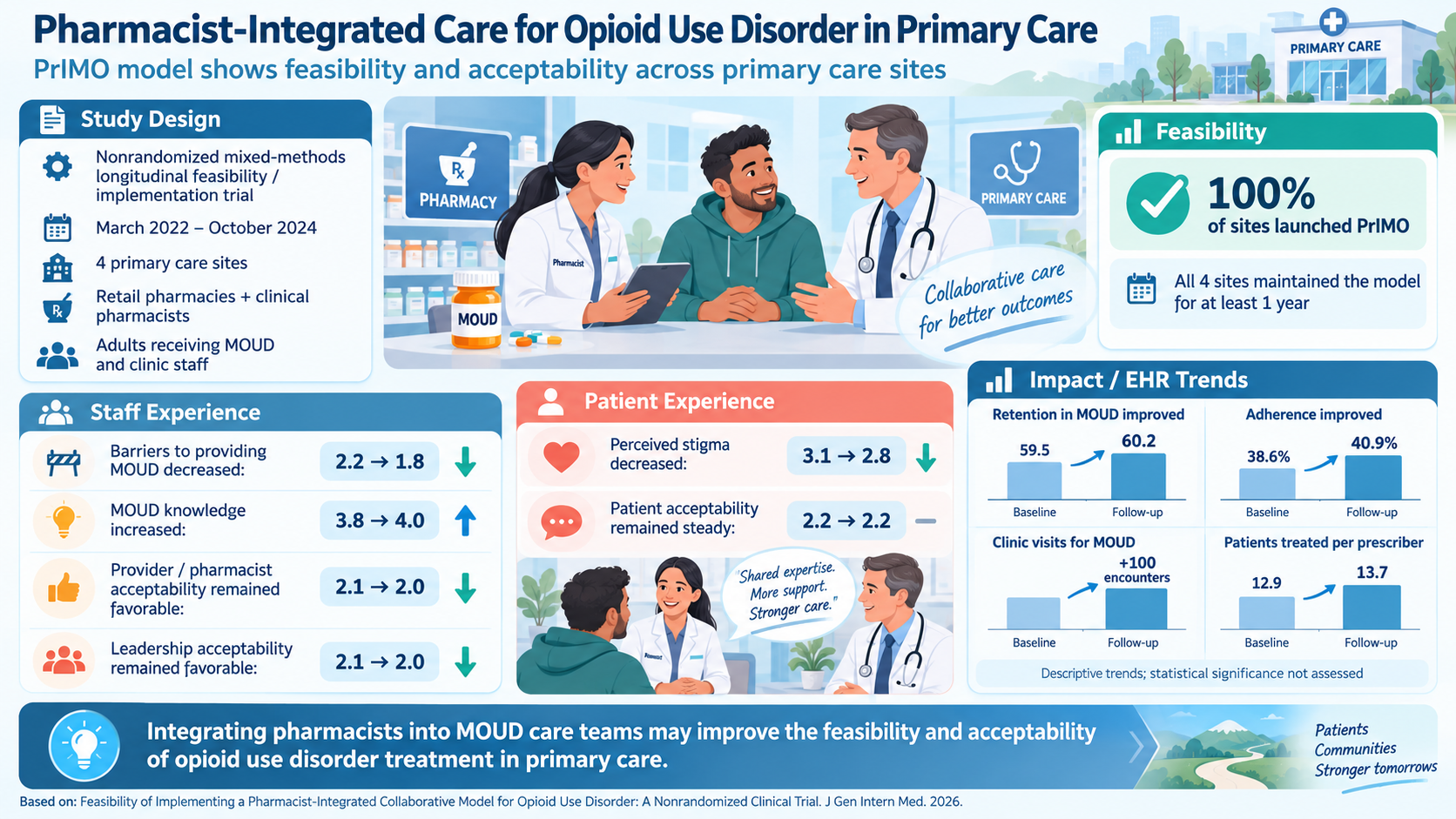
All four primary care sites successfully launched and maintained a pharmacist-integrated opioid use disorder care model over one year.
The intervention was associated with decreased perceived barriers and increased knowledge regarding medication for opioid use disorder (MOUD) among staff.
Patient-reported stigma related to opioid treatment decreased, with steady acceptability of the model sustained over time.
Electronic health records indicated trends toward improved patient retention, adherence, and clinic visit frequency for MOUD, suggesting positive clinical impact.
Study Background
Opioid use disorder (OUD) remains a significant public health crisis, characterized by high morbidity, mortality, and social burden. Effective treatment largely depends on access to medications for opioid use disorder (MOUD) such as buprenorphine and methadone, which substantially reduce overdose risk and improve recovery outcomes. However, barriers including stigma, limited provider capacity, and knowledge gaps impede optimal MOUD delivery, especially in primary care settings. Pharmacists, with their expertise in medication management, represent an underutilized resource to enhance interdisciplinary addiction treatment teams. This study investigates the feasibility and acceptability of embedding pharmacists within primary care teams to collaboratively deliver MOUD care in four clinic sites with integrated retail pharmacy services.
Study Design
This was a nonrandomized, mixed-methods longitudinal feasibility and implementation trial conducted between March 2022 and October 2024. The study sites comprised four primary care clinics with co-located retail pharmacies and clinical pharmacists who integrated into OUD care teams. Participants included clinic-employed adults (providers, pharmacists, and leadership) and adult patients receiving MOUD exposed to the pharmacist-integrated model for at least two weeks. Staff surveys were collected longitudinally over 15 months with 80.6% follow-up completion; patient surveys extended over 6 months with a 75.5% follow-up rate.
The primary intervention involved collaborative integration of pharmacists into MOUD treatment workflows, focused on enhancing medication expertise, adherence support, stigma reduction, and care coordination. Primary outcomes assessed feasibility (successful launch and sustainability), secondary outcomes included acceptability measured via surveys and qualitative interviews, and impact was evaluated using electronic health record (EHR) metrics such as MOUD retention, adherence, clinic visit frequency, and number of treated patients per prescriber.
Key Findings
All four sites launched the pharmacist-integrated model (PrIMO) successfully and sustained operations for at least one year, indicating high feasibility. Staff-reported barriers to MOUD provision decreased significantly, with mean scores improving from 2.2 (SD 0.8) pre-launch to 1.8 (SD 0.5) post-launch on a 1-4 scale. Concurrently, staff knowledge regarding MOUD increased from 3.8 (SD 0.4) to 4.0 (SD 0.5) on a 1-5 scale. Acceptability ratings from providers, pharmacists, and leadership remained stable with slight improvements, measured on a 0–3 scale.
From the patient perspective, reported stigma related to opioid treatment diminished modestly from 3.1 (SD 1.1) to 2.8 (SD 1.1) on a 1-5 scale, while acceptability of the integrated care approach remained steady (2.2, SD 0.4 on 0-3 scale).
EHR data showed trends toward clinical improvements: the proportion of days covered (PDC) for MOUD increased slightly (mean 59.5% to 60.2%), adherence rates improved from 38.6% to 40.9%, clinic visits for MOUD increased by 100 encounters, and the number of patients treated per prescriber rose modestly (mean 12.9 to 13.7). Statistical significance was not assessed for these outcomes, as the primary focus was on feasibility and acceptability rather than efficacy.
These findings suggest that pharmacist integration may reduce systemic barriers, enhance provider knowledge, and foster a supportive environment for patients receiving MOUD in primary care. The increased visit numbers and adherence also hint at potential improvements in treatment engagement.
Expert Commentary
This pragmatic trial addresses an important gap in addiction treatment delivery by operationalizing pharmacist involvement within existing primary care infrastructures. Pharmacists bring specialized medication knowledge that can alleviate prescriber burden, improve medication reconciliation, and monitor adherence — key components to improve MOUD outcomes. The study’s mixed methods design strengthens its real-world applicability by combining quantitative metrics with staff and patient perceptions.
Limitations include the nonrandomized design and absence of a control group, preventing causal inference regarding treatment outcomes. The modest sample size and single-health-system setting may limit generalizability. Moreover, efficacy endpoints lacked statistical testing, underscoring the pilot nature focused on feasibility rather than outcome effectiveness. Future randomized controlled trials could clarify the impact on retention, relapse, overdose rates, and cost-effectiveness.
Guidelines from the Substance Abuse and Mental Health Services Administration increasingly recognize the importance of multidisciplinary teams and the role of pharmacists in expanding access to MOUD. This study provides promising preliminary evidence supporting such integrated models.
Conclusion
Integrating pharmacists into opioid use disorder care teams in primary care settings is feasible and well accepted by providers, staff, and patients. This collaborative model potentially reduces treatment barriers, enhances knowledge, and may improve clinical engagement with MOUD. Although definitive outcome data require further rigorous evaluation, the findings support broader implementation and research on pharmacist-inclusive strategies to combat the opioid crisis.
Funding and Clinical Trial Registration
The trial was registered on ClinicalTrials.gov (NCT05310786) on March 14, 2022. Funding sources are not specified in the provided abstract.
References
1. Homsted F, Fiellin DA, Ghitza UE, et al. Feasibility of Implementing a Pharmacist-Integrated Collaborative Model for Opioid Use Disorder: A Nonrandomized Clinical Trial. Journal of General Internal Medicine. 2026 Oct 14. PMID: 42875616.
This article was created using several editorial tools, including AI, as part of the process. Human editors reviewed this content before publication.