We use cookies

Our website uses essential cookies and, with your consent, additional cookies to measure performance and improve our services. Cookie Policy.

You can change your choice at any time.

MMedXYNews
HomeVideos
MedXY AI/MedXY News/Section: Anesthesiology

Timing of Initiation of Methadone Take-Home Dosing: Evidence Synthesis and Clinical Implications for Opioid Use Disorder Management
MedXY Editorial Team•Sep 17, 2026•Anesthesiology
opioid use disordertreatment retentiontake-home dosingmethadone

Highlights

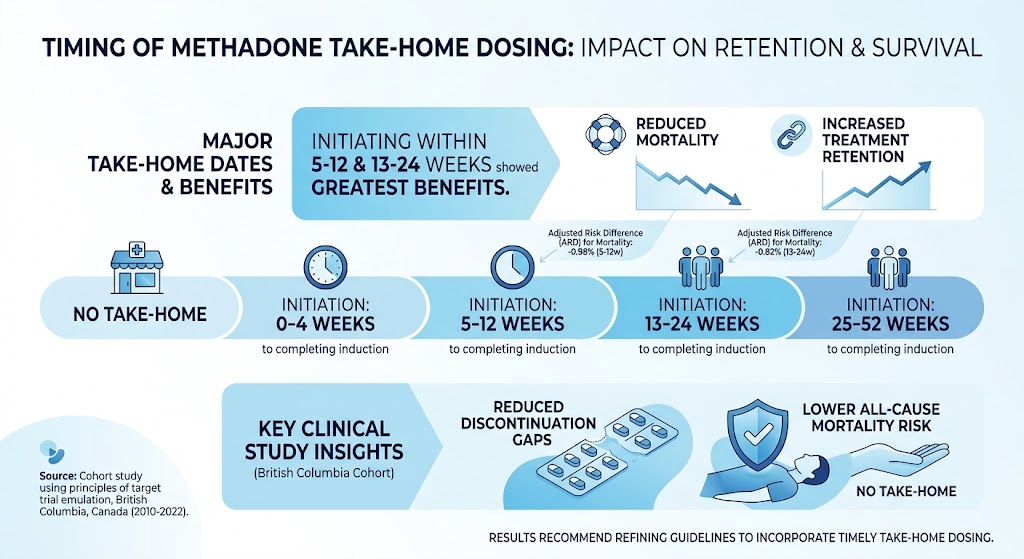
  • Initiation of take-home methadone dosing within 5 to 24 weeks after OAT induction significantly reduces all-cause mortality and methadone discontinuation compared to no take-home dosing.
  • Any initiation of take-home dosing, even as early as within 4 weeks, is associated with better outcomes than daily witnessed ingestion without take-home privileges.
  • COVID-19 pandemic-related regulatory relaxations enhancing take-home dosing led to improved treatment retention and increased enrollment without adversely affecting survival.
  • Urine drug testing frequency and baseline polysubstance use impact treatment retention, but baseline anxiety does not significantly affect OAT retention, highlighting multifactorial determinants of treatment success.

Background

MedXY registered readers

Sign in free to continue reading

Create or use your MedXY account to unlock the complete article.

This article was created using several editorial tools, including AI, as part of the process. Human editors reviewed this content before publication.

Related articles

Open language-specific specialty feeds and department pages.

Receipt of Pharmacotherapy and Healthcare Utilization Among US Adults with Alcohol or Opioid Use Disorder: Insights from 2022-2023 National DataFew US adults with alcohol or opioid use disorder reported addiction pharmacotherapy use in 2022-2023. Pharmacotherapy receipt was linked to increased healthcare utilization, underscoring the need for early outpatient intervention strategieSep 3, 2026Association Between Opioid Use Disorder and Hysterectomy Outcomes: A Comprehensive Clinical ReviewPatients with opioid use disorder (OUD) face higher postoperative complications, longer inpatient stays, and increased costs following hysterectomy. This review synthesizes clinical evidence and explores implications for surgical managementAug 18, 2026Predicting Opioid Use Disorder and Overdose Risk in Older Adults: Evaluating Prognostic ModelsThis study develops and compares predictive models incorporating claims and patient-reported data to forecast time to first opioid use disorder (OUD) or overdose (OD) among older adults with chronic pain on opioids, identifying key risk facJul 21, 2026
Loading comments...
MedXY briefing

Get the free newsletter

Evidence-led clinical news, trends, and analysis—delivered to your inbox.

Ask MedXY AI

Most popular

Intimate Health
Five Benefits for Women Continuing Sexual Activity After Menopause
Intimate Health
Why Some Women Have a Strong Sex Drive—And Why Men Shouldn't Worry About It
Nursing & care
How often should a couple have sex?
Intimate Health
Classic Intimacy Recommendations: How to Help Women Reach Orgasm and Enjoy Mutual Pleasure
Intimate Health
What Makes a Woman "Physiologically Addicted" Is Never Money, But These Two Relationship Qualities
© 2026 MedXY
Contact usAbout usPrivacy PolicyMedXY story
Why an EHR-Embedded OUD Intervention Still Struggled: Lessons from 12 Colorado Hospitals
A qualitative study across 12 Colorado hospitals found that an EHR-embedded OUD intervention improved awareness but still faced stigma, inconsistent messaging, limited addiction expertise, and workflow barriers to MOUD initiation.
Jun 19, 2026
Health Plan Disenrollment and Mortality After Starting Medications for Opioid Use DisorderA large cohort study found that health plan disenrollment after starting buprenorphine or naltrexone for opioid use disorder was linked to higher all-cause and overdose mortality, highlighting the importance of continuous coverage and treatMay 23, 2026
Extended-Release vs Sublingual Buprenorphine in Pregnancy Through 12 Months Post Partum: A Randomized Clinical TrialA clinical trial found that weekly extended-release buprenorphine significantly improves illicit opioid abstinence during pregnancy compared to sublingual forms, with fewer serious adverse events, offering a safer treatment option for opioiAug 18, 2026