Bridging the Gap: Addressing Low Breast Cancer Screening Rates Among Resident Physicians in Academic Primary Care
Highlight
– Resident physicians show significantly lower breast cancer screening rates than faculty physicians in an academic primary care setting.
– Adjustment for patient demographics, clinical complexity, healthcare utilization, and physician attributes reduces but does not fully close the screening gap.
– Patients under resident care have more serious mental illness and fewer primary care encounters, impacting screening adherence.
– Residency training programs may require redesign to ensure equitable preventive care delivery and close care disparities.
Study Background
Breast cancer remains a leading cause of cancer-related morbidity and mortality among women worldwide. Early detection through regular screening mammography is a cornerstone of reducing breast cancer mortality. Primary care physicians play a pivotal role in ensuring women receive timely breast cancer screening. However, previous studies have documented that medical residents often underperform compared with faculty physicians in preventive care delivery, including cancer screening. Factors such as residents’ limited clinical experience, competing demands of training, and discontinuity of care have been implicated. Yet, in primary care practices with robust infrastructural support, it is uncertain whether these disadvantages persist.
The study by Weingart et al. explores the breast cancer screening rates among resident versus faculty physicians within an academic primary care practice characterized by strong practice support. Understanding these factors is crucial for optimizing residency training, ensuring patients’ preventive healthcare needs are met, and ultimately reducing breast cancer mortality.
Study Design
This cross-sectional observational study analyzed breast cancer screening compliance during calendar year 2025 at an academic primary care practice affiliated with a teaching hospital. The patient population included 8,825 women aged 40 to 74 years, eligible for breast cancer screening based on current guideline recommendations.
Patients were classified as compliant if they had undergone a screening mammogram within the preceding two years, excluding those with disqualifying conditions. Electronic medical record data were extracted via EPIC-embedded screening tools. Patient variables included demographics, insurance status, presence of comorbidities including serious mental illness, and healthcare utilization (primary care encounters). Physician characteristics—gender, language proficiency, and years of practice—were also recorded.
Breast cancer screening rates were compared between resident and faculty physician patient panels using both bivariate analyses and multiple logistic regression models. The models sequentially adjusted for (1) patient sociodemographic factors, (2) clinical complexity and healthcare utilization, and (3) physician attributes.
Key Findings
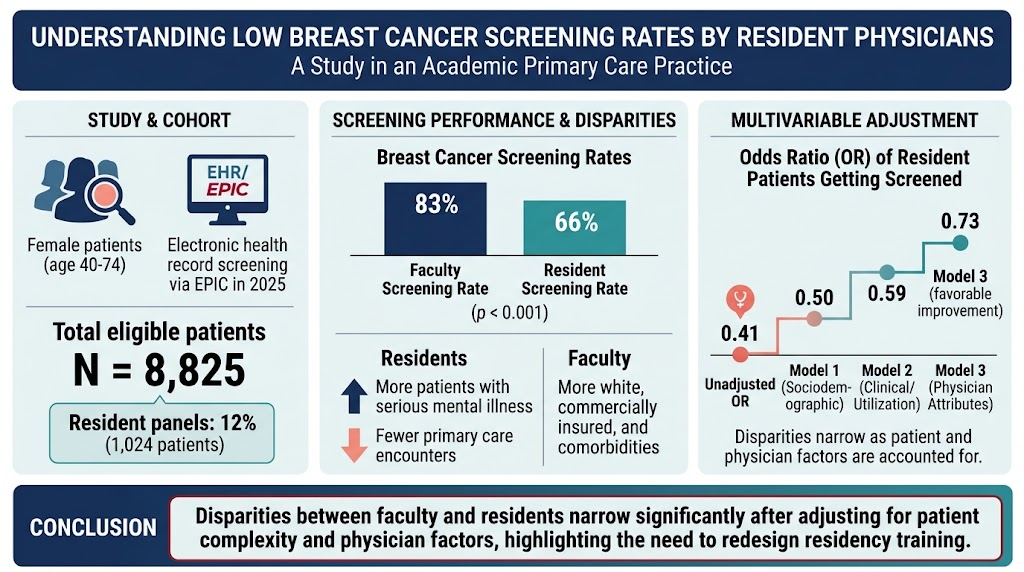
Of the total eligible population, 12% (1,024 patients) were assigned to resident physicians, with the remaining majority cared for by faculty physicians.
Patient panels differed significantly: faculty panels had a higher proportion of white patients, English speakers, commercially insured individuals, and greater burden of medical comorbidities. In contrast, resident panels included more patients with serious mental illness and experienced fewer primary care visits during the study period.
Raw screening rates showed a notable disparity: 83% of faculty physician patients were up-to-date with breast cancer screening compared to only 66% of resident physician patients (p < 0.001).
Unadjusted logistic regression showed that the odds of a resident patient being screened was 0.41 (95% confidence interval 0.35–0.47) compared to faculty. After adjusting for patient sociodemographic factors, this improved to an odds ratio (OR) of 0.50 (0.40–0.62). Incorporating clinical variables and healthcare utilization increased the OR to 0.59 (0.48–0.74). Finally, adjusting for physician characteristics further attenuated the disparity to an OR of 0.73 (0.54–0.98), indicating a smaller but persistent difference.
These findings suggest that differences in patient population and clinical context explain much, but not all, of the lower screening rates among residents. The reduced number of primary care encounters and higher prevalence of mental illness among resident patients likely contribute to barriers in delivering preventive care.
Expert Commentary
This study offers important insights into the multifactorial reasons behind low breast cancer screening rates among resident physicians. The robust primary care infrastructure likely mitigates some resident disadvantages, as evidenced by the improved odds ratios with adjusting for patient and physician factors. However, the persistent gap indicates systemic challenges in residency education and clinical workflow integration.
Previous literature suggests that residents face time constraints, competing educational priorities, and limited continuity with patients, all of which may reduce emphasis on preventive care. Moreover, caring for a vulnerable patient population with serious mental illness poses additional clinical complexity, requiring tailored strategies.
Notably, faculty physicians’ panels included more medically complex patients, which did not translate into lower screening rates, reinforcing that experience and care continuity may facilitate better adherence to preventive guidelines.
Application of quality improvement strategies, enhanced supervision, and embedding screening prompts into electronic health records are necessary but may be insufficient. Introducing dedicated preventive care modules in residency curricula, fostering longitudinal patient relationships, and providing feedback on screening performance might improve resident effectiveness. Further research to determine best practices for integrating preventive care responsibilities within resident training is needed.
Conclusion
This study confirms that resident physicians in academic primary care have significantly lower breast cancer screening rates compared to faculty, even within well-supported clinical environments. Much of the disparity is explained by differences in patient demographics, mental health burden, healthcare utilization, and physician characteristics. Nevertheless, a residual gap remains, signaling a need to innovate residency training models to prioritize preventive care delivery effectively.
Addressing these disparities is critical to ensuring equitable healthcare and maximizing the potential benefits of breast cancer screening. Future efforts should focus on optimizing clinic workflows, enhancing resident education on preventive care, and fostering more continuous patient-physician relationships during training.
Funding
The publication does not report specific funding sources. Further details may be found in the original article.
References
Weingart SN, Kufer KS, Short MI, et al. Understanding Low Breast Cancer Screening Rates by Resident Physicians. J Gen Intern Med. 2026 Oct 16. PMID: 42888341.
American Cancer Society. Breast Cancer Facts & Figures 2021-2022. American Cancer Society; 2022.
Moyer VA; U.S. Preventive Services Task Force. Screening for Breast Cancer: U.S. Preventive Services Task Force Recommendation Statement. Ann Intern Med. 2012;157(2): 100-110.
Yardley S, Dornan T, Balslev T. Experiences of clinical teaching and learning in the UK: perspectives of medical students and junior doctors. BMC Med Educ. 2014;14:30.
Steel T, et al. Barriers to Preventive Care in Resident Clinics: Implications for Cancer Screening in Family Medicine Residents. J Cancer Educ. 2019;34(5):939–944.
This article was created using several editorial tools, including AI, as part of the process. Human editors reviewed this content before publication.