Highlight
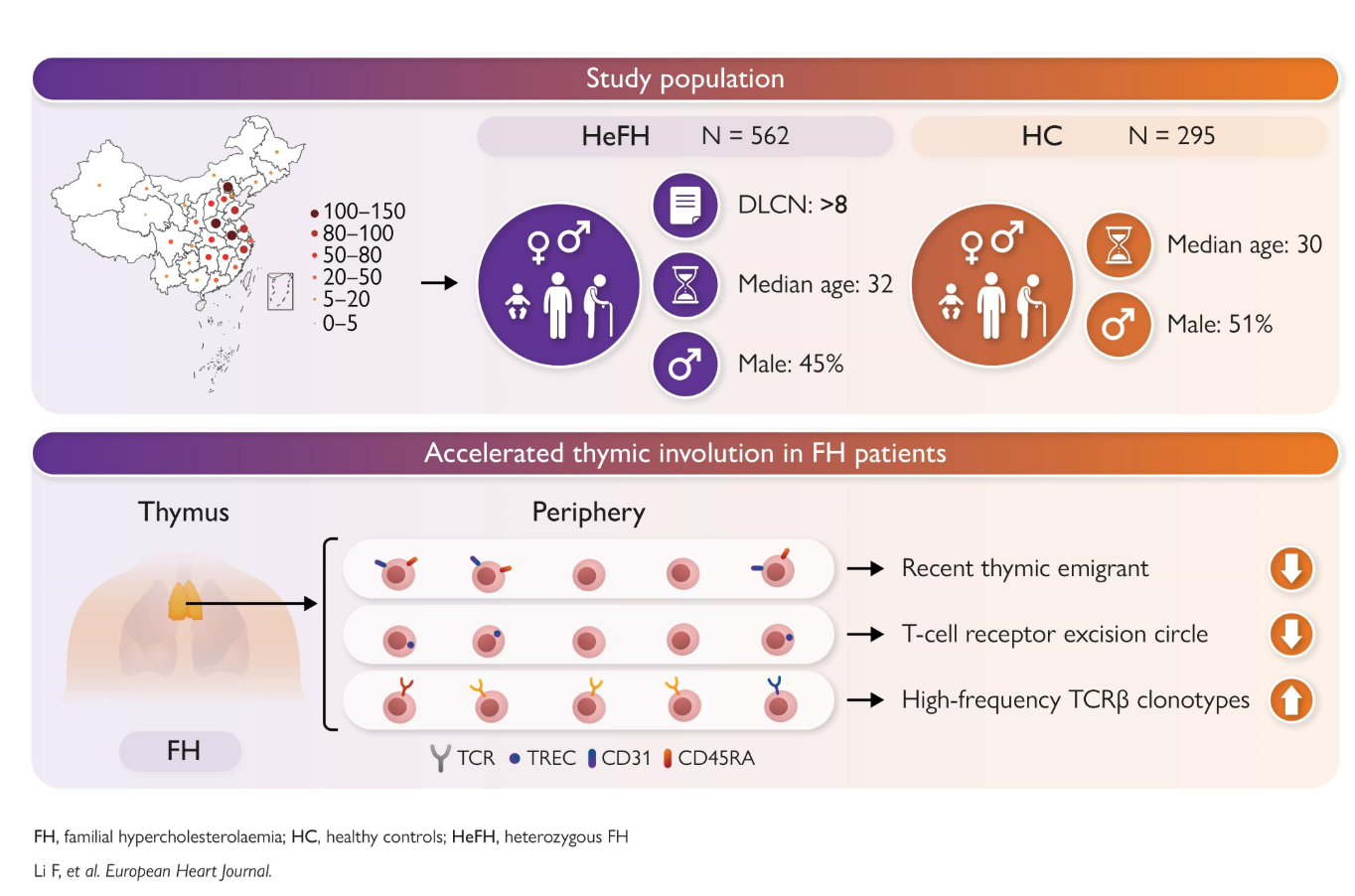
Familial hypercholesterolaemia (FH) is associated with accelerated thymic ageing, evidenced by reduced circulating CD4+ recent thymic emigrants (RTEs) and diminished T-cell receptor excision circles (TRECs).
FH patients reach median thymic output levels typical of healthy controls approximately six years earlier, suggesting premature immune ageing.
Highly pathogenic LDLR gene variants intensify reduction in thymic output, especially in young adults aged 18-30 years.
Lipid-lowering therapy with statins partially restores circulating CD4+ RTE levels, predominantly in female patients, reinforcing the immunologic benefits of early treatment.
Study Background
Familial hypercholesterolaemia is an autosomal dominant genetic disorder characterized by lifelong elevated low-density lipoprotein cholesterol (LDL-C) levels, significantly increasing the risk of premature atherosclerotic cardiovascular disease. While cardiovascular complications have long been the primary focus in FH management, emerging evidence suggests that hypercholesterolaemia adversely impacts other organ systems, including the immune system. The thymus plays a crucial role in the maturation and release of naïve T cells, essential for adaptive immunity. Thymic involution with age contributes to immunosenescence, impacting infection resistance and vaccine responses. However, the relationship between FH-induced chronic hypercholesterolaemia and thymic ageing remains underexplored. This study seeks to fill this knowledge gap by examining thymic output markers in a large Chinese FH cohort and exploring the modulating effect of lipid-lowering therapy.
Study Design
This observational cohort study enrolled 562 heterozygous FH patients diagnosed by Dutch Lipid Clinic Network criteria, subdivided into 236 treatment-naïve and 326 lipid-lowering therapy-treated individuals. The control group comprised 295 age-matched healthy individuals without hypercholesterolaemia. Thymic output was evaluated primarily using flow cytometry quantification of circulating CD4+ recent thymic emigrants (RTEs) within the naïve CD4+ T-cell compartment. Additionally, T-cell receptor excision circles (TRECs), which represent DNA byproducts of T-cell receptor gene rearrangements and indicate thymic output, were quantified in sorted naïve CD4+ and CD8+ T cells. Immune repertoire analyses, including diversity and clonal expansions, were performed by high-throughput T-cell receptor beta sequencing to assess immunosenescence and clonal skewing.
Key Findings
Treatment-naïve FH patients exhibited a significant reduction in the percentage of circulating CD4+ RTEs compared to healthy controls, with this effect most pronounced in young adults between 18 and 30 years of age. This suggests an early compromise of thymic function in FH, preceding typical age-related decline. TREC quantification corroborated these findings, showing markedly lower thymic output in both naïve CD4+ and CD8+ T-cell populations of FH patients. Furthermore, the study found that FH patients reached the median level of CD4+ RTEs observed in healthy controls approximately six years earlier, highlighting accelerated thymic ageing. Specifically, males with FH showed median ages of 19.12 years versus 25.51 in controls, and females 19.18 versus 25.58 years.
Genetic stratification revealed that carriers of highly pathogenic LDL receptor (LDLR) variants had more profound thymic output reductions, indicating that genotype severity may exacerbate immune ageing.
Immune repertoire analysis demonstrated skewing towards high-frequency T-cell receptor beta clones in FH patients, consistent with clonal expansions typically associated with reduced thymic output and immunosenescence.
Notably, FH patients undergoing statin-based lipid-lowering therapy, especially women, had significantly higher levels of circulating CD4+ RTEs compared to treatment-naïve counterparts. This suggests that statin therapy may exert beneficial effects on preserving thymic output and delaying immune ageing.
Expert Commentary
This comprehensive study elucidates a novel dimension of FH beyond its cardiovascular sequelae—its impact on thymic output and immune system ageing. The use of both phenotypic markers (CD4+ RTEs) and molecular signatures (TRECs and T-cell receptor sequencing) strengthens the evidence for impaired thymopoiesis in FH. The finding that thymic ageing occurs approximately six years earlier in FH patients raises important clinical considerations, as reduced naïve T-cell generation may predispose to infections, impaired vaccine responses, and immune dysregulation.
The exacerbation observed with highly pathogenic LDLR mutations implicates lipid metabolism as a direct modulator of thymic biology, although mechanistic pathways require further elucidation. Oxidized LDL and associated inflammation could contribute to thymic stromal damage or altered thymocyte development.
The partial reversal of thymic output deficits with statin therapy is particularly encouraging. Beyond lipid lowering, statins possess pleiotropic anti-inflammatory and immunomodulatory properties that may benefit thymic health. The sex differences observed warrant deeper investigation into hormonal and pharmacologic interactions.
Limitations include the observational design limiting causal inference, potential confounders such as lifestyle factors not fully controlled, and lack of direct thymic imaging or histology. Nevertheless, the large cohort size and multi-modal immune profiling provide robust data. Further longitudinal and mechanistic studies are needed to confirm these findings and unravel pathways linking cholesterol metabolism and thymic function.
Conclusion
This study expands current understanding of familial hypercholesterolaemia by demonstrating its association with accelerated thymic ageing and reduced immune output, particularly in young adults and carriers of severe LDLR mutations. The preservation of thymic output following statin therapy highlights the importance of early and sustained lipid-lowering treatment not only for cardiovascular protection but also for maintaining immune competence. These findings advocate for integrated metabolic and immunologic approaches in managing FH and raise awareness of potential immune dysfunction in this population.
Future research should investigate targeted interventions to preserve thymic function and explore the clinical implications of immunosenescence in FH. Clinicians managing FH patients might consider broader evaluation of immune parameters alongside lipid profiles to optimize holistic care.
Funding and ClinicalTrials.gov
The original publication did not specify funding sources or clinical trial registry numbers for this cohort study.
References
1.Li F, Zhang J, Deng J, Zhang H, Hao Y, Peng J, Wang Z, Hua L, Wang C, Wang J, Wu X, Liu X, Li N, Meng S, Shi Y, Yu Z, Li W, Chen C, Ding N, Ma Y, Lin J, Zeng H. Familial hypercholesterolaemia and thymic ageing in a Chinese cohort. Eur Heart J. 2026 Oct 20:ehag810. doi: 10.1093/eurheartj/ehag810. Epub ahead of print. PMID: 42900678.