We use cookies

Our website uses essential cookies and, with your consent, additional cookies to measure performance and improve our services. Cookie Policy.

You can change your choice at any time.

MMedXYNews
HomeVideos
MedXY AI/MedXY News/Section: Hematology-Oncology

Impact of Clonal Hematopoiesis and Pre-treatment Neutropenia on CAR-T Cell Therapy Outcomes in Hematological Malignancies
MedXY Editorial Team•Oct 9, 2026•Hematology-Oncology
CAR-T TherapyClonal hematopoiesishematologic toxicityNeutropenia

Highlight

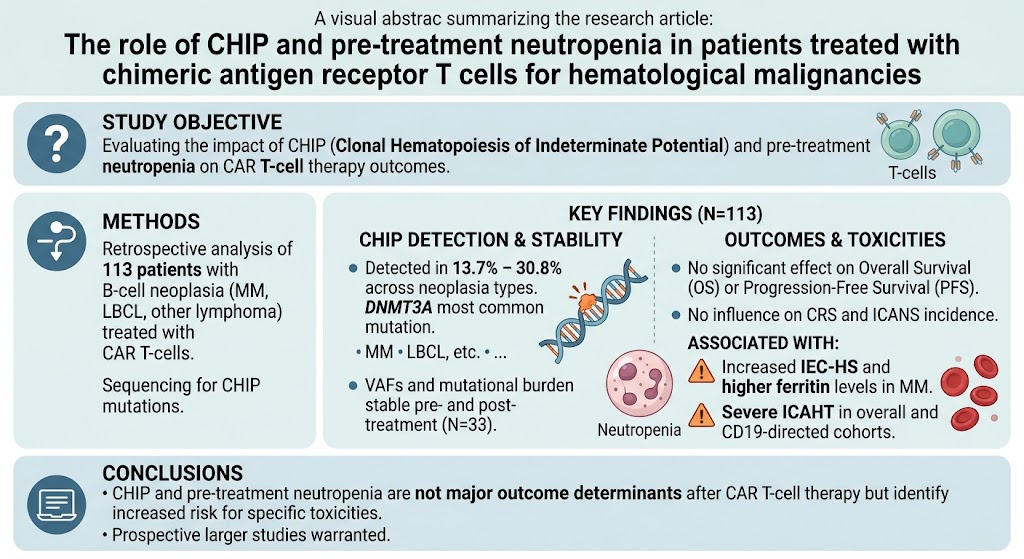
This article explores the influence of clonal hematopoiesis of indeterminate potential (CHIP) and pre-treatment neutropenia on clinical outcomes and immune-related toxicities in patients receiving chimeric antigen receptor T-cell (CAR-T) therapy for hematological malignancies. Key findings indicate that CHIP does not impact overall survival or progression-free survival but is associated with increased hemophagocytic lymphohistiocytosis-like syndrome (IEC-HS) and elevated ferritin in multiple myeloma patients. Pre-treatment neutropenia correlates with severe hematologic toxicities but not with survival or common CAR-T toxicities such as cytokine release syndrome and neurotoxicity.

Study Background

MedXY registered readers

Sign in free to continue reading

Create or use your MedXY account to unlock the complete article.

This article was created using several editorial tools, including AI, as part of the process. Human editors reviewed this content before publication.

Related articles

Open language-specific specialty feeds and department pages.

Influence of Clonal Hematopoiesis and Neutropenia on CAR-T Therapy Outcomes in Hematologic MalignanciesCHIP and pre-treatment neutropenia do not significantly affect survival or main toxicities in CAR-T therapy for hematologic cancers but may predict specific inflammatory toxicities, indicating distinct risk profiles for patient management.Oct 8, 2026Leveraging Proteomic Signatures of Clonal Hematopoiesis to Predict Outcomes in HFpEFThis study identifies plasma proteomic signatures linked to clonal hematopoiesis driver mutations and develops a proteomic risk score that independently predicts adverse clinical outcomes in heart failure with preserved ejection fraction (HSep 23, 2026Cardiovascular Risks of CAR-T Therapy in Older Adults: Insights from US Medicare DataAmong older adults receiving CAR-T therapy, 5.8% experienced major adverse cardiovascular events (MACE), associated with increased mortality. Pre-existing cardiac conditions heightened risk, underscoring the need for cardiovascular monitoriSep 19, 2026NF-κB Driven Transcriptional Signatures in CAR-T Cells Predict Durable Responses in Multiple Myeloma
Loading comments...
MedXY briefing

Get the free newsletter

Evidence-led clinical news, trends, and analysis—delivered to your inbox.

Ask MedXY AI

Most popular

Intimate Health
Five Benefits for Women Continuing Sexual Activity After Menopause
Intimate Health
Why Some Women Have a Strong Sex Drive—And Why Men Shouldn't Worry About It
Nursing & care
How often should a couple have sex?
Cardiology
Precision Medicine for Long QT Syndrome Type 2: Lumacaftor Corrects Trafficking Defects and Shortens QT Interval
General Surgery
Optimizing Postoperative Opioid Prescriptions After Intra-Abdominal Cancer Surgery: Comparing the 5x-Multiplier and 3-Tier Models
© 2026 MedXY
Contact usAbout usPrivacy PolicyMedXY story
Single-cell transcriptomic profiling of ide-cel CAR-T products reveals that intrinsic NF-κB signaling in CD4 CAR-T cells correlates with durable remission in relapsed/refractory multiple myeloma, marking T-cell fitness and potential therape
Sep 17, 2026
Tisagenlecleucel for Post-Transplant Relapse in Young Acute Lymphoblastic Leukemia Patients: European Real-World Determinants of OutcomeThis study evaluates the outcomes and critical factors influencing the success of tisagenlecleucel therapy for children and young adults with B-cell acute lymphoblastic leukemia relapsing after hematopoietic stem cell transplant across EuroSep 16, 2026
Designing Cardiovascular Outcomes Trials in Clonal Hematopoiesis: A Precision Medicine ImperativeClonal hematopoiesis of indeterminate potential (CHIP) poses a novel cardiovascular risk. This article explores challenges and strategies for designing cardiovascular outcomes trials tailored to CHIP’s genetic heterogeneity and clinical comSep 14, 2026