Study Background
Falls represent a significant clinical challenge in Parkinson’s disease (PD), contributing to morbidity, loss of independence, and reduced quality of life. Motor symptoms such as bradykinesia, postural instability, and gait disturbances, combined with cognitive and psychological factors, increase fall risk. Conventional fall prevention strategies often emphasize environmental safety and exercise interventions but may insufficiently address patient autonomy and complex mobility behaviors involving fluctuating disease states. Hence, understanding clinicians’ perspectives on promoting safer mobility behaviors that empower patients could enhance fall prevention strategies and support meaningful engagement in daily activities despite PD progression.
Study Design
This qualitative study employed focus group discussions to explore expert clinicians’ and researchers’ views on safer mobility behavior for fall prevention among people with Parkinson’s disease. Nineteen participants, including physiotherapists, occupational therapists, and researchers with a median of 18 years of clinical/research experience, were divided into five international online focus groups. A reflexive thematic analysis approach was used to identify key themes surrounding safer mobility behavior, its nature, and application in fall prevention.
Key Findings
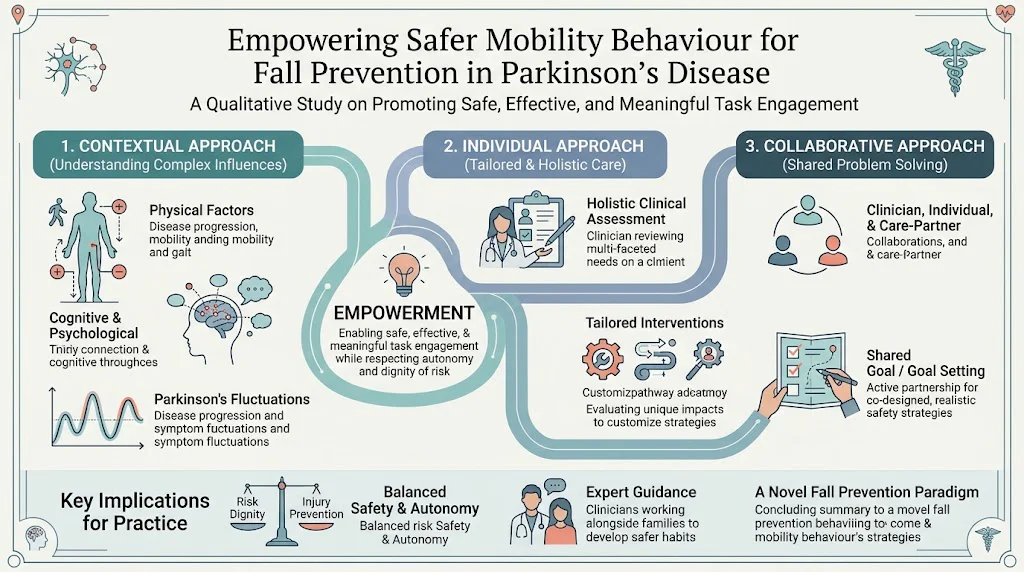
The central theme identified was empowerment, conceptualized as enabling individuals with PD to engage safely, effectively, and meaningfully in activities despite their disease. This concept of empowerment was intertwined with three key sub-themes:
1. Contextual Approach: Participants emphasized understanding the multifaceted influences on mobility behavior. This extends beyond physical impairments to include cognitive workload, psychological status, and Parkinson’s-specific disease fluctuations. Recognizing these dimensions is crucial because mobility is not solely biomechanical but dynamically affected by fluctuating motor and non-motor symptoms.
2. Individualized Assessment and Intervention: A holistic assessment approach tailored to each patient’s unique profile was advocated. Clinicians highlighted the importance of evaluating how physical, cognitive, and psychological factors converge in each individual to affect mobility risks. Interventions were recommended to be personalized, addressing these combined influences rather than applying generic fall prevention protocols.
3. Collaborative Strategy Development: Participants underscored the necessity of a collaborative relationship among clinicians, individuals with PD, and their care partners. Shared problem-solving, goal setting, and decision-making foster ownership and dignity of risk, balancing safety against meaningful activity participation. This alliance supports development of safer strategy use that respects patient autonomy and preferences.
The study’s findings represent a novel perspective on fall prevention in PD, moving beyond traditional safety-first models towards a balanced empowerment paradigm supporting autonomy and quality of life.
Expert Commentary
This study aligns with evolving rehabilitation philosophies emphasizing patient-centered care and empowerment in chronic neurological conditions. The integration of contextual and individualized approaches to mobility reflects a nuanced understanding that falls are complex events influenced by interplay among motor, cognitive, and psychological domains. Notably, the respect for dignity of risk challenges risk-averse practices that may inadvertently promote inactivity and disability.
Limitations include the qualitative design and reliance on expert opinions which may not fully represent all clinical settings or patient populations. Future work should empirically test specific empowerment-based interventions and their impact on fall rates, functional outcomes, and patient satisfaction in PD.
Conclusion
This study highlights empowerment as a foundational framework for safer mobility behavior in fall prevention among people with Parkinson’s disease. It promotes a contextual, individualized, and collaborative approach that respects patient autonomy while mitigating falls risk. These insights lay groundwork for developing tailored rehabilitation strategies that support meaningful and safe mobility, ultimately enhancing quality of life for individuals with PD. Healthcare providers should integrate empowerment principles into clinical practice to optimize fall prevention efforts.
Funding and Clinical Trials
No specific funding or clinical trial registration was reported for this qualitative study.
References
1. Cheung D, Paul SS, Mackenzie L, Wesson J, Allen NE. Empowering safer mobility behaviour for fall prevention in people with Parkinson’s disease: A qualitative study. Clin Rehabil. 2026 Oct 27;2692155261500318. doi:10.1177/02692155261500318. PMID: 42935266.
2. Bloem BR, Grimbergen YA, Cramer M, Willemsen M, Zwinderman AH. Prospective assessment of falls in Parkinson’s disease. J Neurol. 2001 Dec;248(11):950-8. doi:10.1007/s004150170048.
3. Shulman LM. Understanding disability in Parkinson disease. Mov Disord. 2010 Mar 15;25 Suppl 1:S131-5. doi:10.1002/mds.22788.
4. Mak MK, Pang MY. Fear of falling is independently associated with recurrent falls in patients with Parkinson’s disease: a 1-year prospective study. J Neurol. 2009 Mar;256(4):553-9. doi:10.1007/s00415-009-0042-x.
5. Foster ER, Bedekar M, Tickle-Degnen L. Learning Caregiving Skills for Parkinson’s Disease: A Qualitative Study. Am J Occup Ther. 2018 May/Jun;72(3):7203205070p1-7203205070p8. doi:10.5014/ajot.2018.029476.