Highlight
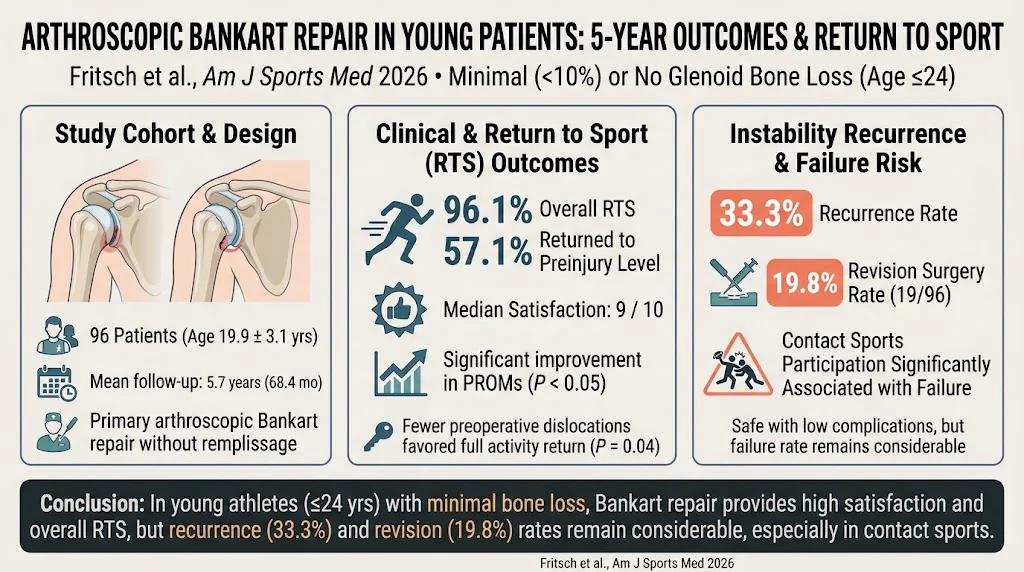
This study evaluated arthroscopic Bankart repair outcomes in young patients (≤24 years) with minimal (<10%) or no glenoid bone loss over a mean of 5.7 years. Key findings include a 33.3% recurrence rate, 19.8% revision surgery rate, high clinical improvement, and a 96.1% return-to-sport (RTS) rate, though only 57.1% returned to preinjury sport level. Contact sport participation was significantly associated with failure, and a higher number of preoperative dislocations predicted poorer RTS outcomes.
Background
Anterior shoulder instability is a common and challenging condition in adolescents and young adults, especially athletes. Arthroscopic Bankart repair is the standard surgical intervention for stabilizing the shoulder when the glenoid bone loss is minimal (<10%). Despite advances, recurrence and failure remain problematic, particularly in young, active populations who often participate in contact sports. Understanding long-term outcomes, return-to-sport rates, and failure predictors is critical for optimizing treatment strategies and patient counseling.
Study Design
This retrospective case series reviewed patients aged 24 years or younger with anterior shoulder instability and minimal glenoid bone loss (<10%) who underwent primary arthroscopic Bankart repair between 2006 and 2020. Patients undergoing remplissage were excluded. Clinical outcomes, radiographic parameters (including glenoid bone loss, glenoid track, and distance-to-dislocation), preoperative instability events, patient-reported satisfaction, and return-to-sport outcomes were analyzed at a mean follow-up of 68.4 months. Failure was defined as recurrent dislocation or instability requiring revision surgery.
Key Findings
A total of 112 patients were included, with 96 (85.7%) available for final follow-up. The mean patient age was 19.9 years. Clinical outcomes improved significantly across all measures except the mental health component of the 12-Item Short Form Health Survey. Median satisfaction was high (9/10).
Recurrence and Revision: Despite improvements, the overall recurrence rate was high at 33.3%, with 19 patients (19.8%) undergoing revision surgery. This highlights a substantial failure burden in this population.
Return to Sport: An encouraging 96.1% resumed participation in sports, but only 57.1% returned to their preinjury level, suggesting challenges in full recovery of function or confidence. Notably, fewer preoperative dislocations predicted better return to full activity.
Risk Factors for Failure: Participation in contact sports was significantly associated with surgical failure. Other measured risk factors such as bone loss (all minimal here), glenoid track measurements, and distance-to-dislocation were not statistically linked to failure, underscoring contact sport as a key consideration.
Expert Commentary
This study contributes robust medium-term data on arthroscopic Bankart repair durability in a high-risk, young athletic population with minimal glenoid bone loss. The high recurrence and revision rates reflect known challenges, especially with contact sports stresses. The finding that many patients return to sport yet fewer reach their previous level aligns with other literature emphasizing functional and psychological recovery barriers.
Limitations include retrospective design and exclusion of remplissage, which some surgeons advocate for even with minimal bone loss in high-risk patients. The lack of mental health score improvement suggests a possible area for integrated rehabilitative approaches. Additionally, the variability in follow-up duration and absence of a control group limits generalizability.
Future directions should explore individualized risk stratification, especially incorporating sport type and preoperative instability burden, to optimize surgical decision-making and rehabilitation protocols.
Conclusion
In young patients with minimal glenoid bone loss, arthroscopic Bankart repair yields significant clinical improvement and high overall return to sport but is associated with considerable recurrence and revision rates, particularly among contact sport athletes. Preoperative instability episodes negatively affect return to full activity. Clinicians should balance patient expectations regarding outcomes and consider additional or alternative stabilization strategies for high-risk individuals.
Funding and Registration
The study did not report specific funding sources. No clinical trial registration was indicated.
References
Fritsch L, Mitchell BC, Horan MP, et al. Five-Year Outcomes and Return to Sport After Arthroscopic Bankart Repair in Young Patients With Minimal (<10%) or No Glenoid Bone Loss. Am J Sports Med. 2026; doi:10.1177/3635465261491064. PMID: 42929666.
Additional references on anterior shoulder instability, Bankart repair, and return to sport can be found in PubMed-indexed literature and current orthopedics clinical guidelines.