Highlight
A smartphone-based multidisciplinary digital therapeutic integrating personalized exercise and cognitive-behavioural therapy significantly reduced knee pain in chronic patellofemoral pain (PFP) over 8 weeks compared with education and exercise instruction alone.
Secondary outcomes including worst pain, knee function, health-related quality of life, and psychological distress improved significantly in the digital therapeutic group.
Exercise adherence exceeded 80%, and the intervention showed no serious device-related or intervention-related adverse events, underscoring its safety and feasibility.
Study Background and Disease Burden
Patellofemoral pain (PFP) syndrome is one of the most common causes of anterior knee pain, especially prevalent among adolescents and young adults. Characterized by chronic anterior or retropatellar pain aggravated by activities such as stair climbing, squatting, and prolonged sitting, PFP presents a significant clinical challenge due to its multifactorial etiology and often refractory nature to standard treatment. Epidemiological data suggest that the condition affects approximately 15%-25% of the general population with knee pain, frequently leading to activity limitations and decreased quality of life.
Standard management strategies for PFP include education, exercise therapy targeting the quadriceps and hip musculature, and addressing biomechanical factors. However, the chronicity of pain and psychosocial contributors such as catastrophizing and depression may reduce the effectiveness of isolated physical interventions. Cognitive-behavioural therapy (CBT) has shown benefit in other chronic musculoskeletal conditions by targeting maladaptive thought patterns and promoting coping strategies, yet integration with physical therapy in a scalable format remains limited.
Emerging digital therapeutics (DTx) leveraging smartphone platforms have the potential to deliver multidisciplinary interventions effectively and remotely. Such digital approaches could enhance adherence, provide tailored content, and facilitate regular monitoring, addressing barriers in traditional care models. Prior to this study, evidence for DTx combining exercise and cognitive-behavioural components specifically for chronic PFP was sparse.
Study Design
This investigation was a multicentre, parallel-group randomized controlled trial conducted across 10 hospitals in the Republic of Korea, enrolling 216 participants diagnosed with chronic PFP. Inclusion criteria stipulated anterior or retropatellar knee pain persisting for at least 3 months, with activity-related provocation.
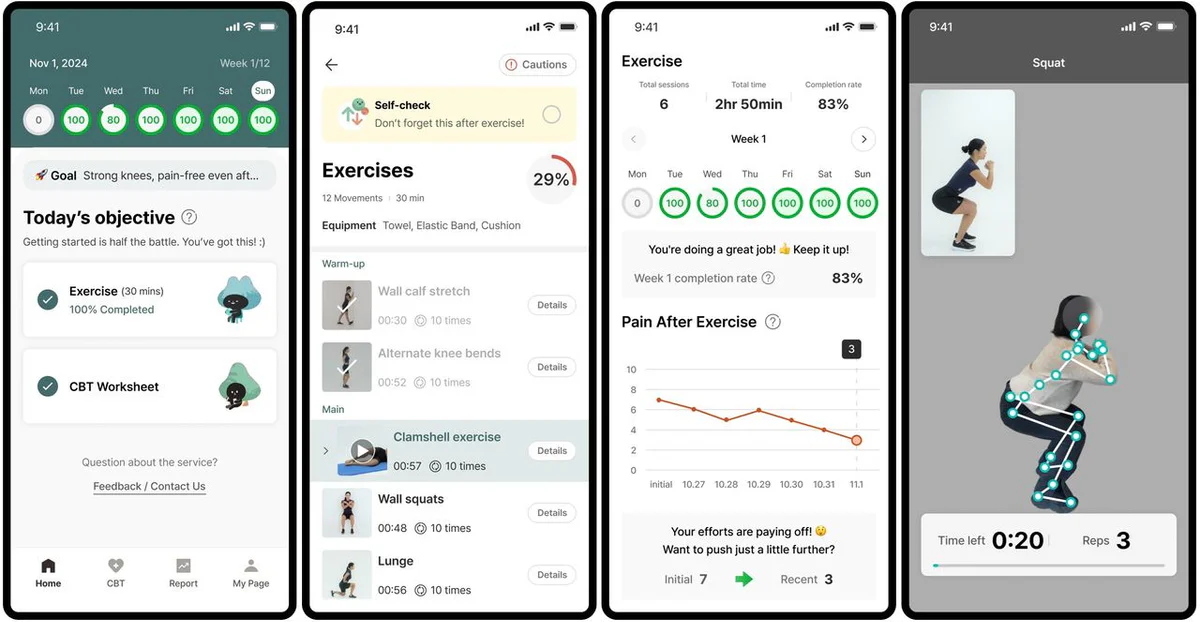
Participants were randomized to either the digital therapeutic (DTx) group or the control group. The DTx intervention utilized the MORA Cure PFP smartphone application, delivering an 8-week structured program comprising personalized home-based exercises, weekly cognitive-behavioural therapy sessions, and daily self-reflective worksheets designed to reinforce cognitive and behavioural strategies.
The control group received usual care consisting of PFP-related education, a one-time exercise instruction session, printed informational materials, and self-monitoring exercise diaries without ongoing digital support.
Primary outcome was the change in usual knee pain at 8 weeks, quantified by a 0–100 mm visual analogue scale (VAS). Secondary outcomes included worst pain, knee function assessed by the Anterior Knee Pain Scale (AKPS), health-related quality of life measured by the EQ-5D-5L and EQ VAS, and psychological distress evaluated using the Patient Health Questionnaire-9 (PHQ-9) and Pain Catastrophizing Scale (PCS). Assessments occurred at baseline, 4, 8, and 12 weeks. Longitudinal effects were analyzed using linear mixed-effects models.
Key Findings
The primary endpoint analysis demonstrated a statistically and clinically significant reduction in usual knee pain at 8 weeks favoring the DTx group with a mean between-group difference of -12.5 mm (95% CI, -17.1 to -7.8) on the VAS. This magnitude surpasses minimal clinically important difference thresholds in musculoskeletal pain trials, affirming the intervention’s effectiveness.
Secondary outcomes at 8 weeks also showed meaningful benefits in the DTx group:
Worst pain: Decreased by 10.7 mm (95% CI, -15.9 to -5.4).
Knee function (AKPS): Improved by 5.2 points (95% CI, 2.7 to 7.7), reflecting enhanced mobility and reduced functional limitations.
Health-related quality of life (EQ VAS): Increased by 10.7 points (95% CI, 7.1 to 14.4), indicating better overall wellbeing.
Psychological outcomes: The PCS score improved by -1.8 points (95% CI, -3.3 to -0.3), suggesting reduced pain catastrophizing; however, changes in PHQ-9 were not highlighted as significant.
Exercise adherence was robust, exceeding 80%, facilitated by the personalized and interactive digital platform. Safety was confirmed with no device-related or intervention-related serious adverse events reported.
Expert Commentary
This trial provides compelling evidence that a smartphone-based multidisciplinary digital therapeutic, integrating both exercise and cognitive–behavioural therapy components, can effectively reduce pain and improve function in chronic PFP, a condition notoriously difficult to manage through standard modalities alone. The incorporation of psychological support addresses the biopsychosocial model of chronic pain, which is increasingly recognized in musculoskeletal disorders.
From a translational perspective, the use of digital platforms allows for scalable, accessible interventions that can extend specialist-driven care beyond traditional clinical settings. The high adherence rate supports acceptability and user engagement, overcoming common barriers such as limited access to physiotherapy and regular psychological counseling.
Limitations include the relatively short follow-up period; longer-term data are necessary to confirm sustained benefits and rule out relapse. Cultural factors related to the Korean healthcare environment may affect generalizability, and replication in diverse populations is warranted. Additionally, while improvements in psychological distress were measured, the extent of CBT’s direct contribution versus exercise alone merits further mechanistic study.
Conclusion
This multicentre randomized trial demonstrates that an 8-week smartphone-based multidisciplinary digital therapeutic combining personalized exercise and cognitive-behavioural therapy significantly reduces pain and improves knee function, psychological outcomes, and quality of life in patients with chronic patellofemoral pain. These findings highlight the potential of integrated digital interventions to transform chronic musculoskeletal pain management by addressing physical and psychosocial domains simultaneously.
Incorporating such digital therapeutics into routine clinical practice could enhance patient access to multimodal therapies, improve adherence, and ultimately yield better long-term outcomes in PFP and possibly other chronic musculoskeletal conditions.
Funding and Trial Registration
The trial was registered on ClinicalTrials.gov under identifier NCT06260865. Details of funding sources were not provided in the abstract but can be accessed via the publication.
References
Park JY, Lee S, Kim JM, et al. Digital therapeutic combining exercise and cognitive-behavioural therapy reduces pain in patients with chronic patellofemoral pain: a multicentre randomised controlled trial. Br J Sports Med. 2026;60(20):1551-1559. PMID: 42692805.
Crossley KM, Stefanik JJ, Selfe J, et al. Patellofemoral pain consensus statement from the 4th International Patellofemoral Pain Research Retreat, Manchester 2018. Br J Sports Med. 2019;53(4):411-424.
Dunstan DA, Scott N. Norms for PHQ-9 and GAD-7 in a community sample. Aust N Z J Psychiatry. 2020;54(2):186-193.
Bennell KL, Dobson F, Hinman RS. Exercise in osteoarthritis: moving from prescription to adherence. Best Pract Res Clin Rheumatol. 2014;28(1):93-117.