Highlight
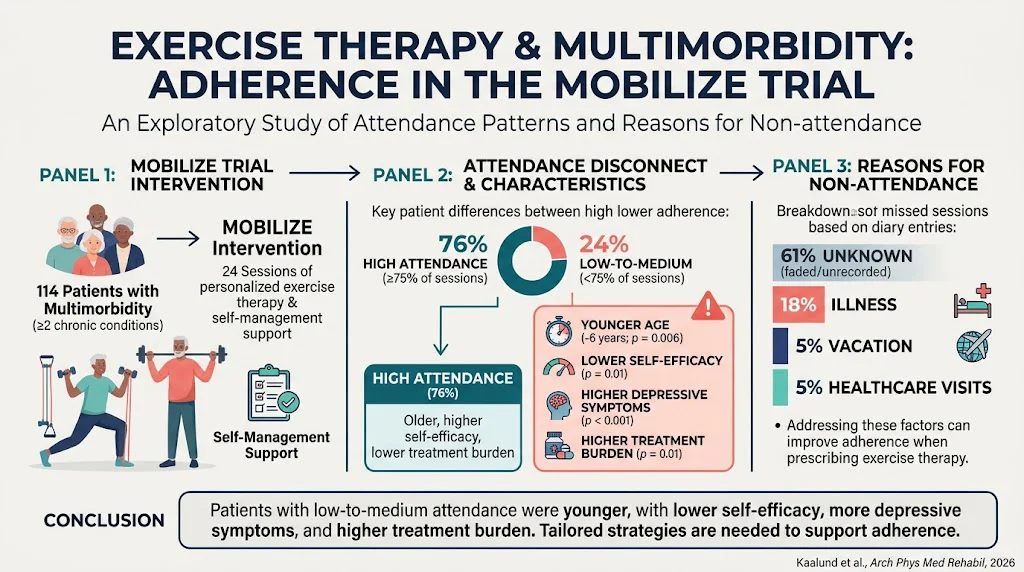
This exploratory cross-sectional study from the MOBILIZE trial identified key characteristics associated with low-to-medium attendance (<75%) at personalized exercise therapy and self-management support sessions among patients with multimorbidity. Notably, younger patients, those with lower self-efficacy to manage chronic disease, more depressive symptoms, and higher treatment burden exhibited lower attendance. Reasons for missed sessions varied, with many unreported, but illness, vacation, and scheduled healthcare visits were common.
Study Background
Multimorbidity, defined as the coexistence of two or more chronic conditions in an individual, is increasingly prevalent in aging populations worldwide. This complexity places substantial burden on patients and healthcare systems, complicating treatment regimens and negatively affecting health outcomes and quality of life. Exercise therapy combined with self-management support constitutes a cornerstone of non-pharmacological management strategies for these patients, aiming to enhance physical function, psychological well-being, and overall disease control.
However, adherence to prescribed interventions is a critical challenge. Understanding factors associated with non-attendance is essential to optimize therapeutic delivery and patient engagement, ultimately improving clinical outcomes in multimorbid populations.
Study Design
The MOBILIZE randomized controlled trial evaluated the impact of a combined exercise therapy and self-management support intervention delivered by physiotherapists across five municipalities. This exploratory cross-sectional analysis included 114 patients aged on average 70 years, predominantly men (61%), with an average of seven chronic conditions (range 2–19).
The intervention comprised 24 personalized sessions encompassing physical exercise and self-management education. Attendance was stratified into low-to-medium (<75% of sessions attended) and high (≥75% attendance) groups. Patient characteristics were compared using appropriate statistical tests (t-test, chi-square test, Mann-Whitney U test), and reasons for non-attendance were extracted from participant diary entries.
Key Findings
Among participants, 76% demonstrated high attendance. Compared to the high attendance group, the low-to-medium attendance group differed significantly on several parameters:
Age: Patients with lower attendance were younger by 6 years on average (mean difference -6 years, 95% CI -9.44 to -1.67; P=0.006).
Self-Efficacy: Lower scores on the Self-Efficacy for Managing Chronic Disease 6-Item Scale by 1.5 points (P=0.01), indicating reduced confidence in managing chronic conditions.
Depressive Symptoms: Higher scores on the Personal Health Questionnaire Depression Scale by 2 points (P<0.001), suggesting greater depressive symptomatology.
Treatment Burden: Increased burden as per the Multimorbidity Treatment Burden Questionnaire by 7.5 points (P=0.01), reflecting perceived complexity and demands of treatment regimens.
Exploring reasons for non-attendance, 61% of missed sessions lacked documented explanations. Among reported reasons, acute illness accounted for 18%, personal vacation 5%, and planned healthcare visits 5%. The broad spectrum of reasons and frequent absence of reported causes emphasize complexities in maintaining adherence.
Expert Commentary
These findings highlight modifiable and non-modifiable factors influencing attendance in multimorbid patients. The paradoxical observation that younger patients had poorer attendance may reflect competing life commitments or different motivational factors than older cohorts. Lower self-efficacy and higher depressive symptoms are consistent with behavioral models linking psychological well-being and treatment adherence, suggesting the need for integrated psychological support within exercise interventions.
High treatment burden impairs patients’ capacity to engage with additional healthcare activities, underscoring the importance of streamlined care pathways and personalized scheduling. The large proportion of unknown reasons for absence reveals gaps in patient-provider communication and tracking, advocating for improved monitoring methods.
Limitations include the exploratory cross-sectional design limiting causal inference, potential recall bias in diary entries, and generalizability confined to the demographic and healthcare context studied.
Conclusion
In multimorbid patients undergoing exercise therapy and self-management support, younger age, lower self-efficacy, greater depressive symptoms, and higher treatment burden are associated with suboptimal attendance. Addressing these factors through tailored interventions, psychological support, and flexible scheduling may enhance adherence. Understanding diverse reasons for missed sessions is crucial in optimizing therapy delivery. Future research should focus on interventional strategies to mitigate these barriers and improve long-term outcomes.
Funding and ClinicalTrials.gov
The MOBILIZE trial was conducted with institutional support from participating municipalities and research centers. Further details on funding sources were not specified in the analyzed publication. The study followed a prespecified statistical analysis plan registered at https://osf.io/tsmjf/. Further trial registration details were not provided in the source document.
References
Kaalund SM, Skou ST, Mortensen SR, et al. Characteristics and Reasons for Non-attendance at Exercise Therapy and Self-Management Support Among Patients With Multimorbidity. An Exploratory Cross-sectional Study From the MOBILIZE Trial. Arch Phys Med Rehabil. 2026 Oct;107(10):2906-2914. doi:10.1016/j.apmr.2026.06.012. PMID: 42285332.
Diederichs C, Berger K, Bartels DB. The measurement of multiple chronic diseases–a systematic review on existing multimorbidity indices. J Gerontol A Biol Sci Med Sci. 2011 Mar;66(3):301-11.
Schulman-Green D, Jaser S, Martin F, et al. Processes of self-management in chronic illness. J Nurs Scholarsh. 2012 Mar;44(2):136-44.
Bayliss EA, Ellis JL, Steiner JF. Barriers to self-management and quality-of-life outcomes in seniors with multimorbidities. Ann Fam Med. 2007 Nov-Dec;5(5):395-402.