Highlight
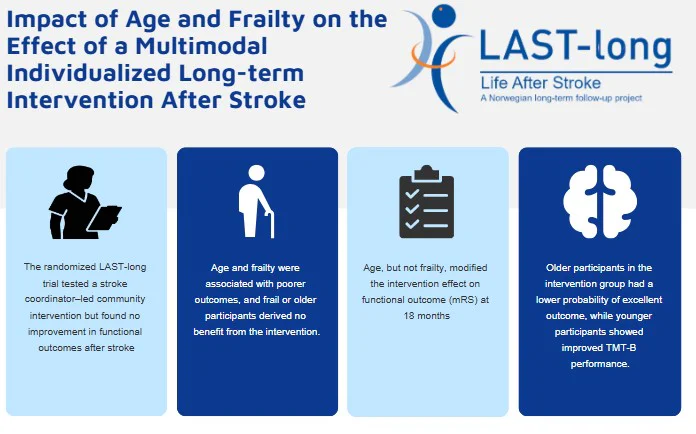
The LAST-long trial evaluated a multimodal, stroke coordinator-led intervention over 18 months post-stroke.
The overall intervention showed no significant functional benefit for all participants combined.
Older patients (≥80 years) had worse functional outcomes with the intervention compared to standard care.
Younger patients demonstrated improved cognitive function (Trail Making Test B) with the intervention, while frailty status did not modify intervention effects.
Study Background
Stroke remains a leading cause of long-term disability worldwide, with an aging population accentuating the burden of chronic stroke sequelae. Post-stroke rehabilitation often focuses on the acute and subacute phases, but optimizing functional outcomes through sustained, individualized interventions in the community setting is an unmet clinical need. Multimodal approaches addressing risk factors, physical and cognitive impairments, and quality of life could improve recovery trajectories. However, stroke survivors tend to be heterogeneous in terms of age, frailty, and stroke severity, raising questions about which subgroups might derive the most benefit from long-term interventions.
The LAST-long randomized controlled trial investigated a comprehensive individualized intervention led by stroke coordinators within community settings aimed at improving long-term functional outcomes after stroke. Prior results showed no overall functional superiority of this intervention versus usual care. Given that most participants had mild stroke symptoms, this secondary analysis focused on whether older age or greater frailty might modify the intervention’s effectiveness. Understanding such differential effects is critical for tailoring post-stroke care strategies for diverse patient populations.
Study Design
The LAST-long trial was a single-blinded randomized controlled trial conducted at four Norwegian hospitals between 2019 and 2022. A total of 301 stroke survivors were randomized 1:1 either to the intervention group, which received individualized, monthly stroke coordinator meetings for 18 months including structured risk assessments and goal setting, or to a control group receiving standard stroke care.
The primary endpoint was functional status measured by the modified Rankin Scale (mRS) at 18 months post-stroke. Secondary outcomes included mortality, cognitive function assessed by tests such as Trail Making Test B, activities of daily living (ADLs), physical function, fatigue, and quality of life.
Subgroup analyses investigated the interaction between the intervention effect and two predefined modifiers: age (younger than 80 years vs. 80 years and older) and frailty status as defined by a Frailty Index ≥0.2. Statistical analyses utilized linear and logistic regression models to probe for interaction effects between age or frailty and the intervention.
Key Findings
Out of 301 randomized participants, 268 had complete mRS data at 18 months (136 intervention; 132 control). The mean age was 71.1 years (SD 12.4), with 24.6% (66 individuals) aged 80 or older. Frailty was identified in 33.2% (89 participants).
The overall trial did not demonstrate a significant functional benefit of the intervention on the global cohort. However, age emerged as a significant modifier of treatment effect on the primary outcome. Among participants aged 80 or older, the intervention group fared worse, with only 23.4% achieving favorable mRS outcomes compared to 57.0% in the control group (p=0.004). This suggests the intervention potentially had a detrimental effect in this older subgroup.
In contrast, younger participants (<80 years) showed no significant functional benefit on mRS but demonstrated cognitive improvements. Specifically, they had a mean 32.2 second faster completion time on the Trail Making Test B (95% CI -58.0 to -6.4; p=0.015) relative to controls. A significant age-intervention interaction was confirmed for this cognitive outcome (p=0.019).
No significant interaction between frailty status and intervention effect was observed for primary or secondary outcomes, indicating frailty, as measured, did not influence response to the intervention.
The intervention was well-tolerated with no reported safety concerns. Mortality and other secondary endpoints similarly showed no differential treatment effects linked to frailty.
Expert Commentary
This secondary analysis sheds light on the complexity of post-stroke long-term management. The finding that older age (≥80 years) may be associated with worse functional outcomes following an otherwise comprehensive and individualized intervention is noteworthy and clinically relevant. Potential explanations include differential capacity for neuroplasticity, comorbidities, or the possibility that intervention components inadvertently increased patient burden or disrupted existing care routines in this group.
The absence of frailty modification may suggest that the frailty index cutoff or selection criteria lacked granularity or that frailty-related risk factors are not the dominant determinants of intervention responsiveness compared to chronological age.
This trial also highlights the importance of tailoring rehabilitation efforts by age and perhaps adopting different strategies specifically for octogenarians and older adults. Stroke rehabilitation guidelines should consider age-stratified recommendations. Further research elucidating mechanisms behind the negative effects seen in older patients is warranted to optimize care.
Limitations include the predominantly mild stroke severity of the cohort, which may reduce generalizability to more severe strokes. The single-blinded design also leaves potential biases in functional assessments despite rigorous methodology. Still, the multicenter, randomized controlled design and robust statistical analyses strengthen the validity of findings.
Conclusion
The LAST-long trial demonstrates that age significantly modifies the benefit of a long-term, multimodal individualized intervention after stroke. While younger patients may experience cognitive benefits, older adults (≥80 years) may not benefit and might even experience worse functional outcomes. Frailty status did not appear to influence intervention response. Individualized community-based stroke care should therefore incorporate age considerations to optimize efficacy and reduce potential harm. These insights advocate for stratified post-stroke rehabilitation protocols and motivate future studies to refine intervention components by patient age and clinical characteristics.
Funding and Clinical Trials Registration
The trial was conducted across four Norwegian hospitals with institutional support. It was registered under ClinicalTrials.gov Identifier NCT03859063.
References
Ihle-Hansen H, Thommessen B, Langlo SR, et al. Impact of age and frailty on the effect of a multimodal individualized long-term intervention after stroke: the last-long trial. J Rehabil Med. 2026 Oct 26;58:jrm46250. PMID: 42929098.
Langhorne P, Bernhardt J, Kwakkel G. Stroke rehabilitation. Lancet. 2011 May 14;377(9778):1693-702. doi: 10.1016/S0140-6736(11)60325-5.
Canadian Stroke Best Practices Advisory Committee. Executive summary. Recommendations on stroke rehabilitation services. CMAJ. 2010 May 11;182(7):844-9.
Fisher RJ, Gaynor C, Kerr M, et al. A randomized controlled trial of a comprehensive stroke education program with and without caregiver involvement. Stroke. 2010 Mar;41(3):558-63.