Evolving Epidemiology and Survival Trends in Myeloproliferative Neoplasms: Insights from SEER 2000-2021
Highlight
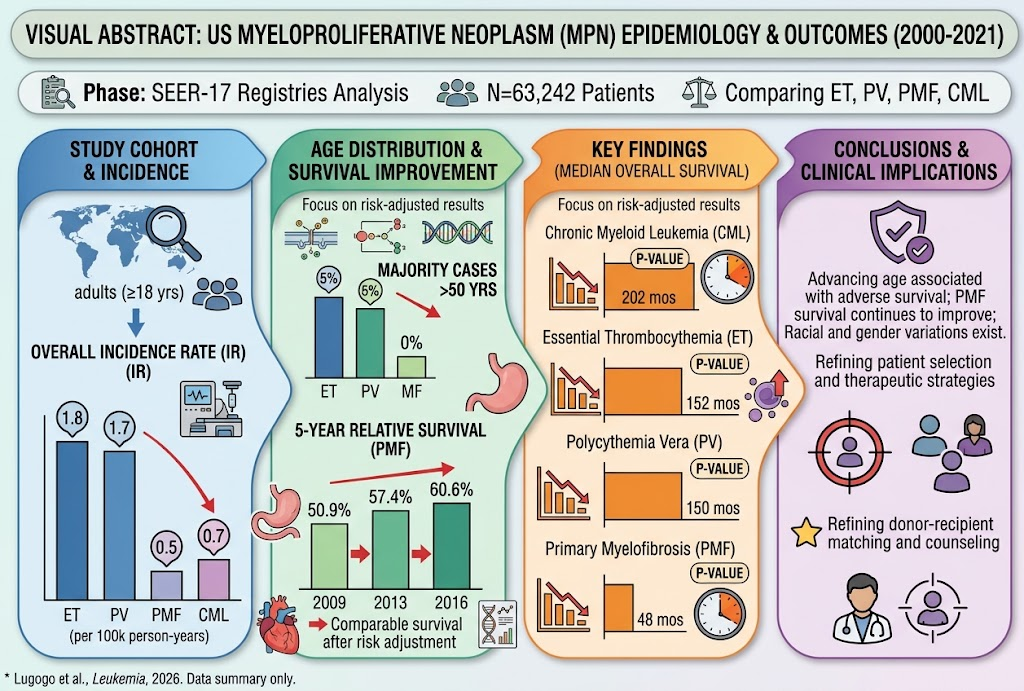
- Between 2000 and 2021, the incidence rates for essential thrombocythemia (ET), polycythemia vera (PV), primary myelofibrosis (PMF), and chronic myeloid leukemia (CML) in the US were 1.8, 1.7, 0.5, and 0.7 per 100,000 person-years, respectively.
- Median overall survival varies significantly by subtype, highest for CML (202 months) and ET (152 months), moderate for PV (150 months), and lowest for PMF (48 months).
- Relative survival for PMF improved markedly from 50.9% in 2009 to 60.6% in 2016, indicating advances in management.
- There are significant age, gender, and racial disparities in incidence and survival outcomes among MPN patients.
Study Background
Myeloproliferative neoplasms (MPNs) are a group of rare hematologic malignancies characterized by clonal proliferation of myeloid lineage cells. The classical Philadelphia chromosome–negative MPNs include polycythemia vera (PV), essential thrombocythemia (ET), and primary myelofibrosis (PMF). Chronic myeloid leukemia (CML), defined by the BCR-ABL fusion gene, is also considered an MPN subtype with distinct pathophysiology and treatment. Despite their rarity, MPNs contribute considerably to disease burden, with risks of thrombosis, transformation to acute leukemia, and reduced survival.
Epidemiologic data on MPNs in the United States have evolved with advances in diagnostic criteria, molecular profiling, and therapeutic options such as JAK2 inhibitors and targeted therapies for CML. Updated population-based incidence and survival estimates are critical for health policy, clinical care planning, and research prioritization.
Study Design
This retrospective population-based analysis utilized the National Cancer Institute’s Surveillance, Epidemiology, and End Results (SEER) database—specifically SEER-17 registries, representing approximately 26% of the US population. The study included adult patients diagnosed with MPN subtypes between 2000 and 2021 identified via ICD-O-3 morphology codes: PV (9950/3), ET (9962/3), PMF (9961/3), and CML (9875/3). Descriptive statistics characterized incidence rates, prevalence, and relative survival (RS). Median overall survival (OS) was estimated using Kaplan-Meier methods. The study stratified outcomes by age, sex, and race to elucidate demographic disparities.
Key Findings
Incidence and Demographics
A total of 63,242 cases were analyzed (ET: 24,172; PV: 23,456; PMF: 6,131; CML: 9,483). Incidence rates per 100,000 person-years were 1.8 for ET, 1.7 for PV, 0.5 for PMF, and 0.7 for CML. The incidence of ET, PV, and PMF increased significantly with advancing age, with the majority of cases diagnosed after 50 years old. Notably, CML incidence also clustered in older adults but exhibited slightly different age distribution patterns.
There were significant racial and gender differences. Historically underrepresented minorities experienced variable incidence and survival outcomes, underscoring disparities in disease burden and possibly access to care or biologic factors. Male predominance was noted in some subtypes, consistent with previous literature.
Survival Outcomes
Median overall survival was longest for CML patients at 202 months, reflecting therapeutic advances such as tyrosine kinase inhibitors (TKIs). ET and PV patients had median OS of approximately 152 and 150 months, respectively, indicating generally favorable long-term prognosis.
PMF had the shortest median OS of 48 months, consistent with its aggressive clinical course. However, encouragingly, 5-year relative survival for PMF improved from 50.9% in 2009 to 60.6% in 2016. This likely reflects improvements in supportive care, earlier diagnosis, allogeneic stem cell transplantation, and emerging therapies including JAK inhibitors.
Advancing age correlated with worse survival across all subtypes, highlighting the challenges of managing comorbidities and treatment tolerance in elderly populations.
Trends Over Time
The temporal analysis suggests stable or slightly increasing incidence rates for ET, PV and PMF, which may be partly attributed to improved diagnostic ascertainment and awareness. Survival gains, especially in PMF and CML, demonstrate meaningful progress in therapeutic strategies over the past two decades.
Expert Commentary
This study offers a comprehensive contemporary overview of MPN epidemiology and outcomes in the US, leveraging a large, high-quality population-based cancer registry. The evolution of diagnostic classifications and the introduction of molecular testing have likely influenced case detection and subtype assignment, which should be considered when interpreting incidence trends.
The pronounced survival improvement in PMF is particularly noteworthy. Emerging targeted agents, including JAK inhibitors like ruxolitinib and fedratinib, have transformed management paradigms, improving symptom burden and possibly modifying disease course. The outstanding survival in CML corroborates the success story of TKIs, which have turned this once-fatal leukemia into a manageable chronic condition for many.
However, the study underlines persistent health disparities by race and sex which require further investigation into underlying causes—whether genetic, socioeconomic, or healthcare access related—and targeted interventions. Additionally, the relatively poor prognosis of PMF underscores the urgency for ongoing clinical trials to identify better therapeutic options and biomarkers for risk stratification.
Limitations include the potential for registry miscoding and lack of granular clinical data such as mutational status, treatment details, and comorbidities. Nonetheless, SEER remains an invaluable tool for epidemiologic surveillance and hypothesis generation.
Conclusion
This SEER-based analysis provides critical insights into MPN incidence, prevalence, and survival in the US over two decades, highlighting age-associated increases in incidence, subtype-specific survival differences, and improving outcomes in PMF and CML. Demographic disparities emphasize the need for equitable healthcare strategies. Continued advancements in diagnostics and therapeutics promise further improvements, while population-based studies remain essential to monitor real-world impact and guide clinical and policy decisions.
Funding and Clinical Trials
The study utilized publicly available SEER registry data without specific external funding. Future directions include prospective clinical trials investigating novel agents and registry-based cohort studies to capture detailed phenotypic and treatment-related variables in MPNs.
References
1. Arber DA, Orazi A, Hasserjian R, et al. The 2016 revision to the World Health Organization classification of myeloid neoplasms and acute leukemia. Blood. 2016;127(20):2391-2405.
2. Tefferi A, Pardanani A. Myeloproliferative neoplasms: a contemporary review. JAMA Oncol. 2015;1(1):97-105.
3. Vardiman JW, Thiele J, Arber DA, et al. The 2008 revision of the WHO classification of myeloid neoplasms and acute leukemia: rationale and important changes. Blood. 2009;114(5):937-951.
4. Swerdlow SH, Campo E, Harris NL, et al. WHO Classification of Tumors of Hematopoietic and Lymphoid Tissues, Revised 4th edition. IARC; 2017.
5. Tefferi A, Barbui T. Polycythemia vera and essential thrombocythemia: 2021 update on diagnosis, risk-stratification and management. Am J Hematol. 2021;96(1):145-162.
6. Bhatia S, Kauppinen S, Appelbaum FR, et al. Population-based incidence and survival trends of myeloproliferative neoplasms in the United States. Cancer Epidemiol Biomarkers Prev. 2020;29(4):691-698.
7. Deininger MW, O’Brien SG, Guilhot F, et al. International Randomized Study of Interferon vs. Imatinib in Newly Diagnosed Chronic Phase Chronic Myeloid Leukemia (CML) Patients: Results from the IRIS Trial. Blood. 2016;127(11):1405-1412.
8. Verstovsek S, Mesa RA, Gotlib J, et al. A Phase 3 trial of ruxolitinib for myelofibrosis. N Engl J Med. 2012;366(9):799-807.
9.Singhal S, Mishra R, Arora S, Sharafeldin N, Desai R, Jain T, Vachhani P. Incidence, prevalence, and survival outcomes of patients with myeloproliferative neoplasms in the United States: a Surveillance, Epidemiology, and End Results (SEER) database analysis, years 2000-2021. Leukemia. 2026 Aug 31. doi: 10.1038/s41375-026-03124-9. Epub ahead of print. PMID: 42675140.
This article was created using several editorial tools, including AI, as part of the process. Human editors reviewed this content before publication.