We use cookies

Our website uses essential cookies and, with your consent, additional cookies to measure performance and improve our services. Cookie Policy.

You can change your choice at any time.

MMedXYNews
HomeVideos
MedXY AI/MedXY News/Section: Cardiology

Heart Failure in Portuguese Adults Aged 50 and Above: Insights from the PORTHOS Study on Prevalence and Predominant Phenotypes
MedXY Editorial Team•Sep 15, 2026•Cardiology
HFpEFepidemiologyNT-proBNP screeningPortuguese populationheart failure

Highlight

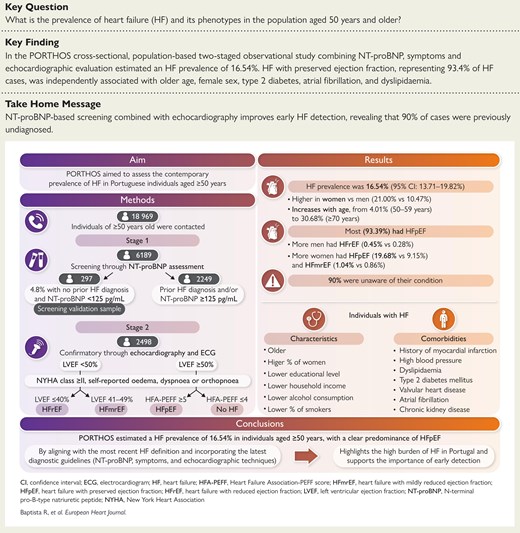
The Portuguese Heart Failure Prevalence Observational Study (PORTHOS) identifies a high prevalence (16.54%) of heart failure (HF) among community-dwelling adults aged 50 years and older in Portugal. Predominantly, HF with preserved ejection fraction (HFpEF) constitutes over 90% of cases. Most HF diagnoses were previously unrecognized, underscoring the importance of NT-proBNP-based screening combined with echocardiographic assessment in early detection.

Study Background

MedXY registered readers

Sign in free to continue reading

Create or use your MedXY account to unlock the complete article.

This article was created using several editorial tools, including AI, as part of the process. Human editors reviewed this content before publication.

Related articles

Open language-specific specialty feeds and department pages.

Bridging Evidence-Based and Personalized Medicine in Heart Failure and Cardiomyopathies: Balancing Standardization with IndividualizationThis article explores the integration of evidence-based medicine and personalized approaches in managing heart failure and inherited cardiomyopathies, proposing a framework to optimize patient care by harmonizing standardized guidelines witSep 17, 2026Global Burden of Disorders of Gut-Brain Interaction: Insights from Rome V Versus Rome IV CriteriaThe Rome V global epidemiology survey confirms a high prevalence of disorders of gut-brain interaction (DGBI) worldwide, consistent with prior Rome IV findings, underscoring a significant and persistent global clinical burden.Sep 15, 2026Cardiac Resynchronization Therapy: Metabolomic Insights into Heart Failure ImprovementThis study reveals how cardiac resynchronization therapy (CRT) improves left ventricular function in heart failure patients and modulates systemic metabolomic profiles, highlighting differences between ischemic and nonischemic cardiomyopathSep 15, 2026
Loading comments...
MedXY briefing

Get the free newsletter

Evidence-led clinical news, trends, and analysis—delivered to your inbox.

Ask MedXY AI

Most popular

Intimate Health
Five Benefits for Women Continuing Sexual Activity After Menopause
Intimate Health
Why Some Women Have a Strong Sex Drive—And Why Men Shouldn't Worry About It
Nursing & care
How often should a couple have sex?
Intimate Health
Classic Intimacy Recommendations: How to Help Women Reach Orgasm and Enjoy Mutual Pleasure
Intimate Health
What Makes a Woman "Physiologically Addicted" Is Never Money, But These Two Relationship Qualities
© 2026 MedXY
Contact usAbout usPrivacy PolicyMedXY story
Evolving Epidemiology and Survival Trends in Myeloproliferative Neoplasms: Insights from SEER 2000-2021
Analysis of SEER data from 2000-2021 reveals incidence, survival trends, and demographic disparities in US patients with myeloproliferative neoplasms, highlighting improved outcomes particularly in primary myelofibrosis and areas for furthe
Sep 13, 2026
High Pesticide Exposure Events and Olfactory Dysfunction: Integrating Subjective and Objective Evidence from Agricultural CohortsEmerging evidence links high pesticide exposure events (HPEEs) in farmers to increased self-reported olfactory dysfunction, though objective smell testing yields inconclusive associations, highlighting critical gaps and methodological consiSep 13, 2026
Genetic Insights into Early Heart Failure Risk in Hypoplastic Left Heart Syndrome: Findings from the NC-DEFINE StudyA prospective study reveals that ultra-rare cardiomyopathy gene variants significantly increase risk for early heart failure in infants with hypoplastic left heart syndrome, highlighting potential for genetic risk stratification and precisiSep 12, 2026