Evaluating Vericiguat in Coronary Vasospasm: Insights from the ViVA Randomized Cross-Over Trial
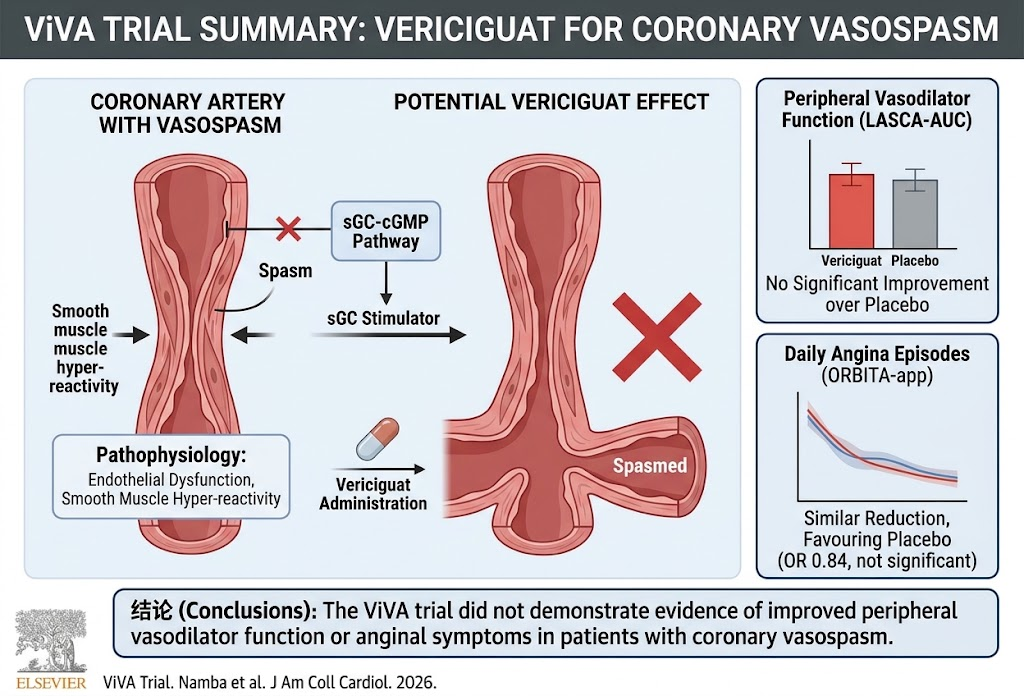
Highlight
- Vericiguat, a soluble guanylate cyclase (sGC) stimulator, was investigated for treating coronary vasospasm in angina patients without obstructive coronary artery disease (ANOCA).
- The ViVA double-blind, placebo-controlled, randomized cross-over trial showed no significant improvement in peripheral vasodilatory function or angina symptom reduction with vericiguat versus placebo.
- Vericiguat was generally well tolerated, with no serious adverse events or clinically relevant laboratory abnormalities observed during the 10-week treatment periods.
- Further larger, longer-term studies are needed to definitively establish vericiguat’s role in managing coronary vasospasm in this patient population.
Study Background
Coronary vasospasm is a pathophysiological condition characterized by hyper-reactivity of coronary artery smooth muscle and endothelial dysfunction, which constricts epicardial or microvascular coronary vessels. It is frequently implicated in patients presenting with angina but no obstructive coronary artery disease (ANOCA), a clinical syndrome that complicates diagnosis and management due to the absence of fixed lesions detectable by angiography. The underlying endothelial dysfunction disrupts the nitric oxide (NO) signaling cascade that normally promotes vasodilation via soluble guanylate cyclase (sGC) activation and subsequent cyclic guanosine monophosphate (cGMP) production.
Vericiguat is a novel sGC stimulator designed to increase sGC sensitivity to endogenous nitric oxide, thus restoring cGMP-mediated vasodilation. Its efficacy was hypothesized to extend to coronary vasospasm, which could ameliorate anginal symptoms and improve endothelial function in ANOCA patients.
Study Design
The ViVA (Vericiguat in Vasospastic Angina) trial was a double-blind, placebo-controlled, randomized cross-over clinical study. Fifty-seven patients diagnosed with epicardial and/or microvascular coronary vasospasm were enrolled. The majority of participants were middle-aged (median age 55 years) and predominantly female (77%), reflecting the known epidemiology of ANOCA.
Participants were assigned in a 1:1 ratio to receive either vericiguat followed by placebo or placebo followed by vericiguat, each treatment phase lasting 10 weeks. This cross-over design allowed each patient to serve as their own control, enhancing sensitivity to detect treatment effects.
The primary functional endpoint was peripheral vasodilator function measured by laser speckle contrast imaging (LSCI) during acetylcholine iontophoresis—a noninvasive technique evaluating endothelial-dependent microvascular responses. The primary clinical endpoint was the difference in daily angina episode frequency recorded by the validated ORBITA-app, capturing real-time patient-reported outcomes.
Key Findings
The trial’s primary functional endpoint showed no statistically significant improvement in peripheral vasodilatory function with vericiguat compared with placebo. The intervention effect estimate on area under the curve (AUC) was -1221 APU•s (95% CI, -4237 to 1796; p=0.42), indicating a lack of benefit in endothelial-dependent vasodilation.
Symptomatically, the final-day odds ratio for reduction in angina episodes demonstrated a trend favoring placebo (OR 0.84; 95% credible interval 0.65 to 1.04), but this did not cross the prespecified thresholds for efficacy or harm. Daily angina episode counts and the number of angina-free days over the 70-day cumulative period were essentially comparable between vericiguat and placebo treatment phases.
Regarding safety, vericiguat was generally well tolerated. Patients experienced modest blood pressure reductions consistent with vasodilatory pharmacodynamics but no serious adverse events attributed to the drug. Laboratory monitoring revealed no clinically significant abnormalities, supporting a favorable risk profile over the short treatment duration.
Expert Commentary
This rigorously designed trial offers valuable insights into the mechanistic and therapeutic complexity of coronary vasospasm in ANOCA. Despite the biological plausibility of enhancing sGC signaling to restore vasodilation, the lack of clinical benefit with vericiguat underscores the multifactorial nature of angina in these patients. Endothelial dysfunction involves not only nitric oxide pathways but also inflammatory, oxidative, and autonomic components potentially unaddressed by sGC stimulation alone.
The study’s cross-over design and objective microvascular assessment are strengths, though limitations include the relatively small sample size and treatment duration, which might have curtailed the ability to detect subtle or delayed effects of vericiguat. Furthermore, peripheral vasodilatory function measured by acetylcholine iontophoresis may not fully capture coronary endothelial physiology or translate directly to symptom improvement.
Current guidelines for management of coronary vasospasm still rely on calcium channel blockers and nitrates, with emerging data needed to identify novel pharmacologic targets. Future research should explore combination therapies, longer-term outcomes, and patient subgroups that may derive differential benefit from sGC stimulators.
Conclusion
The ViVA trial demonstrates that vericiguat does not improve peripheral endothelial function or reduce angina symptoms in patients with coronary vasospasm without obstructive coronary disease. However, the therapy was safe and well tolerated over the 10-week treatment periods.
These findings emphasize the necessity for larger and longer studies to comprehensively evaluate vericiguat’s clinical role. There remains an unmet need for effective targeted therapies in ANOCA with vasospastic angina. Continued investigation into the pathophysiology and multiple therapeutic pathways of vasospasm is essential to advance care for this challenging patient population.
Funding and Clinical Trials Registration
Details regarding funding sources and trial registration were not explicitly published in the source abstract. For further information, readers should consult the original article: Namba HF et al., Journal of the American College of Cardiology, 2026.
References
- Namba HF, de Jong EAM, Dimitriu-Leen AC, et al. Vericiguat for the treatment of coronary vasospasm (ViVA): a double-blind placebo-controlled randomized cross-over trial. J Am Coll Cardiol. 2026 Aug 28. PMID: 42670734.
- Taqueti VR, Di Carli MF. Coronary microvascular disease pathogenic mechanisms and therapeutic options: JACC State-of-the-Art Review. J Am Coll Cardiol. 2018;72(21):2625-2641.
- Beltrame JF, Sasayama S, Maseri A. Pathophysiology, diagnosis and management of vasospastic angina. Heart. 2016;102(12):1008-1012.
- Evgenov OV, Pacher P, Schmidt PM, Hasko G, Schmidt HH, Stasch JP. NO-independent stimulators of soluble guanylate cyclase: discovery and therapeutic potential. Nat Rev Drug Discov. 2006;5(9):755-768.
This article was created using several editorial tools, including AI, as part of the process. Human editors reviewed this content before publication.