Highlight
Left atrial appendage closure (LAAC) shows comparable efficacy to contemporary medical therapy for preventing stroke and systemic embolism in high-risk atrial fibrillation (AF) patients.
No significant difference was observed in major bleeding rates between LAAC and medical therapy, though bleeding risk varied over time.
Early post-procedural bleeding risk was slightly higher with LAAC, but cumulative major bleeding rates converged by three years.
Long-term randomized data remain necessary to ascertain late treatment benefits or risks confidently.
Study Background
Atrial fibrillation (AF) is the most common sustained cardiac arrhythmia, significantly increasing ischemic stroke risk. Oral anticoagulation (OAC) reduces stroke but elevates bleeding risk, creating treatment challenges in patients simultaneously at high risk for stroke and hemorrhage. The left atrial appendage is a major source of thrombus in AF, and percutaneous left atrial appendage closure (LAAC) devices have emerged as an alternative strategy to anticoagulation for stroke prevention. However, the comparative effectiveness and safety of LAAC versus medical therapy, particularly in patients with high stroke and bleeding risks, remain incompletely defined. Reliable evidence is critical to optimize individualized care decisions in this complex population.
Study Design and Methods
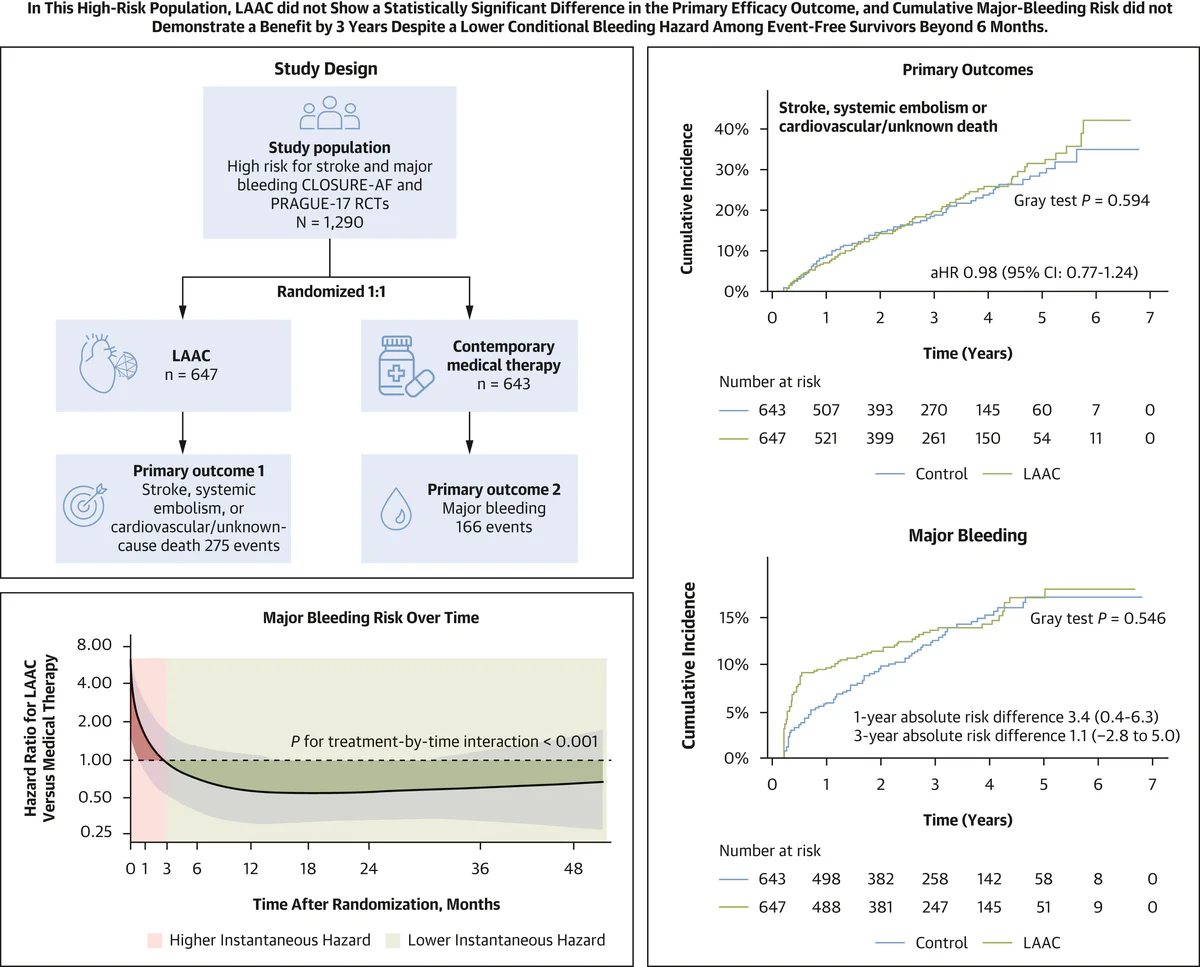
This individual participant data meta-analysis pooled data from two randomized controlled trials, CLOSURE-AF and PRAGUE-17, comprising 1,290 patients with non-valvular AF at high thromboembolic risk (mean CHA2DS2-VASc score ≥4). Participants were randomized to percutaneous LAAC (n=647) or contemporary medical therapy (n=643), including novel oral anticoagulants (NOACs) or antiplatelet regimens as appropriate.
The analysis employed 1-stage common-effect Cox proportional hazards models, stratified by trial and adjusted for age, sex, and risk scores (CHA2DS2-VASc and HAS-BLED). Primary efficacy was the composite of first stroke, systemic embolism, or cardiovascular/unknown death. The primary safety endpoint was time to first major bleeding event. A flexible time-varying Cox model allowed assessment of bleeding risk changes over follow-up. The study protocol was registered with PROSPERO.
Key Findings
The median age was 77.3 years with 62.7% men, reflecting an elderly cohort at substantial risk. Over a median follow-up of 3 years, the primary efficacy endpoint occurred in 21.9% of LAAC patients versus 20.7% with medical therapy, a difference not statistically significant (adjusted hazard ratio [HR] 0.98; 95% confidence interval [CI], 0.77–1.24; P=0.842). This indicates comparable stroke and cardiovascular mortality prevention between the interventions.
Major bleeding events were observed in 13.3% of LAAC patients and 12.4% of controls, also showing no significant difference (adjusted HR 1.03; 95% CI, 0.75–1.39; P=0.874). Notably, the risk of major bleeding varied temporally. During the first year, cumulative incidence of major bleeding was higher with LAAC (9.4%) compared to controls (6.0%), an absolute risk difference of 3.4 percentage points (95% CI, 0.4–6.3). However, by three years, bleeding rates converged (13.2% vs. 12.1%; absolute risk difference 1.1 percentage points; 95% CI, -2.8 to 5.0), suggesting an early procedural bleeding risk offset by lower late bleeding.
These temporal dynamics underscore the importance of close monitoring during the early post-implantation period when procedural complications may contribute to excess bleeding risk. Over longer term, the bleeding hazard from LAAC appears to attenuate.
Expert Commentary
This rigorous meta-analysis synthesizes individual patient data from high-quality randomized trials to clarify the benefit-risk profile of LAAC in an elevated-risk AF cohort. The findings support that LAAC is a viable alternative to medical therapy for stroke prevention in patients for whom long-term anticoagulation poses a significant bleeding threat. However, the absence of a demonstrated long-term bleeding advantage at three years challenges earlier expectations that device closure would reduce hemorrhagic complications by avoiding anticoagulant exposure.
The temporal variation in bleeding hazard aligns with clinical experience that procedural complications—such as pericardial effusion or vascular injury—may elevate early bleeding risk. The convergence of bleeding rates later suggests that benefits of reduced anticoagulant-related bleeding may manifest beyond midterm follow-up—pending confirmatory data.
Limitations include the relatively modest sample size for meta-analysis, limiting precision of late outcome estimates. Additionally, heterogeneity in the types of medical therapy (varied anticoagulant and antiplatelet regimens) may confound interpretation. Trials enrolled selected patients able to tolerate the assigned interventions and may not fully reflect real-world complexity. Therefore, extrapolation to broader populations should be cautious.
Current AF management guidelines increasingly recognize LAAC as an option for patients with contraindications or intolerance to long-term anticoagulation. This analysis corroborates that equivalency in stroke prevention with no imminent bleeding penalty, reinforcing individualized decision-making that balances procedural risks against bleeding history and stroke risk.
Conclusion
Among atrial fibrillation patients at high risk of stroke and bleeding, percutaneous left atrial appendage closure demonstrates similar efficacy and overall major bleeding risk compared to contemporary medical therapy over three years. Early increased bleeding risk following LAAC highlights the need for peri-procedural vigilance. Extended follow-up and larger randomized samples will be essential to define whether late cumulative bleeding benefits emerge, shaping optimal patient selection and timing of intervention. Until then, clinical decisions should weigh procedural risk, patient preferences, and bleeding propensity when considering LAAC versus anticoagulation.
Funding and Clinical Trial Registration
The meta-analysis was conducted by a collaborative group of investigators and funded by institutional grants and industry support disclosed in the original trials. The analysis protocol was registered on PROSPERO (CRD420261335972).
References
1. Skurk C, Eitel I, Thevathasan T, et al. Left Atrial Appendage Closure in Atrial Fibrillation Patients With High Risk of Stroke and Bleeding: An Individual Participant Data Meta-Analysis of Randomized Trials. J Am Coll Cardiol. 2026 Oct 29; PMID: 43018508.
2. Holmes DR Jr, Kar S, Price MJ, et al. Prospective randomized evaluation of the Watchman left atrial appendage closure device in patients with atrial fibrillation versus long-term warfarin therapy: the PROTECT AF trial. J Am Coll Cardiol. 2009 Nov 3;54(22):2055-61.
3. Reddy VY, et al. Left Atrial Appendage Closure vs. Novel Anticoagulation Agents in Atrial Fibrillation: PRAGUE-17 Trial. Circulation. 2020.
4. Kirchhof P, et al. 2020 ESC Guidelines for the diagnosis and management of atrial fibrillation developed in collaboration with the European Association for Cardio-Thoracic Surgery (EACTS). Eur Heart J. 2020;42(5):373-498.
5. Camm AJ, Lip GYH, De Caterina R, et al. 2021 ESC Guidelines for the management of atrial fibrillation developed in collaboration with the European Association for Cardio-Thoracic Surgery (EACTS). Eur Heart J. 2021;42(5):373-498.