MMedXYNews
Ask AIHomeVideos
MedXY AI/MedXY News/Tag: p-tau217

p-tau217

Latest news

Tag

Neurology

Evaluating Blood-Based Biomarkers for Long-Term Prediction of Dementia: Insights from the Whitehall II Cohort

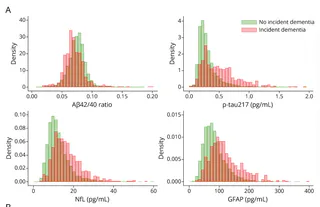
This article reviews a 13-year longitudinal study assessing blood-based biomarkers’ effectiveness in predicting all-cause dementia among community-dwelling older adults, highlighting their modest sensitivity and enhanced predictive value wh

Oct 31, 2026
Neurology

Discriminating Prion Diseases from Alzheimer’s Disease Using Plasma Biomarkers: The Crucial Role of NfL/p-tau217 Ratio

Plasma phosphorylated tau biomarkers overlap in Alzheimer’s and prion diseases, risking diagnostic confusion. The NfL/p-tau217 ratio emerges as an accurate plasma biomarker to distinguish prion diseases from Alzheimer’s, improving diagnosti

Jul 14, 2026
Neurology

Acute Neural Biomarker Elevations After Amateur Soccer Heading: Insights Into Potential Brain Injury

This study reveals that even amateur soccer heading causes immediate, transient increases in blood biomarkers p-tau217 and S100B, indicating acute neural impact and suggesting a dose-response effect.

Jul 14, 2026Sign in to read
Neurology

A Two-Marker Plasma Model Closely Mirrors PET-Based Biological Staging of Alzheimer Disease

Plasma %p-tau217 plus eMTBR-tau243 showed strong agreement with amyloid/tau PET staging, tracked clinical severity, and aligned with neuropathology, supporting a scalable blood-based approach to Alzheimer disease biological staging.

Jun 7, 2026Sign in to read
Neurology

Midlife Central Obesity Tracks With Higher Late-Life Plasma P-tau217 and Biomarker-Verified Alzheimer Dementia, While the Association Reverses in Old Age

In the HUNT Study, higher midlife waist-to-height ratio and BMI predicted higher late-life plasma p-tau217 and biomarker-verified Alzheimer dementia, whereas higher adiposity in late life was associated with lower biomarker levels and lower

Jun 3, 2026
Neurology

Women’s Elevated P-Tau217 Levels and Faster Cognitive Decline: Implications for Preclinical Alzheimer’s Disease

Women with high amyloid-β show higher p-tau217 levels and faster tau accumulation than men, leading to greater cognitive decline. This sex-specific tau response may redefine preclinical Alzheimer’s diagnostics and therapeutics.

Apr 28, 2026
Clinical Updates

Precision Blood-Based Diagnostics for Alzheimer’s Disease: The Synergistic Role of Plasma p-tau217 and eMTBR-tau243

This review synthesizes recent clinical evidence on the integration of plasma p-tau217 and eMTBR-tau243, highlighting how sequential biomarker testing improves the diagnosis of symptomatic Alzheimer’s disease and predicts longitudinal cogni

Apr 7, 2026
Clinical Updates

Precision Diagnostics in Alzheimer’s Disease: Optimizing Plasma p-tau217 Cutoffs for Patients with Comorbidities

This review synthesizes evidence on the impact of kidney function, BMI, and anemia on plasma p-tau217 diagnostic accuracy, advocating for subgroup-specific cutoff strategies to improve clinical outcomes.

Mar 10, 2026
Neurology

Sex-Specific P-Tau217 Dynamics: Why Women Exhibit Accelerated Tau Accumulation and Cognitive Decline

A multi-cohort study demonstrates that women with amyloid-β pathology show higher plasma p-tau217 levels and faster tau PET accumulation than men, providing a biological basis for their increased risk of rapid cognitive decline in preclinic

Feb 20, 2026Sign in to read
Neurology

Biologically Informed p-tau217 Cutoffs: Refining Alzheimer’s Diagnosis Across Diverse Patient Profiles

Standard single cutoffs for plasma p-tau217 are significantly confounded by kidney function, BMI, and anemia. A new study demonstrates that subgroup-specific or double-cutoff strategies markedly improve diagnostic accuracy and cost-effectiv

Feb 6, 2026
Clinical Updates

Precision Screening for Preclinical Alzheimer Disease: The Ascendance of Plasma p-tau217 as a Scalable Biomarker

This review synthesizes recent high-impact evidence on plasma p-tau217, demonstrating its superior utility in identifying amyloid pathology, predicting cognitive decline, and optimizing recruitment for primary prevention trials in cognitive

Jan 2, 2026
Neurology

Plasma p-tau217 and GFAP Emerge as Robust Predictors of Alzheimer’s Progression in Down Syndrome

A pivotal longitudinal study demonstrates that plasma p-tau217 and GFAP accurately predict amyloid-β and tau deposition, cognitive decline, and dementia risk in adults with Down syndrome, offering a transformative, non-invasive tool for cli

Dec 23, 2025
Cardiology

Obicetrapib’s Role in Modulating Alzheimer’s Disease Biomarkers in Patients with Cardiovascular Disease: A Landmark Clinical Study

Obicetrapib, a CETP inhibitor, lowers Alzheimer’s biomarkers like p-tau217 in ASCVD patients, especially ApoE4 carriers, suggesting a potential preventive strategy for high-risk individuals.

Oct 21, 2025
Neurology

Pregnancy Hypertension and Elevated p-tau217: A Midlife Indicator of Alzheimer’s Disease Risk in Women

Pregnancy hypertension is independently associated with higher serum p-tau217 levels in midlife women, suggesting a link to preclinical Alzheimer’s disease pathology and potential for early screening and intervention.

Oct 21, 2025

Most read

  1. 01Intimate Health

    Five Benefits for Women Continuing Sexual Activity After Menopause

  2. 02Intimate Health

    Why Some Women Have a Strong Sex Drive—And Why Men Shouldn't Worry About It

  3. 03Nursing & care

    How often should a couple have sex?

  4. 04Cardiology

    Precision Medicine for Long QT Syndrome Type 2: Lumacaftor Corrects Trafficking Defects and Shortens QT Interval

  5. 05General Surgery

    Optimizing Postoperative Opioid Prescriptions After Intra-Abdominal Cancer Surgery: Comparing the 5x-Multiplier and 3-Tier Models

Go deeper with MedXY AI

Explore the evidence behind the news.

Ask AI
MedXY briefing

Stay informed

Medical news and research updates, delivered to your inbox.

© 2026 MedXY
Contact usAbout usPrivacy PolicyMedXY story