Highlight
The OCEANIC-STROKE trial investigated bleeding patterns associated with asundexian, a novel anticoagulant, in addition to antiplatelet therapy among patients with noncardioembolic ischemic stroke or high-risk transient ischemic attack (TIA). Key findings showed that asundexian significantly reduced ischemic strokes without a significant increase in major bleeding events compared to placebo. However, lower gastrointestinal bleeding incidence was higher with asundexian, primarily involving rectal bleeding. Importantly, bleeding rates were consistent across clinical subgroups, including those receiving dual antiplatelet therapy.
Study Background
Ischemic stroke and transient ischemic attack (TIA) are leading causes of morbidity worldwide, often resulting from thrombotic and embolic mechanisms. Secondary prevention strategies typically involve antiplatelet agents, but residual ischemic risk remains. Novel anticoagulants that minimize bleeding complications could enhance therapeutic options. Asundexian, an oral Factor XIa inhibitor, offers a potentially safer anticoagulant profile to reduce ischemic events without substantially increasing bleeding risk.
The OCEANIC-STROKE trial was designed to evaluate the safety, particularly bleeding risk, of asundexian when added to standard antiplatelet therapy in patients after noncardioembolic ischemic stroke or high-risk TIA, a population with elevated recurrent stroke risk but less tolerance for bleeding complications.
Study Design
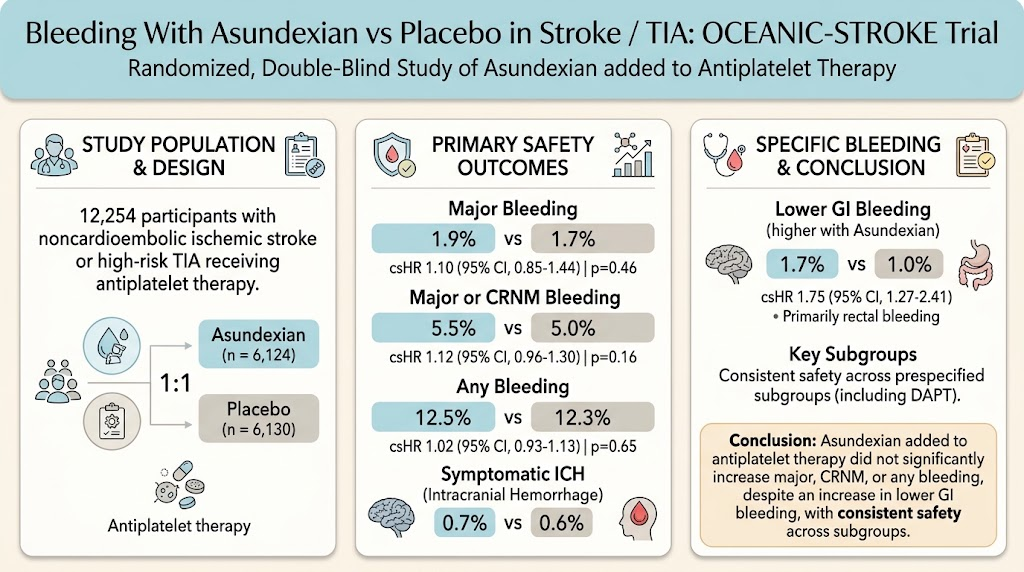
OCEANIC-STROKE was a large, randomized, double-blind, placebo-controlled clinical trial enrolling 12,254 patients who had experienced a recent noncardioembolic ischemic stroke or high-risk TIA. Participants were randomized to receive either asundexian (n=6,124) or placebo (n=6,130), all on background antiplatelet therapy per clinical standard.
The primary safety evaluation focused on bleeding events, categorized by the International Society on Thrombosis and Haemostasis as major bleeding, clinically relevant nonmajor bleeding (CRNM), or minor bleeding. Analyses considered treatment-emergent bleeding with competing risks of death and permanent discontinuation, using cause-specific hazard ratios (csHR) to quantify relative risk.
Key Findings
Major bleeding occurred in 117 patients (1.9%) in the asundexian group versus 107 patients (1.7%) receiving placebo (csHR 1.10; 95% confidence interval [CI] 0.85 to 1.44; P=0.46), indicating no statistically significant increase in major bleeding risk with asundexian.
When combining major and CRNM bleeding, rates were 5.5% with asundexian versus 5.0% with placebo (csHR 1.12; 95% CI 0.96 to 1.30; P=0.16), again showing no significant difference. Overall bleeding events—including minor bleeds—were similar between groups (12.5% vs 12.3%; csHR 1.02; 95% CI 0.93 to 1.13; P=0.65).
Subgroup analyses confirmed consistent safety profiles irrespective of planned dual antiplatelet therapy, highlighting the robustness of bleeding risk findings across clinical contexts.
Symptomatic intracranial hemorrhage, a feared complication post-stroke, was rare and comparable between groups (0.7% vs 0.6%). However, any gastrointestinal bleeding was more frequent with asundexian (3.0% vs 2.4%; csHR 1.28; 95% CI 1.03 to 1.59), particularly lower gastrointestinal bleeding (1.7% vs 1.0%; csHR 1.75; 95% CI 1.27 to 2.41), predominantly manifesting as rectal bleeding.
Other bleeding categories, such as procedure-related or mucosal bleeding, did not show significant differences between treatment arms.
Expert Commentary
The OCEANIC-STROKE trial’s findings are clinically significant because they demonstrate the potential to intensify anticoagulation via Factor XIa inhibition on top of antiplatelet therapy without a corresponding increase in severe bleeding events, a balance rarely achieved in stroke secondary prevention.
Increased gastrointestinal bleeding, especially rectal bleeding, with asundexian requires vigilance but appears manageable and may reflect localized mucosal effects rather than systemic bleeding propensity. While the lack of a significant rise in intracranial hemorrhage is reassuring, long-term data will be important to confirm these safety findings.
Limitations include the trial’s relatively short follow-up and the fixed asundexian dose, which may limit assessment of dose-dependent bleeding risks. Generalizability to diverse populations, including those with cardioembolic stroke, also merits further investigation. Mechanistically, Factor XIa inhibition targets the intrinsic coagulation pathway, sparing primary hemostasis, possibly explaining the favorable bleeding profile.
Conclusion
The addition of asundexian to antiplatelet therapy in patients with noncardioembolic ischemic stroke or high-risk TIA reduces ischemic strokes without significantly increasing major bleeding, including intracranial hemorrhage. The notable exception is an increased incidence of lower gastrointestinal bleeding, primarily rectal, warranting clinical awareness and monitoring.
These results highlight asundexian as a promising therapeutic agent balancing stroke prevention and bleeding risk, though further studies are needed to ascertain long-term safety and broader applicability.
Funding and Registration
The OCEANIC-STROKE trial was registered on ClinicalTrials.gov under identifier NCT05686070. Details related to funding sources were not specified in the summary but are important for transparency.
References
Eikelboom JW, Xu L, Shoamanesh A, Dong Q, Hirano T, Saver JL, et al. Bleeding With Asundexian Versus Placebo in Patients With Noncardioembolic Ischemic Stroke or High-Risk TIA: OCEANIC-STROKE Randomized Trial. Circulation. 2026 Oct 13. PMID: 42866879. Available at: https://pubmed.ncbi.nlm.nih.gov/42866879/