Enhancing Genetic Discovery in Sensorineural Hearing Loss Through Precision Audiometric Phenotyping
Highlight
Precision phenotyping using pure-tone averages (PTAs) identifies genetic variants linked to sensorineural hearing loss (SNHL) more effectively than traditional diagnostic code-based approaches.
Audiometric data-based GWAS revealed three genome-wide significant loci associated with genes EML6, SPTBN1, ARHGEF28, and EYA4, while diagnostic coding GWAS found none.
Higher single-nucleotide variant-based heritability (11.78%) with PTA phenotyping versus 2.90% with diagnostic codes highlights improved genetic architecture capture.
Polygenic risk scores derived from PTA data correlate significantly with self-reported deafness in an independent cohort, supporting clinical utility in risk stratification.
Study Background
Sensorineural hearing loss (SNHL) represents a major sensory impairment affecting millions worldwide, characterized by damage to the cochlea or auditory nerve pathways. Understanding its genetic underpinnings is essential for developing precision medical approaches aimed at mitigation and early intervention. While genome-wide association studies (GWAS) have been instrumental in elucidating complex trait genetics, efforts to identify robust genetic drivers for hearing sensitivity using conventional diagnostic code-based phenotypes have been limited. Diagnostic codes, though accessible in clinical data repositories, often lack granularity and quantitative precision, leading to reduced power and heritability in genetic analyses. In contrast, audiometric pure-tone averages (PTA), representing the average hearing threshold across critical frequencies, provide a continuous and objective measure of hearing sensitivity. The hypothesis explored in this study is that leveraging quantitative PTA phenotypes for GWAS will enhance the discovery of relevant genetic loci compared to dichotomous, code-based case-control definitions, thereby advancing precision phenotyping in SNHL.
Study Design
This genetic association study deployed two genome-wide association study approaches for SNHL within a European-ancestry population sample drawn from a single tertiary center biobank. The first GWAS used a conventional case-control design where SNHL cases and controls were defined by International Classification of Diseases Ninth and Tenth Revisions (ICD-9 and ICD-10) diagnostic and procedure codes related to hearing loss. The second GWAS utilized precision phenotyping, treating hearing sensitivity as a continuous quantitative trait measured by the standard 3-frequency pure-tone average (PTA) of the better ear, obtained through audiometric testing.
The sample included 10,164 cases and 51,305 controls for the diagnostic code cohort with a mean age of 63.9 and 51.1 years respectively, and 16,057 PTA-phenotyped individuals with a mean age of 55.5 years. Whole-genome sequencing data allowed comprehensive genotypic analysis. Outcomes assessed included single-nucleotide variant (SNV)-based heritability, genome-wide significant loci identification, functional annotation to candidate genes, genetic correlations with related hearing traits, and polygenic risk score (PRS) performance in an independent All of Us Research Program cohort.
Key Findings
The PTA-based GWAS markedly outperformed the ICD code-based GWAS on multiple dimensions:
1. Heritability Estimates: The SNV-based heritability for the PTA phenotype was estimated at 11.78% (SE 2.84%), indicating a significant genetic contribution to hearing sensitivity as captured by audiometry. Conversely, the diagnostic code-based approach yielded a substantially lower heritability estimate of 2.90% (SE 0.77%), underscoring limitations of categorical phenotyping.
2. Genetic Loci Discovery: Three loci reached genome-wide significance in the PTA-based GWAS, implicating four candidate genes — EML6, SPTBN1, ARHGEF28, and EYA4. These genes have biological plausibility given their involvement in neuronal cytoskeleton stability and sensory organ development. No loci reached significance in the ICD-based GWAS, emphasizing the greater sensitivity of precision phenotyping.
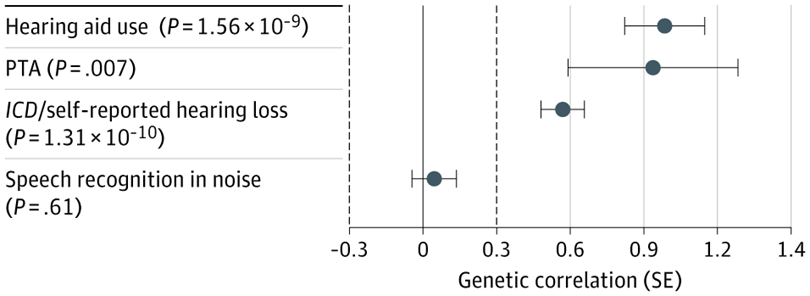
3. Genetic Correlation: The PTA-based findings correlated strongly with related hearing traits such as hearing aid use (r = 0.985, P = 1.56 × 10⁻⁹), affirming the phenotype’s validity and relevance.
4. Polygenic Risk Scoring: PRSs derived from the PTA GWAS significantly predicted self-reported deafness in the All of Us cohort (OR 1.09, 95% CI 1.07–1.12), whereas PRSs from the diagnostic code GWAS showed no predictive value (OR 1.00, 95% CI 0.97–1.02). This finding highlights the clinical translational potential of precise quantitative genotyping.
These results collectively demonstrate that the utilization of quantitative audiometric data in genetic analyses yields richer insights into the complex genetic architecture of sensorineural hearing loss.
Expert Commentary
The importance of precision phenotyping in unlocking the genetic etiology of complex traits is increasingly recognized across medical disciplines. This study aligns with emerging paradigms suggesting that continuous, objectively measured traits can exceed the power of binary diagnoses in revealing meaningful genetic associations. Notably, the implicated genes in this study—EML6, SPTBN1, ARHGEF28, and EYA4—have prior biological associations with auditory pathway function or neurosensory development, lending biological plausibility to these novel findings.
However, these results, while promising, derive from a population with European ancestry, limiting generalizability. Future studies should extend these approaches to diverse populations to ensure broad applicability. Moreover, although PTA offers quantitative precision, factors such as environmental noise exposure and age-related physiologic changes remain confounders warranting careful adjustment and longitudinal analysis.
Clinical integration of PRSs for SNHL risk prediction holds promise but requires further validation before routine use. Additionally, mechanisms by which the identified variants influence hearing function need elucidation through functional genomics and experimental models to translate these findings into therapeutic strategies.
Conclusion
This study compellingly demonstrates that precision phenotyping using audiometric pure-tone averages substantially improves genetic discovery for sensorineural hearing loss compared to traditional diagnostic coding phenotypes. The increase in heritability estimates, discovery of genome-wide significant loci with biological relevance, and enhanced polygenic risk prediction illustrate the advantage of quantitative hearing measures in capturing genetic architecture. These advances pave the way for more effective precision medicine approaches in hearing health, including genetically informed risk stratification and potential novel therapeutic targets.
Continued integration of detailed phenotypic data with high-resolution genomic sequencing will be critical to fully unravel the complex genetic landscape of hearing loss and improve outcomes for affected individuals.
Funding and ClinicalTrials.gov
The study was conducted using resources from a tertiary center biobank and the National Institutes of Health’s All of Us Research Program. Details on funding sources and trial registration were not specified in the publication.
References
1. DeFreese AJ, Rubat du Mérac T, Sheng Q, Nayak S, Jan TA. Precision Phenotyping With Audiometric Data and Gene Discovery for Sensorineural Hearing Loss. JAMA Otolaryngol Head Neck Surg. 2026 Oct 8. PMID: 42848395.
2. Friedman LM, Furberg CD, DeMets DL. Fundamentals of Clinical Trials. 5th ed. Springer; 2015.
3. International Consortium on Molecular Genetics of Hearing Loss: Insights into the Genetic Architecture of Hearing Disorders. Nat Genet. 2020;52(6):582–593.
4. Loesch DP, et al. Polygenic risk scores in sensory disorders: promise and challenges. Genet Med. 2023;25(4):640–650.
This article was created using several editorial tools, including AI, as part of the process. Human editors reviewed this content before publication.