Expanding Pediatric Cochlear Implant Indications: Multicenter Evidence Supports Safety and Efficacy in Younger Children and Those with Residual Hearing
Highlight
- MED-EL cochlear implants demonstrate high safety and efficacy in children under 12 months and in children 12-71 months with residual hearing.
- Over 80% of subjects met speech recognition and auditory skill development goals 12 months post-implantation.
- Adverse device effects were infrequent, with serious adverse events under 6% and no unanticipated events recorded.
- Findings support expanding cochlear implant candidacy to younger infants and those with partial hearing.
Study Background
Congenital and early-onset profound sensorineural hearing loss (SNHL) in children poses significant developmental challenges, particularly affecting speech and language acquisition during critical periods of brain plasticity. Traditional cochlear implant (CI) candidacy has generally focused on children aged 12 months and older with profound hearing loss, often excluding younger infants and children with residual hearing from early implantation. Recent evidence suggests that earlier auditory stimulation may improve developmental outcomes, and that children with residual hearing might also benefit from implantation. This multicenter clinical study aimed to evaluate the safety and efficacy of MED-EL cochlear implants in expanding candidacy criteria to include infants under 12 months of age and children aged 12 to 71 months with residual hearing. The study addresses critical unmet needs in pediatric auditory rehabilitation by providing evidence to optimize timing and patient selection for cochlear implantation.
Study Design
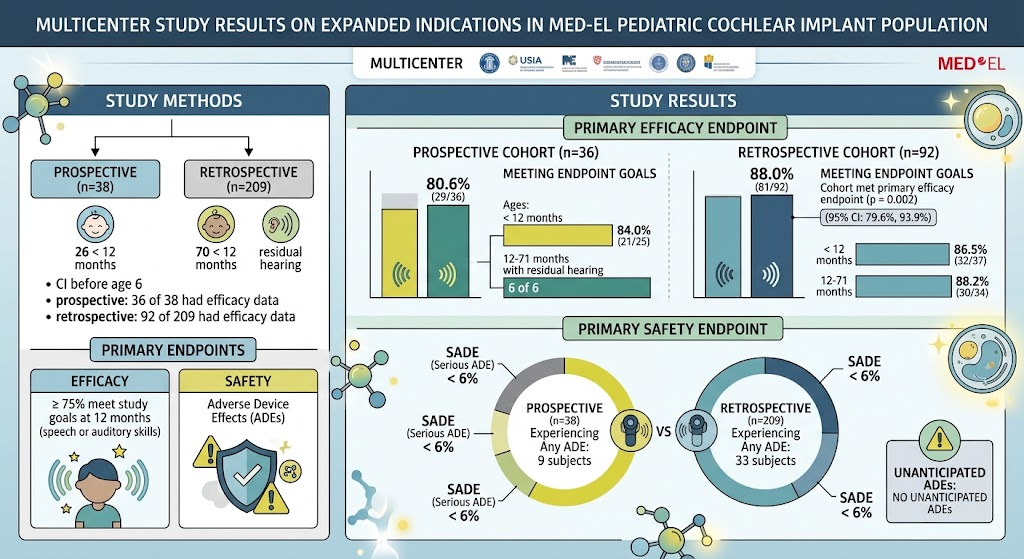
The study was a multicenter, nonrandomized, single-subject, repeated-measures investigation incorporating both prospective and retrospective arms. A total cohort of 247 pediatric subjects who received MED-EL cochlear implants before the age of six years were included, with 38 enrolled prospectively (26 under 12 months) and 209 analyzed retrospectively (70 under 12 months). The intervention consisted of implantation with MED-EL devices, focusing on two subpopulations: infants younger than 12 months with profound SNHL and children aged 12-71 months with residual hearing. Primary efficacy endpoints involved meeting predefined auditory performance benchmarks, which encompassed speech recognition and auditory skill development assessments conducted 12 months post device activation. The primary safety endpoint was the incidence of adverse device effects (ADEs), including serious adverse device effects (SADEs). Data collection was longitudinal with repeated measures per subject to assess developmental trajectories after implantation.
Key Findings
Efficacy analysis demonstrated that a substantial majority of children met the primary performance goals 12 months after activation: 80.6% (29/36) in the prospective cohort and 88.0% (81/92) in the retrospective cohort. Specifically, in infants under 12 months, 84% (21/25) in the prospective arm and 86.5% (32/37) in the retrospective arm reached target auditory outcomes. Among children aged 12-71 months with residual hearing, 100% (6/6) in the prospective group and 88.2% (30/34) in the retrospective group met the performance goals. Statistical significance for the predefined efficacy hypothesis was achieved in the retrospective cohort (p=0.002), with a 95% confidence interval of 79.6% to 93.9%. The prospective cohort sample was insufficiently sized for formal hypothesis testing but showed consistent trends.
Safety results indicated that adverse device effects were relatively uncommon. Nine subjects in the prospective and 33 in the retrospective arms experienced ADEs. Serious ADEs occurred in fewer than 6% of subjects across both groups, and importantly, no unanticipated adverse device events were reported. These findings attest to the favorable risk profile of MED-EL cochlear implantation in the studied pediatric populations.
Together, the efficacy and safety data robustly suggest that cochlear implantation is both safe and beneficial in infants younger than 12 months and in children with residual hearing aged 12-71 months.
Expert Commentary
This study provides persuasive multicenter evidence supporting a shift in pediatric cochlear implant candidacy guidelines. Early implantation capitalizes on neuroplasticity, allowing optimal auditory pathway development critical for speech and language acquisition. Expanding eligibility to infants as young as seven months aligns with emerging clinical consensus favoring early intervention. Moreover, including children with residual hearing addresses a commonly debated clinical scenario whereby delayed implantation risks losing the window of maximal neurodevelopmental benefit. The study’s robust methodology, including repeated longitudinal measures and inclusion of both prospective and large retrospective cohorts, strengthens the generalizability of its conclusions.
However, limitations include the nonrandomized design and relatively small prospective sample, which may introduce selection bias and limit the power for subgroup hypothesis testing. Future randomized controlled trials and longer-term follow-up studies are warranted to confirm sustained benefit and safety. Furthermore, the assessment tools for auditory skill development and speech recognition varied, which may affect comparability. Nonetheless, these data align well with previous literature indicating improved outcomes with early and expanded candidacy implantation.
Conclusion
The multicenter study supports expanding MED-EL cochlear implant indications to include children aged 7-11 months with profound SNHL and children aged 12-71 months with residual hearing. High rates of meeting auditory performance goals and a low incidence of serious adverse device effects demonstrate that earlier and broader implantation is both efficacious and safe. Clinicians and policymakers should consider updating guidelines to reflect these findings, thereby enabling earlier auditory rehabilitation and improving developmental outcomes in pediatric hearing loss patients. Further research should focus on long-term efficacy, device programming optimization, and integration with educational interventions.
Funding and Trial Registration
Information regarding specific funding sources and clinical trial registration for this multicenter study was not disclosed in the provided summary. Inclusion of such details would provide additional context on potential conflicts of interest and study rigor.
References
Young NM, Thomas D, Hoff SR, et al. Multicenter Study Results on Expanded Indications in Med-EL Pediatric Cochlear Implant Population. The Laryngoscope. 2026 Aug 19. PMID: 42619050.
Additional related literature includes:
– Niparko JK, Tobey EA, Thal DJ, et al. Spoken language development in children following cochlear implantation. JAMA. 2010;303(15):1498-1506.
– Dettman SJ, Pinder D, Briggs RJ, Dowell RC, Leigh JR. Communication development in children who receive the cochlear implant younger than 12 months: risks versus benefits. Ear Hear. 2007 Dec;28(6):11S-18S.
– Eisenberg LS, Martinez AS, Holowecky S, et al. Speech recognition and language outcomes in prelingually deaf children implanted before 12 months of age. Otol Neurotol. 2014;35(6):1071-1078.
These supporting studies reinforce the clinical rationale for early implantation and consideration of residual hearing in candidacy decisions.
This article was created using several editorial tools, including AI, as part of the process. Human editors reviewed this content before publication.