Highlight
FLT3-ITD acute myeloid leukemia (AML) often develops resistance to FLT3 tyrosine kinase inhibitors (TKIs), necessitating novel targets to overcome drug tolerance.
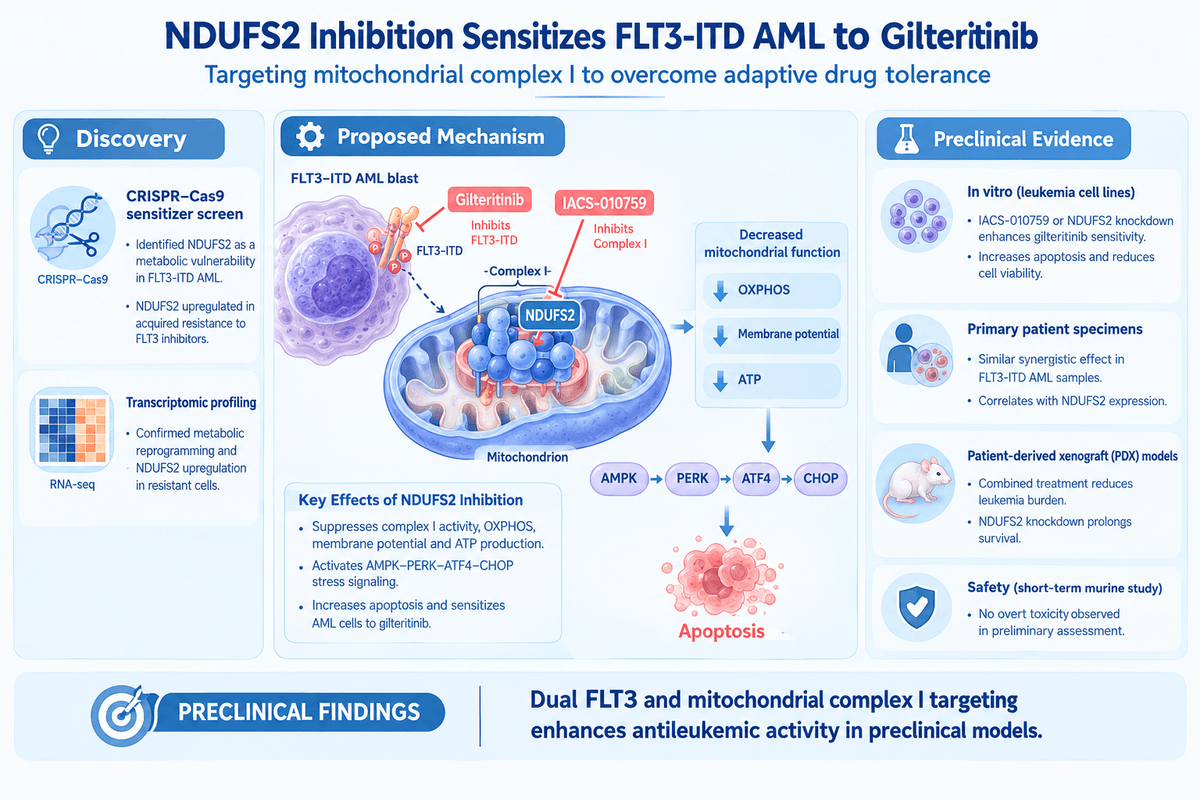
The mitochondrial complex I subunit NDUFS2 is identified as a key mediator of tolerance to FLT3 TKI therapy in FLT3-ITD AML.
Targeting NDUFS2 genetically or pharmacologically decreases mitochondrial respiratory function, promoting apoptosis and restoring FLT3 inhibitor sensitivity.
Preclinical models show that combining FLT3 inhibitors with mitochondrial complex I inhibition reduces leukemia burden without overt toxicity.
Study Background
Acute myeloid leukemia (AML) harboring FLT3 internal tandem duplication (FLT3-ITD) mutations represents a subset of AML with particularly poor prognosis due to high relapse rates after treatment. Although FLT3 tyrosine kinase inhibitors (TKIs) like gilteritinib have improved outcomes, drug resistance and disease recurrence remain major clinical challenges. Understanding mechanisms underlying FLT3 TKI tolerance is critical to developing effective combination therapies. Previous research has suggested metabolic adaptations contribute to drug resistance in AML, but specific metabolic dependencies remain insufficiently characterized.
Study Design
This study employed a comprehensive approach integrating metabolism-focused CRISPR-Cas9 sensitizer screens with transcriptomic profiling of both gilteritinib-resistant cell lines and primary FLT3-ITD AML samples. The CRISPR screen aimed to identify metabolic genes whose inhibition would sensitize AML cells to FLT3 TKI cytotoxicity. Genetic knockdown and pharmacologic inhibition of candidate targets were evaluated in vitro and in patient-derived xenograft (PDX) mouse models to assess effects on mitochondrial function, apoptosis, drug sensitivity, and leukemia burden. Safety assessments were conducted by preliminary murine toxicity studies under a short-term dosing regimen.
Key Findings
The study revealed that the mitochondrial complex I subunit NDUFS2 was consistently upregulated in cells with acquired resistance to gilteritinib and was preferentially expressed in FLT3-ITD AML compared to other subtypes. Genetic knockdown of NDUFS2 led to significant impairment of complex I enzymatic activity, disrupted oxidative phosphorylation, reduced mitochondrial membrane potential, and decreased ATP production. These mitochondrial perturbations triggered apoptosis, effectively sensitizing FLT3-ITD AML cells to gilteritinib treatment.
Pharmacologic inhibition of complex I using IACS-010759 mirrored the effects of genetic knockdown, enhancing the efficacy of gilteritinib against FLT3-ITD AML cell lines and primary patient samples ex vivo. Mechanistically, combined treatment activated an integrated stress response involving AMPK-PERK-ATF4-CHOP signaling pathways, further promoting apoptosis.
In vivo, co-treatment with gilteritinib and IACS-010759 significantly reduced leukemia burden in PDX models of FLT3-ITD AML. Genetic NDUFS2 knockdown similarly prolonged survival in xenograft mice. Notably, preliminary murine safety studies did not identify overt toxicity with short-term dosing of the complex I inhibitor, supporting potential translational feasibility. These results underscore NDUFS2-dependent complex I activity as an adaptive metabolic dependency facilitating FLT3 TKI tolerance.
Expert Commentary
The identification of NDUFS2 as a metabolic vulnerability in FLT3-ITD AML addresses a pressing clinical need given the frequent failure of FLT3 TKIs due to resistance. Targeting mitochondrial metabolism, specifically complex I activity, represents a compelling approach to augment FLT3 inhibitor efficacy by disrupting energy homeostasis essential for resistant leukemic cells’ survival.
The activation of the AMPK-PERK-ATF4-CHOP axis implicates an integrated cellular stress response, linking metabolic stress to apoptosis induction. This mechanistic insight enhances biological plausibility and provides avenues for biomarker development to monitor treatment response. However, longer-term safety and the specificity of mitochondrial inhibitors in normal hematopoietic cells require further evaluation.
Future clinical trials could consider combination regimens integrating FLT3 TKIs with mitochondrial complex I inhibitors, with stratification based on NDUFS2 expression or metabolic signatures. Integration with existing therapeutic strategies, including chemotherapy and emerging immunotherapies, will also be critical.
Conclusion
This study highlights mitochondrial complex I subunit NDUFS2 as a key mediator of FLT3 TKI tolerance in FLT3-ITD AML and demonstrates that targeting NDUFS2-dependent complex I activity can sensitize resistant AML cells to FLT3 inhibitors. The combined genetic and pharmacologic approaches led to enhanced apoptosis and reduced leukemia burden in preclinical models without significant toxicity signals. These findings offer a promising metabolic targeting strategy to overcome FLT3 inhibitor resistance. Further clinical development and mechanistic exploration are warranted to translate this approach into improved patient outcomes.
Funding and ClinicalTrials.gov
The original study funding sources and clinical trial registrations were not specified in the abstract. For translation to clinical trials, comprehensive safety and efficacy evaluation of mitochondrial complex I inhibitors in combination with FLT3 TKIs is necessary.
References
Tong X, Chen G, Pan Y, et al. Targeting the mitochondrial complex I subunit NDUFS2 potentiates FLT3 inhibition in acute myeloid leukaemia with FLT3 internal tandem duplication. Leukemia. 2026 Oct 19. PMID: 42897233.
Stone RM, Mandrekar SJ, Sanford BL, et al. Midostaurin plus Chemotherapy for Acute Myeloid Leukemia with a FLT3 Mutation. N Engl J Med. 2017;377(5):454-464.
Perl AE. FLT3 inhibition in acute myeloid leukemia: Military lessons beyond the battlefield. Hematology Am Soc Hematol Educ Program. 2018;2018(1):330-337.
DiNardo CD, Pratz K, Pullarkat V, et al. Venetoclax combined with decitabine or azacitidine in treatment-naive, elderly patients with AML. Blood. 2019;133(1):7-17.
Farge T, Saland E, de Toni F, et al. Chemotherapy-Resistant Human Acute Myeloid Leukemia Cells Are Not Enriched for Leukemic Stem Cells but Require Oxidative Metabolism. Cancer Discov. 2017;7(7):716-735.