Highlight
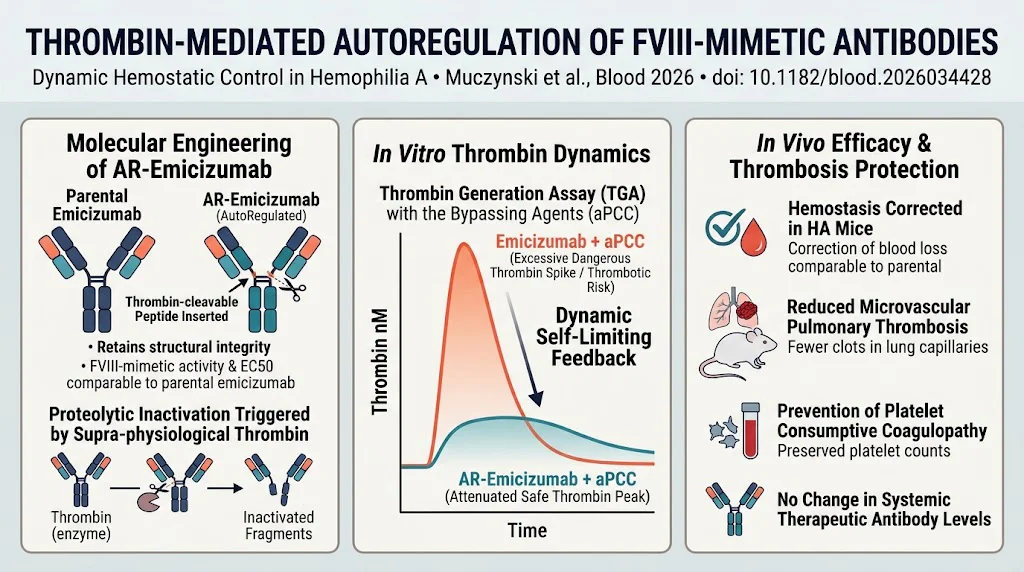
A thrombin-sensitive peptide was engineered into emicizumab to confer thrombin-mediated proteolytic inactivation upon high thrombin exposure.
The AutoRegulated (AR) emicizumab retained full FVIII-mimetic activity and corrected bleeding in hemophilia A mice comparable to the parental antibody.
Thrombin-dependent inactivation dynamically limits excessive thrombin generation, effectively reducing risks linked to co-administration of bypassing agents such as aPCC.
In vivo, AR-emicizumab prevented thrombotic complications including platelet consumption and pulmonary microvascular thrombosis without reducing systemic exposure.
Study Background
Hemophilia A (HA) is a congenital bleeding disorder caused by deficiency or dysfunction of coagulation factor VIII (FVIII). Emicizumab, a bispecific monoclonal antibody mimicking FVIII activity, has revolutionized HA management by facilitating convenient subcutaneous prophylaxis effective regardless of inhibitor status. Despite its efficacy, emicizumab possesses constitutive procoagulant activity which lacks feedback inhibition, predisposing some patients, especially when given alongside bypassing agents like activated prothrombin complex concentrates (aPCC), to excessive thrombin generation and thrombotic microangiopathy. This class effect among FVIII-mimetic antibodies highlights a significant unmet safety need to dynamically regulate procoagulant activity in response to local coagulation status, ideally preserving hemostatic efficacy while minimizing thrombotic risk.
Study Design
Researchers developed an AutoRegulated (AR) version of emicizumab by inserting a short thrombin-cleavable peptide within the hinge region of both antibody arms. This engineering aimed to enable thrombin-mediated proteolytic cleavage and functional inactivation of the antibody upon exposure to supra-physiological thrombin concentrations. Structural integrity and biological function were characterized through in vitro FVIII-mimetic assays measuring effective concentration for half-maximal activity (EC50), thrombin generation tests, and in vivo bleeding models in HA mice. Safety assessments included evaluation of platelet counts, microvascular thrombosis, and systemic antibody levels, with particular attention to effects during combined administration with bypassing agents such as aPCC.
Key Findings
The AR-emicizumab maintained potent FVIII-mimetic activity similar to the parental molecule, with comparable EC50 values and efficacy in correcting hemorrhage in HA mouse models. Crucially, the engineered thrombin-cleavable hinge did not compromise antibody stability or baseline functional potency.
Upon exposure to elevated thrombin levels exceeding physiological ranges, AR-emicizumab underwent proteolytic cleavage resulting in inactivation of procoagulant activity, whereas parental emicizumab remained unaffected. In thrombin generation assays, AR-emicizumab substantially mitigated the excessive thrombin peak triggered by co-administration of aPCC, indicating a self-limiting feedback mechanism that dynamically adjusted coagulation enzyme generation.
In vivo experiments corroborated these findings: AR-emicizumab prevented adverse effects seen with parental emicizumab combined with aPCC, specifically platelet consumptive coagulopathy and microvascular thrombosis within pulmonary circulation, both key contributors to thrombotic morbidity associated with excess thrombin generation in this context. Importantly, systemic circulating antibody concentrations were not diminished, underscoring that the control mechanism acted in an on-demand, localized manner in synchrony with thrombin presence.
Expert Commentary
These findings represent a significant advancement for hemophilia A therapeutics, addressing the critical challenge of balancing efficacy with safety in FVIII-mimetic antibody technology. The novel AR design introduces a biologically plausible and elegant strategy leveraging endogenous thrombin feedback to autoregulate antibody activity. This reduces risk of thrombosis during complex coagulopathic conditions without losing the benefits of continuous prophylaxis.
While the preclinical data is compelling, clinical validation will be essential to confirm translational safety and effectiveness. Potential limitations include variability in thrombin dynamics across patients and clinical situations and unknown long-term immunogenicity of the modified antibody. Nevertheless, this study exemplifies a precision medicine approach, integrating an enzyme-responsive cleavage site to achieve context-dependent modulation of coagulation therapy.
Conclusion
Thrombin-mediated AutoRegulated FVIII-mimetic antibodies, exemplified by AR-emicizumab, offer a promising new class of hemophilia A therapies coupling potent hemostatic efficacy with dynamic, thrombin-triggered safety control. This innovative platform could transform management paradigms by aligning procoagulant activity with local physiological needs, minimizing potentially life-threatening thrombotic risks inherent to current FVIII replacements and mimetics. Future clinical trials are warranted to assess the translation of these benefits into patient outcomes and to explore broader applicability for hemostatic biologics requiring tight feedback regulation.
Funding and Clinical Trials
Details regarding funding sources and clinical trial registrations were not provided in the primary publication. Continued development and clinical evaluation of AR-emicizumab will likely involve collaborative efforts between academic investigators and industry sponsors.
References
Muczynski V, Smith A, Baccaro A, et al. Thrombin-mediated AutoRegulation of FVIII-mimetic antibodies enabling dynamic control of the hemostatic response. Blood. 2026 Oct 23; PMID: 42913487.
Shima M, Hanabusa H, Taki M, et al. Emicizumab prophylaxis in patients with hemophilia A with inhibitors. N Engl J Med. 2016;374(23):2246-53.
Oldenburg J, Mahlangu JN, Kim B, et al. Emicizumab prophylaxis in hemophilia A with inhibitors. N Engl J Med. 2017;377(9):809-18.
Fitzgerald D, Granger CB. Novel strategies to regulate coagulation: a role for feedback-controlled therapeutics. J Thromb Haemost. 2023;21(6):1088-1097.