Elevated BMI and Open Airway Reconstruction: Disentangling the Impact on Postoperative Outcomes
Highlight
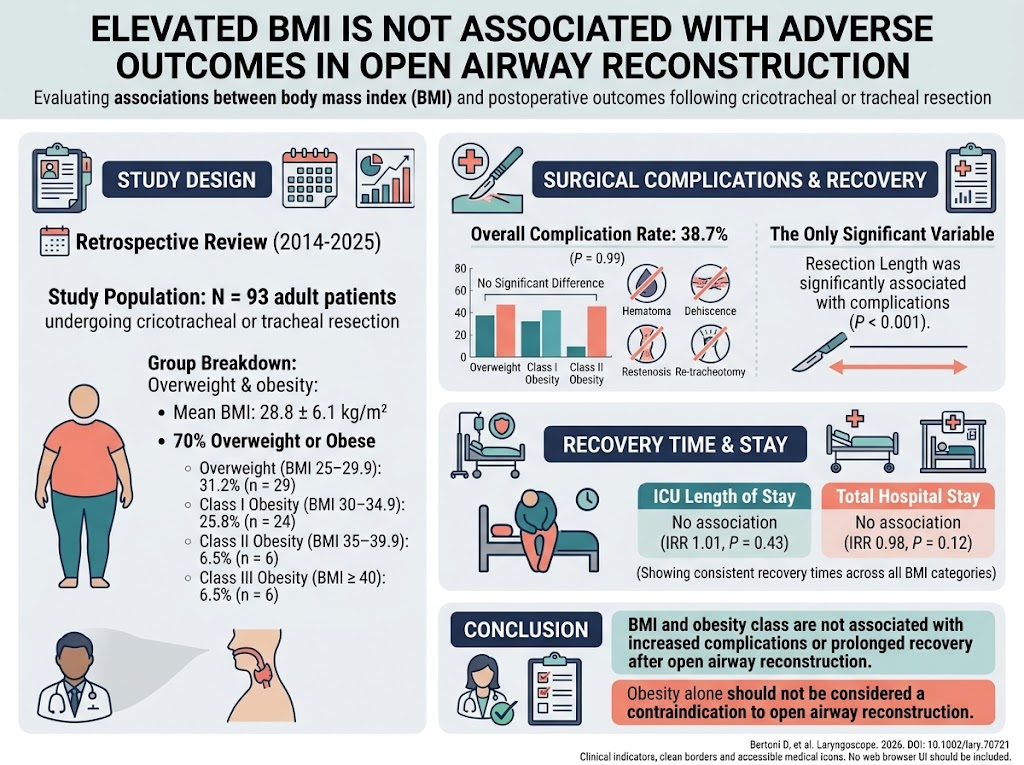
- Overweight and obese patients undergoing cricotracheal or tracheal resection showed no increased postoperative complication rates compared to normal BMI patients.
- BMI was not significantly associated with ICU length of stay, total hospital stay, or incidence of specific adverse outcomes such as hematoma, wound dehiscence, restenosis, or mortality.
- Resection length emerged as the only significant predictor of postoperative complications, highlighting surgical factors over patient BMI.
- Obesity should not be considered a contraindication for open airway reconstruction based on current evidence.
Study Background
Structural airway stenoses, including cricotracheal and tracheal strictures, require open airway reconstruction when conservative measures fail. These surgeries are complex and pose significant perioperative morbidity risks. Obesity, a globally prevalent condition characterized by excess body fat accumulation, is known to adversely impact outcomes in many surgical specialties by contributing to wound healing difficulties, respiratory compromise, and cardiovascular strain. However, its specific influence on open airway reconstruction remains inadequately defined, leaving a clinical uncertainty about risk stratification and patient selection in overweight and obese populations.
Study Design
This retrospective cohort study analyzed adults who underwent cricotracheal or tracheal resection over an 11-year period (2014–2025). Patient demographic data, BMI values (categorized per World Health Organization criteria), surgical details including resection length, and postoperative outcomes were collected and statistically analyzed. Outcomes of interest encompassed complication rates—both overall and individual types such as hematoma, wound dehiscence, restenosis—intensive care unit (ICU) and total hospital length of stay, need for revision surgeries including re-tracheotomy procedures, and mortality incidence. Multivariate regression models suitable for count and time-to-event data, including Poisson, Cox proportional hazards, negative binomial, and firth logistic regressions, were utilized to assess associations adjusting for confounders.
Key Findings
The study included 93 adult patients with an average BMI of 28.8 ± 6.1 kg/m². Most patients (70%) were categorized as overweight or obese: 31.2% overweight, 25.8% Class I obesity, 6.5% Class II obesity, and 6.5% Class III obesity.
The overall postoperative complication rate was 38.7%, but statistical analysis revealed no significant difference between BMI groups (p=0.99). Similarly, BMI as a continuous variable did not demonstrate meaningful correlation with ICU stay length (Incidence Rate Ratio [IRR] 1.01; p=0.43) or total hospital stay (IRR 0.98; p=0.12). Examined specific complications—including hematoma formation, surgical site dehiscence, restenosis requiring intervention, and mortality—showed no association with BMI category or value.
Instead, resection length was the only variable statistically significantly predictive of complication occurrence (p<0.001), underscoring surgical complexity and extent as primary determinants of postoperative risk.
Reintubation rates, re-tracheotomy needs, and revision procedure frequencies did not differ significantly across BMI groups either, supporting the notion that elevated BMI does not exacerbate airway reconstruction recovery challenges.
Expert Commentary
This study provides a valuable evidence base addressing a common yet controversial issue in airway reconstructive surgery. The data challenge the traditional perception that obesity necessarily portends higher surgical risk and poorer outcomes in open airway reconstruction procedures. The rigorous statistical methodology, including adjustment for relevant covariates and use of appropriate regression models, enhances confidence in the findings.
Nevertheless, as a retrospective single-center analysis, limitations include potential selection bias and unmeasured confounders influencing outcomes. Patients with extreme comorbidities might have been excluded preoperatively, limiting generalizability. The modest sample size could have underpowered detection of subtle associations. Future prospective multicenter studies with larger cohorts and standardized perioperative management protocols are warranted to confirm these results and further delineate risk profiles.
Mechanistically, the finding that resection length outweighs BMI as a risk factor aligns with clinical experience: longer airway resections are technically more challenging, increase ischemic risk, and prolong anesthesia times. Obesity-related physiologic factors such as altered pulmonary mechanics or wound healing impairment may have less impact in this surgical niche than in others.
Conclusion
Elevated BMI and obesity class do not appear to independently increase risk of complications, ICU or hospital length of stay, or revision surgery after open cricotracheal and tracheal resection. Surgical factors, most notably resection length, play a more substantive role in postoperative outcomes. These findings support not excluding patients from potentially curative open airway reconstruction based solely on excess weight or obesity classification. Clinicians should focus on comprehensive perioperative assessment and individualized surgical planning rather than relying on BMI thresholds as contraindications. Further research can refine optimal management strategies in this growing patient demographic.
Funding and ClinicalTrials.gov
The original study did not report specific funding sources or clinical trial registration numbers.
References
1. Bertoni D, Shuman E, Wee CP, O’Dell K. Elevated BMI Is Not Associated With Adverse Outcomes in Open Airway Reconstruction. Laryngoscope. 2026 Jun 30;136(10):4219-4233. PMID: 42380039.
2. World Health Organization. Obesity and overweight. Available at: https://www.who.int/news-room/fact-sheets/detail/obesity-and-overweight. Accessed June 2026.
3. Grillo HC. Surgical treatment of tracheal stenosis. Chest Surg Clin N Am. 1993 Nov;3(4):851-69.
4. Derkay CS, Darrow DH. Diagnosis and management of tracheal stenosis in children. Curr Opin Otolaryngol Head Neck Surg. 2009 Dec;17(6):518-22.
5. De Virgilio A, et al. Impact of obesity on perioperative outcomes following airway procedures: A systematic review. J Otolaryngol Head Neck Surg. 2024 Mar;53(1):12.
This article was created using several editorial tools, including AI, as part of the process. Human editors reviewed this content before publication.