We use cookies

Our website uses essential cookies and, with your consent, additional cookies to measure performance and improve our services. Cookie Policy.

You can change your choice at any time.

MMedXYNews
HomeVideos
MedXY AI/MedXY News/Section: news

Evaluating the Impact of Bony Union on Outcomes in Osseous Microvascular Midface Reconstruction
MedXY Editorial Team•Oct 5, 2026•news
Bony unionMicrovascular free flapMidface reconstructionVirtual Surgical Planning术后并发症

Highlight

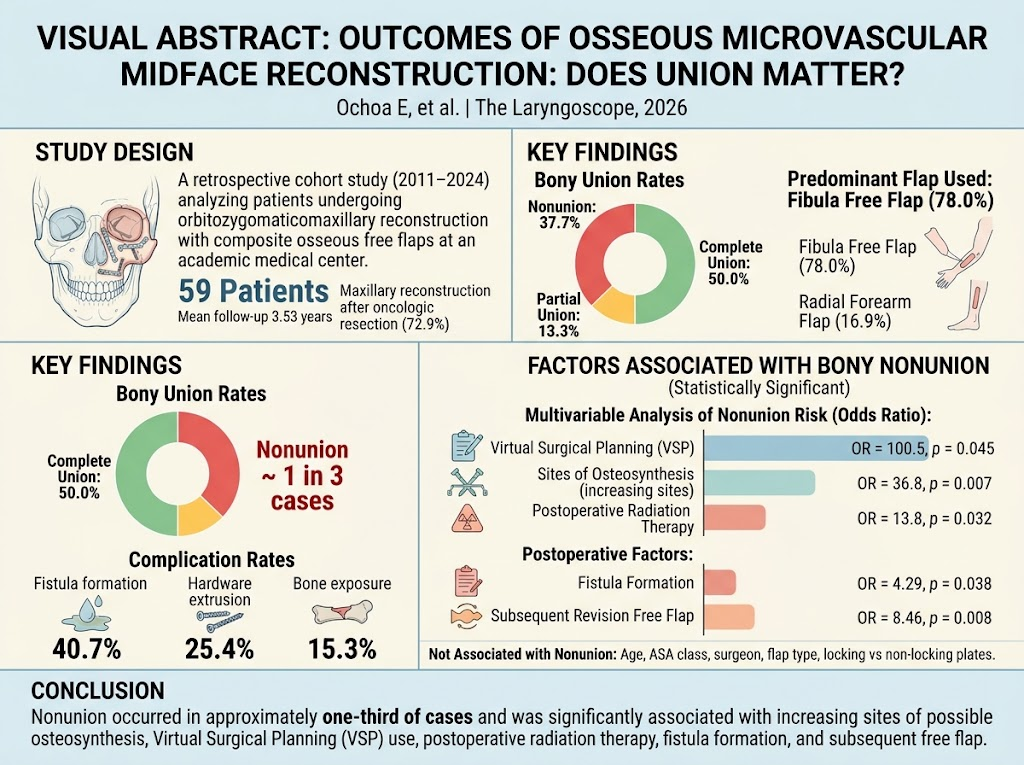
– Approximately one-third of osseous microvascular midface reconstructions exhibit nonunion.
– Increased number of osteosynthesis sites, Virtual Surgical Planning (VSP), and postoperative radiation are strongly associated with nonunion.
– Postoperative complications such as fistula formation and subsequent free flap surgeries significantly correlate with impaired bony union.
– Standard clinical factors like patient age, flap type, and ischemia time do not predict union outcomes.

Study Background

MedXY registered readers

Sign in free to continue reading

Create or use your MedXY account to unlock the complete article.

This article was created using several editorial tools, including AI, as part of the process. Human editors reviewed this content before publication.

Related articles

Open language-specific specialty feeds and department pages.

Elevated BMI and Open Airway Reconstruction: Disentangling the Impact on Postoperative OutcomesThis study demonstrates that elevated BMI and obesity classification do not increase the risk of complications or prolong recovery times following open airway reconstruction surgeries, guiding surgical decision-making in overweight and obesOct 5, 2026Short-Term Outcomes of Polydioxanone Synthetic Mesh in Two-Stage Breast Reconstruction: Insights from a Single-Center Comparative StudyThis study assesses early postoperative complications following tissue expander breast reconstruction using polydioxanone synthetic mesh, biologic mesh, or no mesh, revealing comparable short-term outcomes and highlighting factors like radiSep 29, 2026Reevaluating Angiography in the Diagnosis and Management of Intraluminal Hemorrhage Following Pancreatoduodenectomy: Insights from 115 Cases Among 3,011 SurgeriesThis study highlights the diagnostic and therapeutic value of angiography in intraluminal postpancreatoduodenectomy hemorrhage, revealing its superiority in bleeding source localization and effective hemostasis compared to other modalities.Sep 17, 2026
Loading comments...
MedXY briefing

Get the free newsletter

Evidence-led clinical news, trends, and analysis—delivered to your inbox.

Ask MedXY AI

Most popular

Intimate Health
Five Benefits for Women Continuing Sexual Activity After Menopause
Intimate Health
Why Some Women Have a Strong Sex Drive—And Why Men Shouldn't Worry About It
Nursing & care
How often should a couple have sex?
Cardiology
Precision Medicine for Long QT Syndrome Type 2: Lumacaftor Corrects Trafficking Defects and Shortens QT Interval
General Surgery
Optimizing Postoperative Opioid Prescriptions After Intra-Abdominal Cancer Surgery: Comparing the 5x-Multiplier and 3-Tier Models
© 2026 MedXY
Contact usAbout usPrivacy PolicyMedXY story
Intraoperative Botulinum Toxin Injection to Reduce Postoperative Sialocele After Parotidectomy: A Retrospective Cohort AnalysisThis study suggests intraoperative botulinum toxin may reduce sialocele formation after parotidectomy, though larger prospective trials are needed to confirm efficacy and guide clinical use.Sep 15, 2026
Impact of Severe Anastomotic Leak After Esophagectomy on Long-Term Survival: Insights from a Modern Multicenter CohortA large European study shows that severe anastomotic leaks requiring surgical reintervention after esophagectomy significantly reduce long-term survival and increase postoperative mortality, underscoring the need for targeted management strSep 12, 2026
Impact of Weight-Loss Methods on Post-Bariatric Body Contouring Surgery Outcomes: A Comparative AnalysisThis study examines complication rates following body-contouring surgeries in patients after weight loss via bariatric surgery, GLP-1 receptor agonists, combination therapy, or lifestyle changes, finding modality-independent risk but highliSep 2, 2026