What is the Elderly Mobility Scale Calculator?
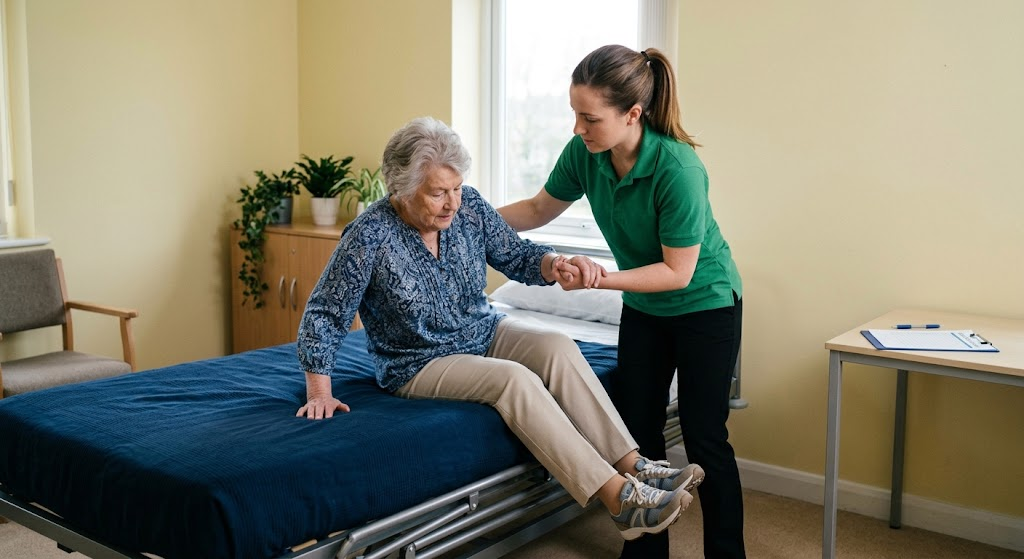
The elderly mobility scale calculator (EMS calculator) is a validated clinical assessment tool designed specifically to evaluate functional mobility in adults over 55 years old. Developed by Dr. Rosalie Smith in 1994, this evidence-based screening instrument helps healthcare professionals, caregivers, and families assess mobility limitations, predict fall risk, and guide care planning decisions for elderly individuals.
Unlike generic mobility assessments, the EMS focuses on seven critical functional tasks that directly impact daily living independence. The calculator provides an objective scoring system ranging from 0-20 points, with higher scores indicating better mobility and lower fall risk.
The 7 Core Components of the Elderly Mobility Scale
The EMS calculator evaluates mobility through seven distinct functional assessments:
1. Lying to Sitting Transfer
This assessment evaluates core strength and coordination needed for bed mobility. Patients attempt to move from a lying position to sitting upright on the edge of a bed.
Scoring:
2 points: Independent transition without assistance
1 point: Requires assistance from one person
0 points: Needs help from two or more people
2. Sitting to Lying Transition
Measures controlled movement and balance when returning to a horizontal position, essential for safe bed transfers.
Scoring:
2 points: Independent controlled descent
1 point: Needs minimal assistance or guidance
0 points: Requires substantial help from multiple people
3. Sitting to Standing Transfer
Assesses lower limb strength, balance, and the ability to perform one of the most fundamental mobility tasks.
Scoring:
3 points: Independent rise in under 3 seconds
2 points: Independent rise taking over 3 seconds
1 point: Requires assistance from one person
0 points: Needs help from two or more people
4. Standing Balance
Evaluates postural control and the ability to maintain balance while upright, crucial for fall prevention.
Scoring:
3 points: Stands without support and can perform functional reach
2 points: Stands independently but is unable to reach
1 point: Stands with support or assistance
0 points: Cannot maintain standing position
5. Gait Assessment
Analyzes walking pattern, stability, and the need for assistive devices during locomotion.
Scoring:
3 points: Normal gait, no walking aid needed
2 points: Independent but abnormal gait pattern
1 point: Walks with aid (cane, walker) or assistance
0 points: Cannot walk or needs significant support
6. Timed 6-Meter Walk
Measures walking speed and endurance over a standardized distance, providing objective mobility data.
Scoring:
3 points: Completes walk in under 15 seconds
2 points: Completes walk in 15-45 seconds
1 point: Takes over 45 seconds to complete
0 points: Unable to walk the distance
7. Functional Reach Test
Assesses dynamic balance and fall risk by measuring how far a person can reach forward while standing.
Scoring:
4 points: Can reach over 10 inches forward
2 points: Reaches 4-10 inches forward
1 point: Reaches less than 4 inches
0 points: Cannot perform a reach without losing balance
How to Use the Elderly Mobility Scale Calculator?
Required Equipment
Stopwatch or timer
Measuring tape (for 6-meter distance)
Standard bed and chair
Safe, clear walking area
Optional: mobility aids if normally used
Administration Steps
Preparation: Ensure patient safety with adequate space and supervision. Have assistance available if needed.
Sequential Testing: Perform assessments in order, allowing rest breaks between tasks as necessary.
Scoring: Record individual scores for each task immediately after completion.
Calculation: Sum all individual scores for the total EMS score (0-20 points).
Interpretation: Use established cut-off scores to guide clinical decision-making.
EMS Score Interpretation and Clinical Significance
Score Category | Assessment Details |
|---|---|
14-20 points High Independence |
|
10-13 points Moderate Independence |
|
0-9 points High Dependence |
|
To ensure consistency, accuracy, and patient safety during the assessment, follow these detailed clinical protocols:
Pre-Assessment Preparation
Environment & Equipment: Use a standard-height bed and chair (with or without armrests, kept consistent), a clear 6-meter walking corridor, a stopwatch, a measuring tape, and protective mats if needed.
Patient Readiness: Ensure the patient is alert, comfortable, and not experiencing acute pain or severe fatigue. If the patient routinely uses a walking aid (e.g., cane, walker), ensure it is available and documented.
Safety First: The assessor must stand close to the patient (slightly to the side/rear) at all times to provide immediate manual support if the patient loses balance.
Scoring Criteria & Administration Notes
Lying to Sitting & Sitting to Lying: Focus on trunk control and independence. Score 2 for independent completion, 1 for assistance from one person, and 0 if assistance from two or more people is required.
Sitting to Standing: Evaluates lower limb power and postural control. Score 3 for rising independently in under 3 seconds, 2 for rising independently in over 3 seconds, 1 for help from one person, and 0 for help from two or more.
Standing Balance: Tests postural control without external support. Score 3 for standing independently and achieving a functional reach, 2 for standing independently without reach, 1 for standing with support, and 0 for an inability to stand.
Gait Assessment: Evaluates walking posture and device dependency. Score 3 for normal gait without aids, 2 for an abnormal gait pattern performed independently, 1 for requiring walking aids or human assistance, and 0 for inability to walk.
Timed 6-Meter Walk: Measures functional gait speed. Score 3 for completing under 15 seconds, 2 for 15–45 seconds, 1 for over 45 seconds, and 0 if unable to complete.
Functional Reach Test: Measures dynamic standing balance. Score 4 for reaching forward over 10 inches, 2 for 4–10 inches, 1 for under 4 inches, and 0 for losing balance during the attempt.
Interpreting Results & Best Practices
Total Score: Sum the 7 sub-scores to generate a overall score between 0 and 20 points.
Progress Tracking: Perform reassessments periodically (e.g., every 2–4 weeks during rehabilitation) to track functional recovery or decline over time.
Clinical Context: The EMS score provides valuable objective data, but it should always be interpreted alongside the patient's medical history, cognitive status, and environmental conditions.
Fall Risk Assessment Using EMS
Research consistently demonstrates the EMS's effectiveness in identifying fall risk among elderly populations. Key findings include:
Patients scoring below 14 show significantly higher rates of experiencing two or more falls within 4-6 months
The functional reach component demonstrates particular sensitivity for predicting future falls
The combined scoring approach provides a more comprehensive risk assessment than individual components
EMS Score Range | Fall Prevention Strategies |
|---|---|
Scores 14-20 Maintenance Level |
|
Scores 10-13 Moderate Intervention |
|
Scores 0-9 Intensive Intervention |
|
Technology Integration and Digital Tools
Modern healthcare increasingly incorporates digital EMS calculators offering:
Automated Scoring: Reduces calculation errors and saves time
Progress Tracking: Longitudinal data storage and trend analysis
Clinical Decision Support: Integrated interpretation guidelines
Documentation Integration: Seamless EHR incorporation
Future Developments and Research Directions
Current research focuses on:
Enhanced Sensitivity: Developing modifications to reduce ceiling effects
Population-Specific Versions: Adaptations for specialized patient groups
Technology Integration: Sensor-based assessments and remote monitoring
Predictive Modeling: Machine learning applications for improved risk stratification
Conclusion: Maximizing Clinical Value of EMS Assessment
The elderly mobility scale calculator represents a gold-standard approach to mobility assessment in older adults. Its combination of clinical validation, practical utility, and predictive value makes it an essential tool for healthcare professionals working with elderly populations.
Key takeaways for optimal EMS utilization:
Standardize Administration: Follow established protocols for consistent results
Clinical Context: Always interpret scores within broader patient assessment
Serial Monitoring: Use repeated assessments to track change over time
Intervention Planning: Link scores to specific interventions and goals
Interdisciplinary Communication: Share results across care team members
By incorporating the EMS into routine clinical practice, healthcare providers can enhance their ability to assess mobility, predict fall risk, and develop targeted interventions that maintain independence and improve quality of life for elderly patients.
FAQs
1. Can I use the EMS calculator without clinical training?
Yes, anyone can use the calculator, but interpretation of the results is best done by a trained healthcare provider. The EMS is designed to support—but not replace—clinical judgment.
2. How accurate is the EMS calculator for home use?
The EMS calculator is reliable for basic mobility assessment, but accuracy depends on correct observation and scoring. For critical decisions, a professional assessment is recommended.
3. Is the Elderly Mobility Scale recognized globally?
Yes, the EMS is widely used in the UK, Australia, and several other countries. While not universal, it is considered a valid tool in many geriatric and rehabilitation settings.
4. How can I improve a low EMS score?
A low EMS score indicates limited mobility. Improvement can be achieved through physiotherapy, strength training, balance exercises, and fall prevention strategies—ideally guided by a healthcare professional.
5. Where can I find a certified EMS practitioner?
You can consult local physiotherapists, geriatricians, or occupational therapists. Many clinics and hospitals with geriatric services have staff trained in EMS assessments.
Related Mobility & Assessment Tools
While the Elderly Mobility Scale (EMS) is a reliable measure of mobility and fall risk, clinicians and caregivers often combine it with other standardized assessment tools for a comprehensive evaluation:
Berg Balance Scale (BBS): A 14-item objective measure designed to assess static and dynamic balance, widely used to identify fall risks in older adults and neurological patients.
Timed Up and Go (TUG) Test: Measures the time it takes for a patient to rise from a chair, walk 3 meters, turn, walk back, and sit down. Excellent for quick screening in outpatient and community settings.
Tinetti Performance-Oriented Mobility Assessment (POMA): Evaluates both gait and balance through specific subtests, making it useful for identifying detailed gait abnormalities (e.g., step length, asymmetry).
Barthel Index (BI): Assesses performance in daily self-care activities (ADLs) such as feeding, bathing, grooming, and bowel/bladder control, often used alongside EMS to determine overall care needs.
Short Physical Performance Battery (SPPB): Combines gait speed, a balance test, and a chair-stand test to evaluate lower extremity function and physical frailty in elderly individuals.
This article was created using several editorial tools, including AI, as part of the process. Human editors reviewed this content before publication.