Economic and Patient-centered Outcomes of Minimally Invasive versus Open Hepatopancreatobiliary Surgery: A One-Year Comparative Study
Highlight
- Minimally invasive hepatopancreatobiliary (HPB) surgery reduces hospital length of stay and 30-day readmission rates compared to open surgery.
- Patients undergoing minimally invasive HPB surgery have significantly lower one-year total healthcare expenditures, mainly due to reduced insurer payments.
- Out-of-pocket patient spending does not differ significantly overall between minimally invasive and open surgery, but savings vary by insurance plan types.
- Minimally invasive surgery patients experience fewer missed workdays within one year, potentially reflecting faster recovery and improved quality of life.
Study Background
Hepatopancreatobiliary surgery, encompassing complex procedures such as hepatectomy and pancreatectomy, traditionally involves significant morbidity and high healthcare resource utilization. Minimally invasive surgical techniques, including laparoscopic and robotic approaches, have been increasingly adopted with aims to reduce perioperative morbidity, hasten recovery, and enhance long-term outcomes. While previous studies have demonstrated immediate postoperative benefits such as shorter hospital stays and lower complication rates, economic evaluations that capture cumulative healthcare expenditures beyond the index hospitalization period remain limited. Additionally, the impact on patient out-of-pocket expenses and indirect costs such as missed workdays has not been comprehensively addressed. Understanding these factors is crucial to justify wider adoption of minimally invasive approaches and guide healthcare policy and patient counseling.
Study Design
This retrospective cohort study identified adults who underwent hepatectomy or pancreatectomy between 2016 and 2023 from the IBM MarketScan Commercial Claims and Encounters database. The database captures detailed healthcare claims and payments for a large commercially insured population in the United States, enabling assessment of total healthcare expenditures, insurer payments, and patient out-of-pocket spending over a one-year follow-up period.
Minimally invasive surgery (MIS) was compared with open surgery based on procedural coding. To adjust for confounding and differences in baseline characteristics, inverse probability of treatment weighting (IPTW) with a doubly robust specification was applied, improving the validity of comparative estimates. Key endpoints included length of hospital stay, 30-day readmission rates, total one-year healthcare expenditures, insurer payments, out-of-pocket costs, and missed workdays derived from healthcare encounters.
Key Findings
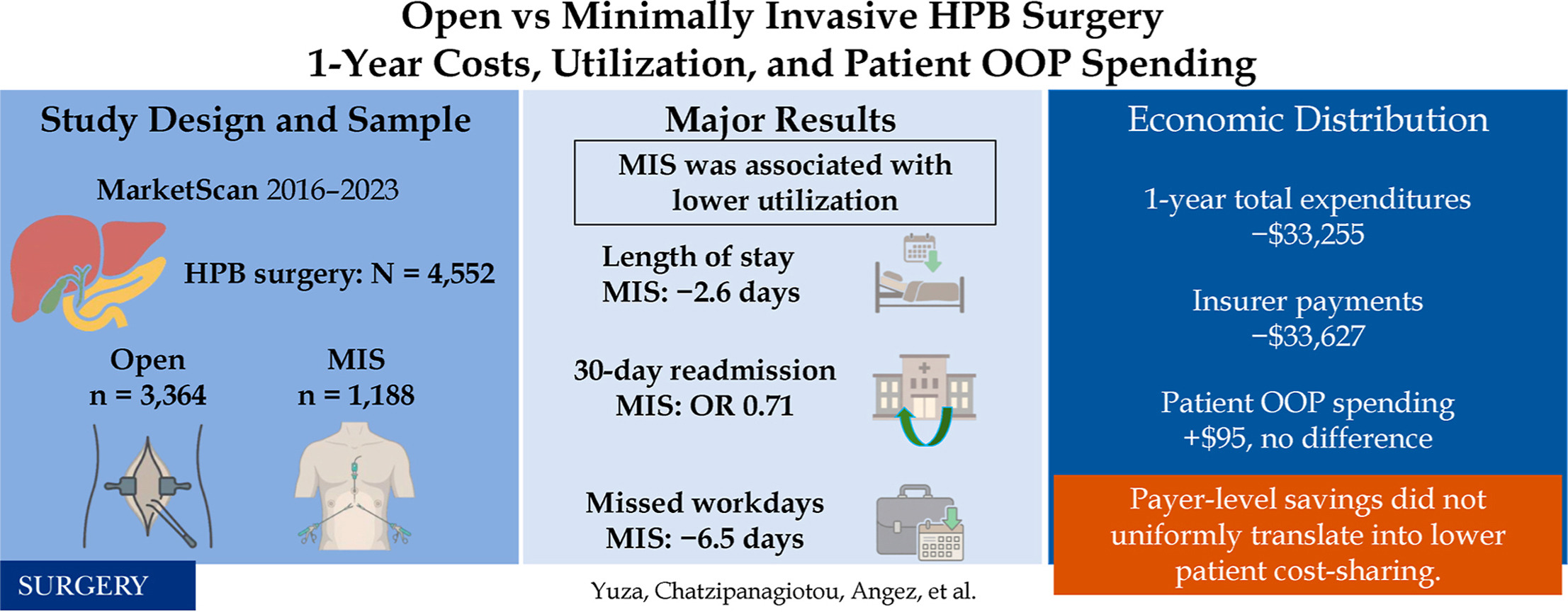
Among 4,552 patients undergoing HPB surgery, 26.1% (1,188 patients) received minimally invasive surgery.
Hospitalization and Readmissions: Minimally invasive surgery yielded a reduction in length of hospital stay by an average of 2.6 days (95% CI -3.1 to -2.1 days) relative to open surgery. The odds of 30-day readmission were significantly lower with MIS (OR 0.71, 95% CI 0.58-0.88), indicating fewer early postoperative complications or adverse events requiring rehospitalization.
Healthcare Expenditures: Total healthcare expenditures at one year were substantially lower following MIS, with a mean reduction of $33,255 (95% CI -46,582 to -20,789) compared to open surgery. This financial benefit was predominantly driven by reduced insurer payments, which decreased by $33,627 (95% CI -48,365 to -21,593).
Patient Out-of-Pocket Costs: Aggregate out-of-pocket spending for covered services did not differ statistically significantly between the two surgical approaches (+95, 95\% CI -691 to $1,040, P=0.827). However, an interaction with insurance plan type was identified (P=0.019), wherein MIS was associated with decreased out-of-pocket expenses in more restrictive insurance plans but not in less restrictive plans. This suggests that plan design influences the extent to which payer savings translate to patients.
Indirect Costs: Patients receiving MIS experienced fewer missed workdays derived from encounter data, averaging 6.5 fewer days (95% CI -8.4 to -4.6), implying faster recovery and less disruption to employment and productivity.
Expert Commentary
This comprehensive analysis provides robust real-world evidence supporting the clinical and economic advantages of minimally invasive HPB surgery beyond immediate perioperative metrics. The substantial reductions in healthcare expenditures and readmissions align with previously reported improvements in perioperative morbidity and recovery. The innovative use of large claims data and rigorous statistical adjustments strengthen the validity of the findings.
Importantly, the absence of a significant reduction in patient out-of-pocket costs despite overall cost savings highlights a critical gap in healthcare economics. Currently, insurance benefit designs and cost-sharing structures may attenuate individual financial benefits from less invasive surgical approaches. Furthermore, the detected heterogeneity by plan type underscores the need for patient-specific counseling and potential policy reforms to ensure equitable cost savings.
Despite the large sample size and rigorous adjustment, limitations include the retrospective design and reliance on administrative data, which may lack granular clinical detail such as tumor characteristics or postoperative complications. Moreover, missed workdays derived from healthcare encounters may underestimate true productivity losses. Future prospective studies with comprehensive clinical and patient-reported outcomes are needed to confirm and expand on these findings.
Conclusion
Minimally invasive hepatopancreatobiliary surgery is associated with shorter hospital stays, fewer readmissions, significantly lower insurer-paid healthcare expenditures, and reduced missed workdays compared to open surgery over one year after the procedure. However, this financial benefit does not uniformly translate into lower out-of-pocket patient spending, which varies depending on insurance plan characteristics. These findings emphasize the clinical and economic value of minimally invasive surgery and illuminate the complex interplay between healthcare costs, insurance design, and patient financial burden. Enhanced patient counseling, insurer policy alignment, and ongoing research are warranted to optimize the holistic benefits of advanced surgical techniques.
Funding and ClinicalTrials.gov
No specific funding information or clinical trial registration was reported in the source study.
References
1. Yuza K, Chatzipanagiotou OP, Angez M, et al. One-year health care expenditures and patient out-of-pocket spending after open versus minimally invasive hepatopancreatobiliary surgery. Surgery. 2026 Jun 15;197:110391. doi:10.1016/j.surg.2026.110391. PMID: 42398204.
2. Kendrick ML, Farnell MB, Truty MJ, et al. Postoperative outcomes and quality of life after minimally invasive versus open pancreaticoduodenectomy: a propensity score matching analysis. Ann Surg. 2020;272(2):289-296.
3. Abu Hilal M, Di Fabio F, et al. Minimally invasive hepatectomy: A systematic review and meta-analysis. Ann Surg. 2016;263(5):856-870.
4. Dimick JB, Staiger DO, et al. Surgical innovations and the relative value of outcomes-Implications for surgical care and reimbursement. JAMA Surg. 2017;152(1):1-2.
5. Scrimshar AM, Zafar SN, et al. Patient out-of-pocket costs: A vital metric for cancer care delivery research. J Clin Oncol. 2019;37(27):2359-2361.
This article was created using several editorial tools, including AI, as part of the process. Human editors reviewed this content before publication.