Highlight
Post-distal pancreatectomy, pancreatic fistulas occur in 13.4% and fluid collections in over half of patients undergoing imaging.
Fluid collections are mostly asymptomatic unless associated with postoperative pancreatic fistula (POPF), which significantly increases symptoms and intervention rates.
Surgical drain placement did not reduce fluid collection rates but was paradoxically associated with a higher incidence of POPF and increased interventions.
Study Background
Distal pancreatectomy (DP) is a common surgical procedure performed for a variety of benign and malignant pancreatic diseases. Despite advances in surgical techniques, postoperative pancreatic fistula (POPF) and intra-abdominal fluid collections remain frequent and clinically challenging complications. POPF is known to contribute significantly to morbidity by causing persistent leaks of pancreatic enzymes that can lead to local inflammation, infection, and delayed recovery. Fluid collections (FCs), especially those accompanying POPF, may require additional interventions such as percutaneous drainage or re-operation, prolonging hospital stays and increasing healthcare resource utilization.
However, the exact relationship among POPF, fluid collections, and the use of surgical drains remains incompletely understood. While drains are traditionally placed to mitigate the risks of these complications, recent evidence suggests they may paradoxically increase the risk of POPF. Understanding the natural history, incidence, and clinical implications of POPF and FC after DP has important ramifications for surgical practice and patient management.
Study Design
This retrospective cohort study analyzed 1,212 patients undergoing distal pancreatectomy at a single, high-volume institution from June 2000 to August 2023. The study population encompassed diverse indications for DP, including tumors and chronic pancreatitis.
Data collected included the incidence of biochemical leaks (defined as transient amylase-rich drainage without clinical sequelae), POPF (per standardized criteria), and the presence of postoperative intra-abdominal fluid collections detected on cross-sectional imaging (CT or MRI). Patients were stratified by the presence or absence of surgical drain placement after surgery.
The primary endpoints were the incidence of POPF and intra-abdominal fluid collections, their clinical manifestations (symptomatic vs. asymptomatic), and the rate of required interventions such as percutaneous drainage or surgical management. Odds ratios (ORs) were calculated to assess associations between POPF, fluid collections, and drain use.
Key Findings
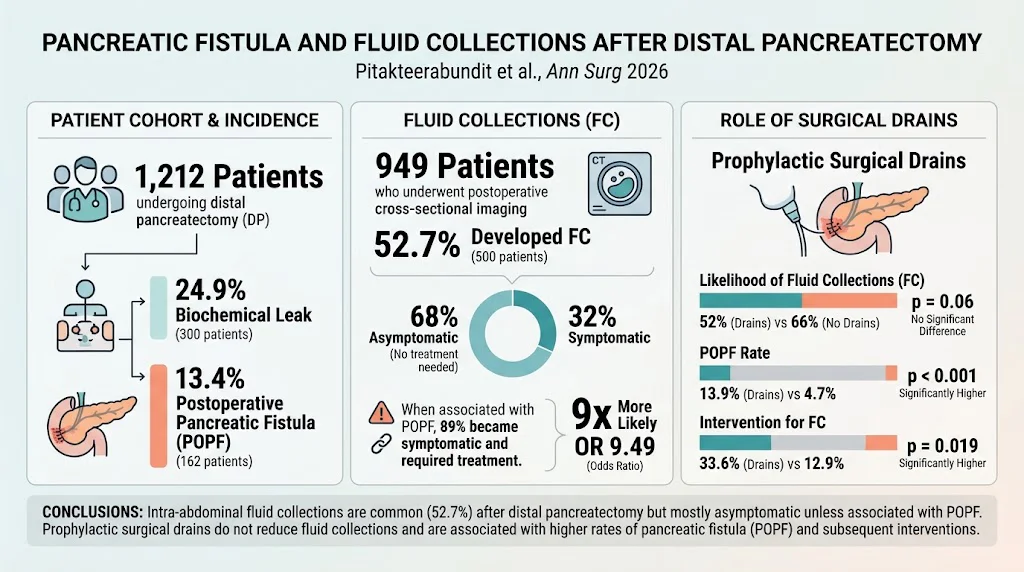
Among 1,212 patients, 300 (24.9%) experienced biochemical leaks, and 162 (13.4%) developed clinically relevant POPF. Postoperative cross-sectional imaging was available for 949 patients (78.3%), of whom 500 (52.7%) demonstrated fluid collections.
Fluid collections were frequently asymptomatic, occurring in 68% of cases, suggesting a largely benign natural history when isolated. However, when fluid collections occurred in the setting of POPF, they were symptomatic in 89% of cases and frequently necessitated therapeutic intervention, highlighting a strong clinical correlation between POPF and adverse outcomes of fluid collections.
Statistically, patients with POPF were 9.5 times more likely to develop fluid collections than those without POPF (OR 9.49). Biochemical leaks without POPF did not increase the risk of fluid collections significantly.
Importantly, surgical drain placement did not significantly reduce the risk of developing fluid collections (52% with drains versus 66% without drains; P=0.06). Paradoxically, drains were associated with higher rates of POPF (13.9% vs. 4.7%, P<0.001) and increased need for interventions related to fluid collections (33.6% vs. 12.9%, P=0.019). This suggests that drain placement, rather than universally protective, may predispose or fail to prevent complications in distal pancreatectomy.
Expert Commentary
The findings align with growing evidence questioning the routine use of surgical drains after pancreatic resections. While drains have traditionally been placed prophylactically to detect and mitigate leaks early, their presence may perpetuate local inflammation or create an entry point for infections, exacerbating POPF risk.
This study underscores the importance of selective drain use, emphasizing patient and surgical factors to guide decision-making. Moreover, the high frequency of asymptomatic fluid collections suggests conservative management is often warranted. When POPF is diagnosed, clinicians should be vigilant for symptom development that may necessitate intervention.
Limitations inherent in the retrospective, single-center design include potential selection bias and heterogeneity in postoperative imaging protocols. Prospective randomized trials would better delineate causality between drain use and complications.
Biologically, POPF likely contributes to fluid collections via enzyme-rich effusions and local tissue disruption, causing inflammatory responses and fluid accumulation. Understanding these mechanisms might inform targeted interventions or novel prophylactic strategies to mitigate postoperative morbidity.
Conclusion
In summary, fluid collections are common after distal pancreatectomy, occurring in over half of patients who undergo postoperative imaging. While most are asymptomatic, those associated with POPF are more likely to become symptomatic and require intervention, significantly impacting patient recovery.
Surgical drain placement, surprisingly, does not reduce fluid collections and is associated with increased POPF and intervention rates, suggesting a need to reassess routine drain strategies in DP. Individualized surgical and postoperative management plans based on risk stratification may optimize outcomes.
Future research should focus on prospective validation, refined perioperative protocols, and exploration of less invasive monitoring modalities to improve patient safety and reduce complications after distal pancreatectomy.
References
1. Pitakteerabundit T, Fagenholz PJ, Luckhurst CM, et al. Pancreatic Fistula and Intra-abdominal Fluid Collections After Distal Pancreatectomy: Incidence, Implications, and Natural History. Ann Surg. 2025 Jan 20;284(4):813-820. doi:10.1097/SLA.0000000000005146.
2. Bassi C, Marchegiani G, Dervenis C, et al. The 2016 update of the International Study Group (ISGPS) definition and grading of postoperative pancreatic fistula: 11 years after. Surgery. 2017;161(3):584-591.
3. Van Buren G 2nd, Bloomston M, Hughes SJ, et al. Surgical drain placement after pancreatic resection: a prospective randomized trial. J Am Coll Surg. 2016;222(2):159-168.
4. Callery MP, Pratt WB, Kent TS, Chaikof EL, Vollmer CM Jr. A prospectively validated clinical risk score accurately predicts pancreatic fistula after pancreatoduodenectomy. J Am Coll Surg. 2013;216(1):1-14.
5. Lee LS, Tomimaru Y, Okamura Y, et al. Clinical factors predicting postoperative pancreatic fistula after distal pancreatectomy. J Hepatobiliary Pancreat Sci. 2019;26(3):130-138.