We use cookies

Our website uses essential cookies and, with your consent, additional cookies to measure performance and improve our services. Cookie Policy.

You can change your choice at any time.

MMedXYNews
HomeVideos
MedXY AI/MedXY News/Section: General Surgery

Pan-European Collaborative Training Elevates Safety and Outcomes in Robotic Pancreatoduodenectomy
MedXY Editorial Team•Oct 11, 2026•General Surgery
patient safetyPhẫu thuật xâm lấn tối thiểurobotic pancreatoduodenectomySurgical Training

Highlight

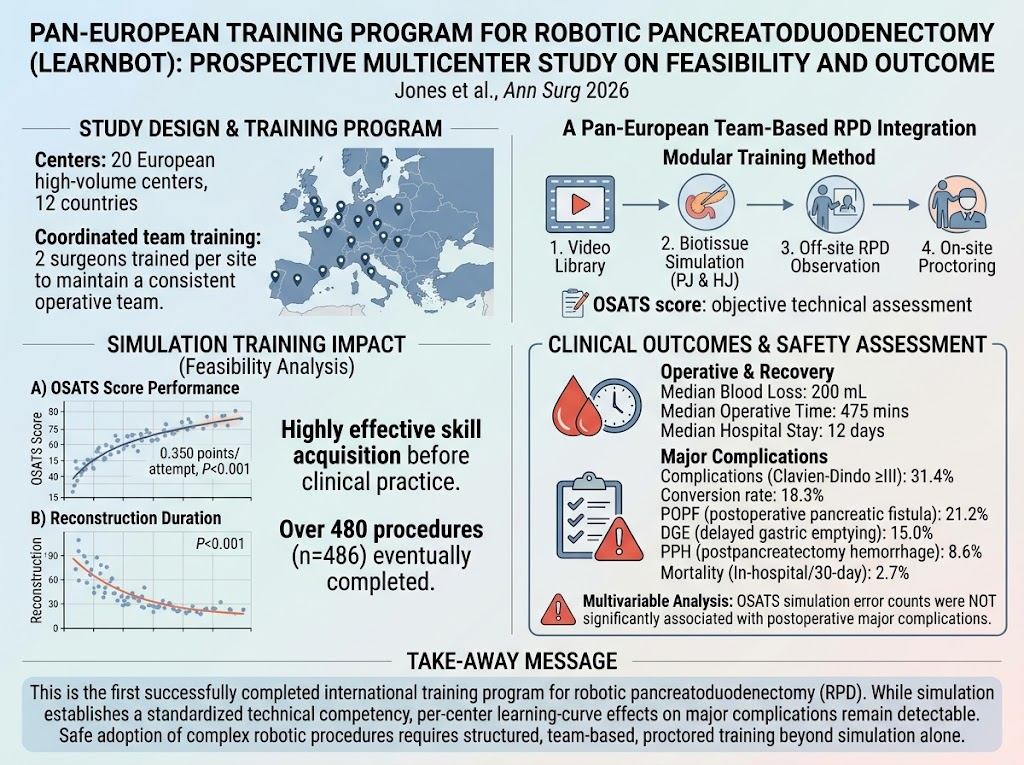
This prospective multicenter study demonstrates that a structured pan-European training program for robotic pancreatoduodenectomy (RPD) is feasible and results in acceptable patient outcomes across varied high-volume centers without prior robotic experience. Key technical skills and operative performance significantly improved through simulation-based training combined with team-based proctoring. Despite learning-curve effects, patient safety was maintained, underscoring the necessity of comprehensive, standardized training frameworks for complex robotic procedures.

Study Background

MedXY registered readers

Sign in free to continue reading

Create or use your MedXY account to unlock the complete article.

This article was created using several editorial tools, including AI, as part of the process. Human editors reviewed this content before publication.

Related articles

Open language-specific specialty feeds and department pages.

Evaluating Conversational AI in Urgent Primary Care: A Prospective Feasibility Study of the Articulate Medical Intelligence ExplorerThis study assesses the safety, quality, and user acceptance of a conversational AI system aiding urgent primary care by engaging patients before appointments, demonstrating promising feasibility for clinical integration.Oct 18, 2026Navigating Home Care Safety for Children with Medical Complexity: Parental Challenges and InnovationsParents of children with medical complexity face numerous safety challenges in managing tube-related care at home, developing creative strategies to mitigate risks while often lacking communication with healthcare teams, highlighting the neOct 18, 2026The Role of Medical Interpreters in Enhancing Resilience and the Challenges for Artificial Intelligence IntegrationThis review synthesizes evidence on medical interpreters’ critical roles in supporting resilience for non-English language preference patients during ambulatory diagnostic care, highlighting gaps and implications for AI interpretationOct 15, 2026
Loading comments...
MedXY briefing

Get the free newsletter

Evidence-led clinical news, trends, and analysis—delivered to your inbox.

Ask MedXY AI

Most popular

Intimate Health
Five Benefits for Women Continuing Sexual Activity After Menopause
Intimate Health
Why Some Women Have a Strong Sex Drive—And Why Men Shouldn't Worry About It
Nursing & care
How often should a couple have sex?
Cardiology
Precision Medicine for Long QT Syndrome Type 2: Lumacaftor Corrects Trafficking Defects and Shortens QT Interval
General Surgery
Optimizing Postoperative Opioid Prescriptions After Intra-Abdominal Cancer Surgery: Comparing the 5x-Multiplier and 3-Tier Models
© 2026 MedXY
Contact usAbout usPrivacy PolicyMedXY story
Clinical AI Competence in Obstetrics and Gynecology: Balancing Innovation with Patient Safety and Accountability
The integration of artificial intelligence in obstetrics and gynecology necessitates clinical competence to ensure patient safety, verify outputs, and maintain physician accountability. Structured training and evaluation are essential for r
Oct 6, 2026
Minimally Invasive Breast Augmentation: Enhanced Recovery and Sensory Outcomes Compared to Hybrid TechniquesThis study evaluates patient-reported outcomes after minimally invasive breast augmentation (Mia) versus hybrid augmentation, demonstrating superior recovery, pain reduction, and nipple sensitivity with Mia, without compromising satisfactioSep 30, 2026
Rising Trends and Clinical Outcomes of Outpatient Hysterectomy in Ontario: A Population-Based AnalysisOutpatient hysterectomy has increased significantly in Ontario from 2010 to 2024, showing favorable 90-day readmission rates, reduced complications, and lower health system costs compared to inpatient procedures.Sep 23, 2026