Early Rhythm Control Reduces Cardiovascular Events in Atrial Fibrillation Patients With Chronic Kidney Disease
Early rhythm control (ERC) reduced the primary composite outcome (cardiovascular death, stroke, hospitalization for heart failure, or acute coronary syndrome) in patients with and without chronic kidney disease (CKD).
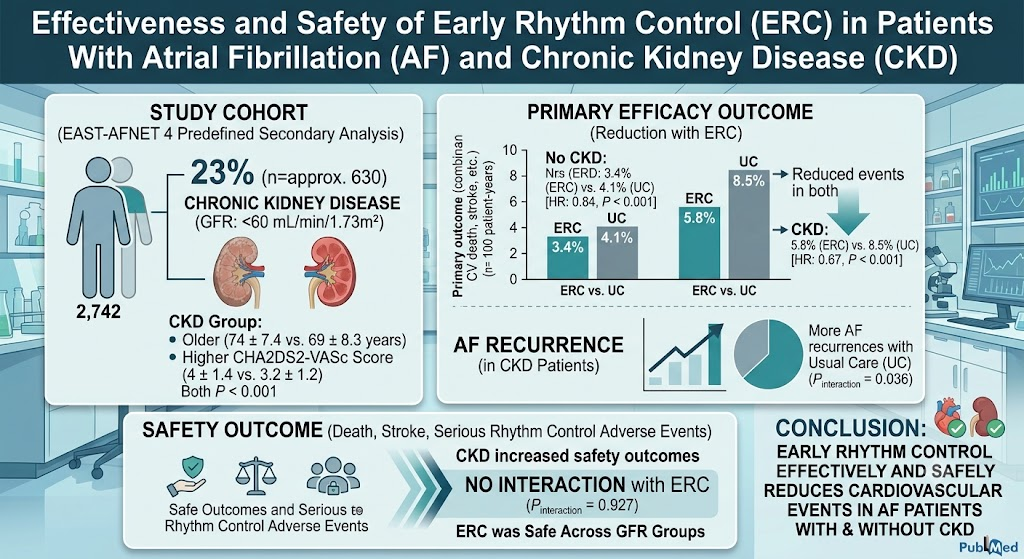
In patients with CKD, ERC was associated with a hazard ratio of 0.67 (p<0.001) compared with usual care; the absolute event rate was 5.8 vs 8.5 per 100 patient-years.
The safety composite (death, stroke, serious rhythm control-related adverse events) was not increased with ERC, and no interaction with CKD status was observed.
Patients with CKD had more atrial fibrillation recurrences under usual care, and ERC significantly reduced recurrence risk (interaction p=0.036).
Study Snapshot
Design: Predefined secondary analysis of EAST-AFNET 4, a multicenter, randomized, controlled trial.
Population: 2,742 patients with recently diagnosed atrial fibrillation and stroke risk factors; 23% had CKD (eGFR <60 mL/min/1.73 m²).
Intervention: Early rhythm control (antiarrhythmic drugs or ablation) vs usual care (rate control).
Primary outcome: Composite of cardiovascular death, stroke, hospitalization for worsening heart failure, or acute coronary syndrome.
Key result (CKD group): ERC 5.8 events/100 patient-years vs usual care 8.5 events/100 patient-years; HR 0.67; 95% CI and exact p-value not specified in abstract but reported as p<0.001.
Safety: No significant interaction between CKD and ERC for the safety composite (p=0.927).
Registry: NCT01288352
Background: Atrial fibrillation and chronic kidney disease
Atrial fibrillation (AF) and chronic kidney disease (CKD) frequently coexist, and each condition independently increases the risk of cardiovascular events and mortality. Patients with CKD are often undertreated with rhythm control strategies due to concerns about drug toxicity and limited evidence from clinical trials. The EAST-AFNET 4 trial previously demonstrated that early rhythm control (ERC) improves cardiovascular outcomes in recently diagnosed AF, but whether this benefit extends to patients with CKD remained uncertain. This predefined secondary analysis evaluated the efficacy and safety of ERC specifically in patients with CKD using data from EAST-AFNET 4.
Study design and population
EAST-AFNET 4 was an international, multicenter, randomized trial that enrolled 2,789 patients with recently diagnosed AF (≤12 months) and at least one additional stroke risk factor. Patients were randomized to either ERC (antiarrhythmic drugs or catheter ablation) or usual care (rate control with rhythm control only if symptomatic). For this subanalysis, baseline creatinine was available in 2,742 patients (98.3%), of whom 23% met Kidney Disease Improving Global Outcomes criteria for CKD (eGFR <60 mL/min/1.73 m²). Patients with CKD were older (mean age 74 vs 69 years, p<0.001) and had higher CHA2DS2-VASc scores (mean 4.0 vs 3.2, p<0.001). Over a median follow-up of 5.1 years, overall event rates were higher among patients with CKD (hazard ratio 0.98 per mL GFR decrease, 95% CI 0.97–0.99).
Primary endpoint: cardiovascular event reduction
Early rhythm control reduced the primary composite outcome (cardiovascular death, stroke, hospitalization for worsening heart failure, or acute coronary syndrome) in both groups. In patients without CKD, the event rate was 3.4 per 100 patient-years with ERC versus 4.1 with usual care (HR 0.84; p<0.001). In patients with CKD, the reduction was numerically larger: 5.8 vs 8.5 per 100 patient-years (HR 0.67; p<0.001). The interaction p-value was 0.133, indicating that the treatment effect did not statistically differ between CKD and non-CKD groups, but the absolute benefit was greater in CKD due to higher baseline risk.
Safety outcomes and tolerability
The composite safety outcome — death, stroke, or serious rhythm control-related adverse events — occurred more frequently in patients with CKD overall, but early rhythm control did not increase this risk. The hazard ratio for ERC versus usual care was similar in CKD and non-CKD patients (interaction p=0.927). This suggests that ERC is not associated with excess harm in CKD, a group often excluded from rhythm control trials.
Secondary outcomes: AF recurrence and symptom burden
Atrial fibrillation recurrence was a secondary outcome. CKD patients had a higher burden of AF recurrence under usual care, and ERC was particularly effective in reducing recurrences in this subgroup (interaction p=0.036). This finding may help explain the larger observed cardiovascular benefit in CKD, as sustained sinus rhythm likely reduces thromboembolic and heart failure risk.
Interpretation and limitations
This analysis provides evidence that early rhythm control is effective and safe in CKD patients with recently diagnosed AF. The greater absolute risk reduction in CKD is clinically relevant, given that these patients have limited therapeutic options and worse outcomes. However, several limitations must be considered. This is a subgroup analysis — albeit predefined — and the primary interaction test was not statistically significant (p=0.133), so the differential effect should be confirmed in dedicated trials. CKD was defined by a single eGFR measurement, and no data on proteinuria or CKD stage progression were available. Dosing of antiarrhythmic drugs in CKD was not detailed, and the number of patients with advanced CKD (eGFR <30) was likely small. Generalizability to patients with longer-standing AF or more severe CKD is uncertain.
Clinical implications
For clinicians managing atrial fibrillation in patients with chronic kidney disease, these results support the use of early rhythm control as a first-line strategy. The safety profile appears acceptable, and the potential for a larger absolute benefit in this high-risk population is encouraging. Careful monitoring of renal function and appropriate dose adjustment of renally cleared antiarrhythmic agents remain mandatory. Ongoing and future trials focusing specifically on CKD patients will help refine patient selection and treatment strategies.
Funding and registration
The EAST-AFNET 4 trial was supported by the German Ministry of Education and Research, the German Center for Cardiovascular Research, and other national funding bodies. This subanalysis did not receive separate funding. The trial is registered at ClinicalTrials.gov: NCT01288352.
References
Schenker N, Borof K, Goette A, et al. Effectiveness and Safety of Early Rhythm Control in Patients With Atrial Fibrillation and Chronic Kidney Disease. Journal of the American College of Cardiology. 2026;88(2):227-241. PMID: 42126365.
This article was created using several editorial tools, including AI, as part of the process. Human editors reviewed this content before publication.