We use cookies

Our website uses essential cookies and, with your consent, additional cookies to measure performance and improve our services. Cookie Policy.

You can change your choice at any time.

MMedXYNews
HomeVideos
MedXY AI/MedXY News/Section: Diabetes & Endocrinology

Longitudinal Glycemic Trajectories in Adults with Type 1 Diabetes: Insights from a Three-Year Multicenter CGM Study
MedXY Editorial Team•Sep 21, 2026•Diabetes & Endocrinology
Glycemic Controlβ-cell functiontype 1 diabetescontinuous glucose monitoringchronic kidney disease

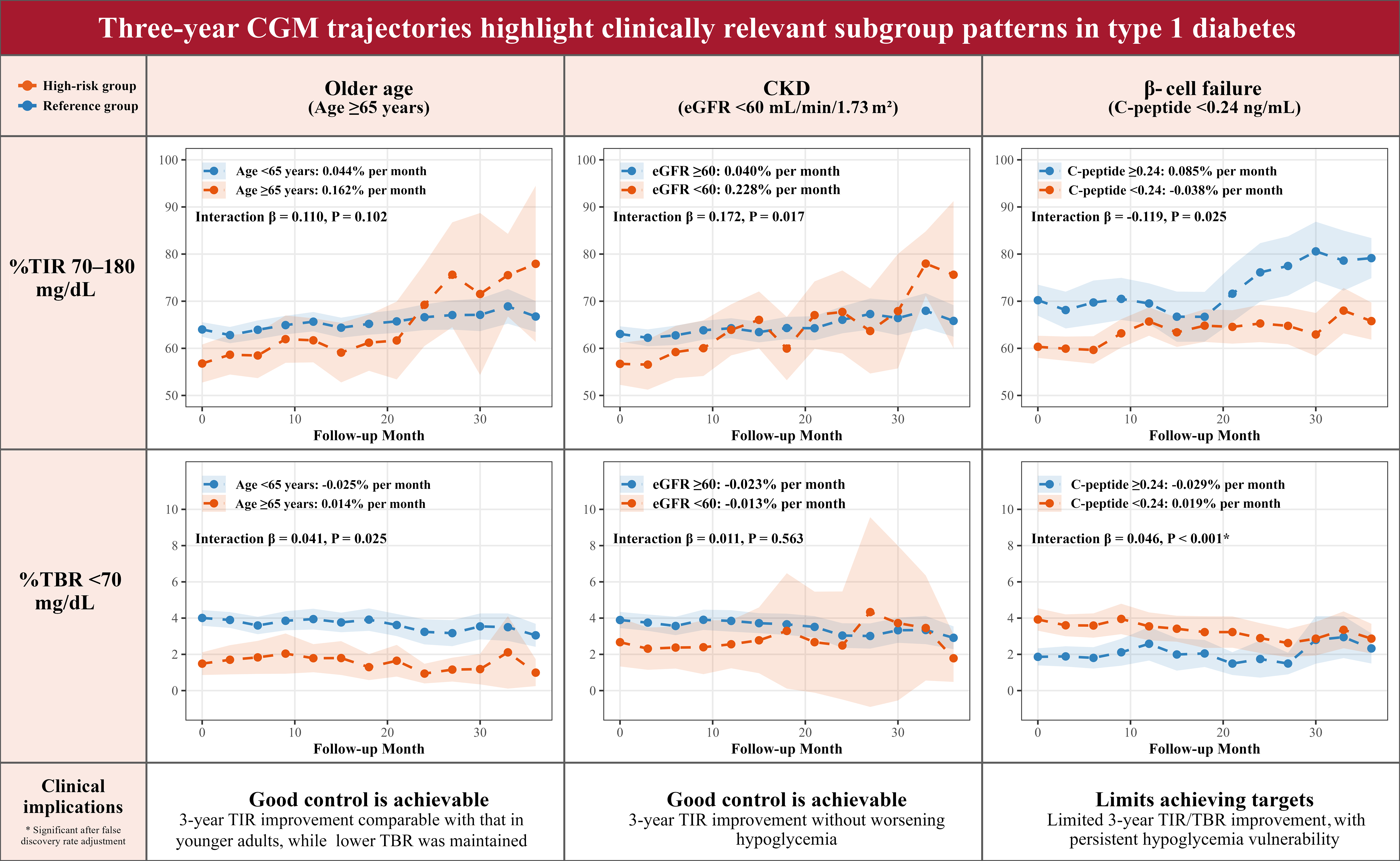
Six line graphs compare three-year continuous glucose monitoring trajectories by age, chronic kidney disease, and beta-cell failure. Time in range from 70 to 180 milligrams per decilitre generally increases across follow-up months, while time below range under 70 milligrams per decilitre remains lower. Each comparison presents high-risk and reference groups with monthly rates, interaction beta values, P values, and variability bands. Clinical implications state that good control is achievable for older age and chronic kidney disease groups, while beta-cell failure limits achieving targets.

Highlight

  • Older age and chronic kidney disease (CKD) subgroups demonstrated improvements in glycemic control over three years without increased hypoglycemia risk.
  • Severe β-cell failure was associated with more glycemic variability and hypoglycemia, limiting improvements in glucose control despite monitoring.
  • Higher BMI and elevated triglyceride-glucose (TyG) index were linked to lower absolute time in range (TIR), but those with highest TyG showed greater glycemic improvement longitudinally.
  • Considerable intragroup variability supports tailoring glycemic targets informed by continuous glucose monitoring (CGM) trajectories rather than uniform goals.

Study Background

MedXY registered readers

Sign in free to continue reading

Create or use your MedXY account to unlock the complete article.

This article was created using several editorial tools, including AI, as part of the process. Human editors reviewed this content before publication.

Related articles

Open language-specific specialty feeds and department pages.

Worsening Time in Range as a Predictor of Microvascular Complications in Type 1 Diabetes: Insights from a 5-Year Real-World StudyA 5-year real-world cohort study reveals that declines in CGM-derived time in range correlate with increased microvascular complications in type 1 diabetes, offering prognostic value beyond HbA1c.Sep 27, 2026Impact of Age at Type 1 Diabetes Onset on Mortality and Organ Complications: Insights from a Nationwide Swedish CohortYounger age at type 1 diabetes diagnosis significantly increases risks of mortality, cardiovascular, and kidney complications; each additional year delay in onset reduces these risks. This review synthesizes nationwide cohort findings and cSep 23, 2026Efficacy and Safety of Low-Dose Rivaroxaban in Advanced Chronic Kidney Disease with High Cardiovascular Risk: A Comprehensive ReviewLow-dose rivaroxaban failed to reduce cardiovascular events but increased major bleeding in advanced CKD patients at high cardiovascular risk, underscoring the need for cautious anticoagulant use.Sep 21, 2026
Loading comments...
MedXY briefing

Get the free newsletter

Evidence-led clinical news, trends, and analysis—delivered to your inbox.

Ask MedXY AI

Most popular

Intimate Health
Five Benefits for Women Continuing Sexual Activity After Menopause
Intimate Health
Why Some Women Have a Strong Sex Drive—And Why Men Shouldn't Worry About It
Nursing & care
How often should a couple have sex?
General Surgery
Optimizing Postoperative Opioid Prescriptions After Intra-Abdominal Cancer Surgery: Comparing the 5x-Multiplier and 3-Tier Models
Intimate Health
Classic Intimacy Recommendations: How to Help Women Reach Orgasm and Enjoy Mutual Pleasure
© 2026 MedXY
Contact usAbout usPrivacy PolicyMedXY story
KDIGO 2026 on Anemia in CKD: Key Recommendations and Practical Guidance for Clinicians
KDIGO 2026 updates anemia care in CKD: evidence-based thresholds for iron therapy, preference for IV iron on hemodialysis, ESA-first approach over HIF-PHIs, individualized Hb initiation, and an ESA maintenance upper Hb target <11.5 g/dL.
Sep 18, 2026
Advancing SGLT Inhibitor Use for Heart and Kidney Protection in Type 1 Diabetes: Opportunities and ChallengesThis article reviews expert perspectives on the efficacy and safety of SGLT inhibitors for cardiovascular and renal disease in type 1 diabetes, outlines translational insights from type 2 diabetes data, and proposes a roadmap for regulatorySep 15, 2026
β-Cell Dysfunction Enhances Prediction of Type 1 Diabetes Progression in Individuals with Single Autoantibody PositivityAssessment of β-cell dysfunction using stimulated glucose and C-peptide measures improves risk stratification for type 1 diabetes progression among single autoantibody-positive relatives, enabling personalized monitoring and targeted intervSep 15, 2026