Highlight
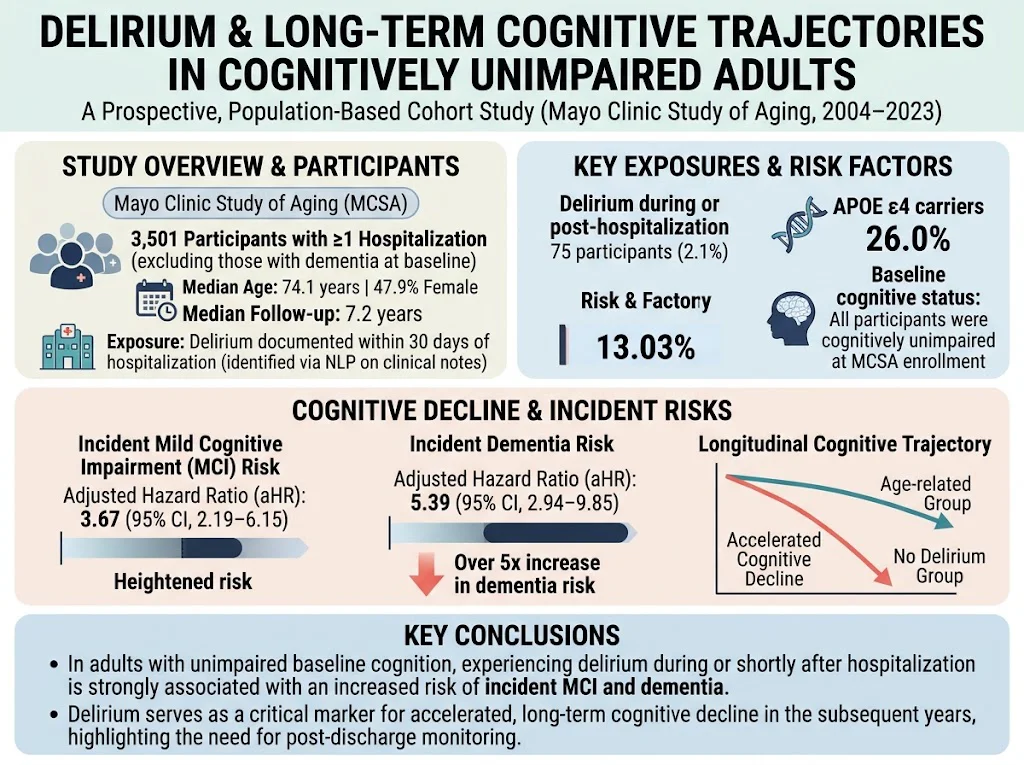
Delirium occurring during hospitalization in cognitively unimpaired adults significantly raises the risk of developing mild cognitive impairment (MCI) and dementia.
Individuals who experience delirium show accelerated cognitive decline compared to those without delirium over a median follow-up of 7.2 years.
The study utilized validated natural language processing algorithms applied to clinical notes for accurate delirium detection, enhancing the robustness of findings.
Age, sex, education level, and APOE ε4 genotype were adjusted in the analyses, strengthening the conclusion of an independent association between delirium and long-term cognitive deterioration.
Study Background
Delirium is an acute neuropsychiatric syndrome characterized by fluctuating disturbances in attention, awareness, and cognition. It frequently occurs during hospitalization, especially among older adults. Although traditionally considered a transient and reversible event, emerging evidence suggests delirium may have longer-lasting consequences on cognitive health. The public health implications are profound, as dementia and MCI pose substantial burdens on patients, caregivers, and healthcare systems worldwide. However, the temporal relationship between delirium episodes and subsequent cognitive trajectories, particularly in initially cognitively unimpaired individuals, remains incompletely understood. Determining this association is crucial to inform prevention strategies and guide clinical management to preserve cognitive health in aging populations.
Study Design
This study was embedded within the Mayo Clinic Study of Aging (MCSA), a prospective, population-based longitudinal cohort study tracking cognitive aging in residents of Olmsted County, Minnesota. Participants enrolled between October 2004 and December 2023 who underwent at least one hospitalization prior to their last MCSA follow-up visit were included, excluding those with baseline or pre-hospitalization dementia.
Delirium ascertainment employed a novel, validated natural language processing (NLP) algorithm applied to electronic health records and clinical notes, covering hospitalizations, emergency visits, and outpatient follow-ups within 30 days. Delirium was treated as a time-dependent exposure within analyses.
Primary outcomes encompassed incident mild cognitive impairment and dementia diagnosed through expert consensus using standardized neuropsychological evaluations at approximately 15-month intervals. Cognitive performance over time was also assessed via repeated neuropsychological testing.
Multivariable Cox proportional hazards models adjusted for confounders including age, sex, years of education, and APOE ε4 carrier status were used to evaluate risk associations. Longitudinal cognitive trajectories were modeled with linear mixed-effects methods.
Key Findings
The analytic cohort comprised 3,501 cognitively unimpaired adults who had experienced at least one hospitalization, with a median age of 74.1 years and an approximate balanced sex distribution. APOE ε4 carriers constituted 26% of participants. The median follow-up duration was 7.2 years.
Delirium was identified in 75 participants (2.1%) within 30 days of hospitalization. Individuals with delirium demonstrated substantially increased risks of developing MCI (adjusted hazard ratio [aHR], 3.67; 95% confidence interval [CI], 2.19–6.15) and dementia (aHR, 5.39; 95% CI, 2.94–9.85) compared to those without delirium.
Furthermore, delirium was linked to a significantly accelerated decline in cognitive test scores over time, persisting well beyond the acute hospitalization period. This provides compelling evidence that delirium is not merely a transient cognitive disturbance but may contribute causally or serve as a marker for progressive neurodegeneration.
Expert Commentary
This study reinforces and extends previous findings implicating delirium as a critical modifiable risk factor for cognitive decline. The use of advanced NLP techniques for delirium detection addresses known challenges in clinical documentation and retrospective studies, strengthening confidence in the observed associations.
Mechanistically, delirium may precipitate or unmask neuroinflammatory pathways, neuronal injury, or vascular insults that accelerate neurodegeneration. Alternatively, delirium could be a clinical manifestation of pre-existing brain vulnerability that later manifests as MCI or dementia. While APOE ε4 genotype was accounted for, other pathophysiological factors may also mediate this relationship.
Limitations include the observational design, which cannot definitively establish causality, and the relatively low documented incidence of delirium, which may underestimate true exposure due to coding or documentation limitations despite NLP usage. Additionally, the study population predominantly reflects a single geographic and ethnic group, potentially limiting generalizability.
Nonetheless, these findings emphasize the importance of delirium prevention, early detection, and mitigation strategies during hospitalization in older adults. Current clinical guidelines increasingly advocate for multicomponent interventions to reduce delirium incidence, such as minimizing sedatives, promoting early mobilization, and optimizing sensory inputs.
Conclusion
Among cognitively unimpaired adults, delirium occurring during hospitalization is independently associated with a markedly increased risk of subsequent mild cognitive impairment, dementia, and a faster rate of cognitive decline. These findings underscore delirium’s role as a significant contributor to adverse long-term cognitive outcomes and highlight the critical need for heightened clinical vigilance and proactive delirium management strategies in hospital settings. Future research should explore underlying mechanisms and effective interventions that could mitigate delirium’s impact on cognitive aging.
Funding and Clinical Trials
Details on funding sources for the MCSA study and any associated clinical trials were not specified in the cited abstract. For further information, consult the original publication by Palmer et al. in JAMA Neurology, 2026.
References
1. Palmer AK, Mullan AF, Graff-Radford J, et al. Delirium and Long-Term Cognitive Trajectories in Cognitively Unimpaired Adults. JAMA Neurol. 2026; doi:10.1001/jamaneurol.2026.42970282.
2. Inouye SK, Westendorp RG, Saczynski JS. Delirium in elderly people. Lancet. 2014;383(9920):911-922.
3. Witlox J, Eurelings LS, de Jonghe JF, et al. Delirium in elderly patients and the risk of postdischarge mortality, institutionalization, and dementia: a meta-analysis. JAMA. 2010;304(4):443-451.
4. Maldonado JR. Delirium pathophysiology: an updated hypothesis of the etiology of acute brain failure. Int J Geriatr Psychiatry. 2018;33(11):1428-1457.
5. Inouye SK, Robinson T, Blaum C, et al. Consensus statement on prevention of delirium. J Am Geriatr Soc. 1999;47(5):681-690.